Summertime lameness - Dealing with sole lesions
The longer summer evenings bring longer walks to paddocks, and after an extended spring inside, it has been a recipe for disaster for hoof health on our farm, writes farm vet Hazell Mullins.
Summertime lameness - Dealing with sole lesions

cow hoof

This is my first article as a married woman, and the week before my wedding, I was plagued with lame cows in the herd. And I can tell you, I would take the stress of the wedding over the stress of looking at lame cows any day.

Lameness is one of the biggest welfare issues in the modern dairy cow; bigger herds mean longer walks, and unfortunately, winter housing means lots of standing on concrete, which is not feet-friendly for a 600kg dairy cow.

The longer summer evenings bring longer walks to paddocks, and after an extended spring inside, it has been a recipe for disaster on our farm. At first, there was only one, but within ten days, we had three severely lame cows that required urgent attention. 

On inspection of the feet, all had what if referred to as sole lesions, meaning they didn’t have an infectious cause such as Mortellaro or Foul of the foot.

When lifting feet, always be aware of the safety of you and the cow, the 'hoofnak' from O Neill’s Engineering in West Cork is an essential piece of kit that I use for examining lame cows.

I will hold my hand up, I am not the biggest fan of paring cows; however, the satisfaction I get when I discover the issue and implement a treatment plan is worth the effort.

It is important to recognise lame cows in your herd by routinely implementing mobility scoring on the farm; cows are scored from 1 to 5. 

It has been shown that cows treated early at a score of 2 or 3 have a much higher likelihood of recovery.

Teagasc has lots of excellent tools online for identifying lame cows in the herd, which include looking at the arch of their backs and also the landing position of their feet or as my equine colleagues would say, “Tracking up”.

Sole ulcers

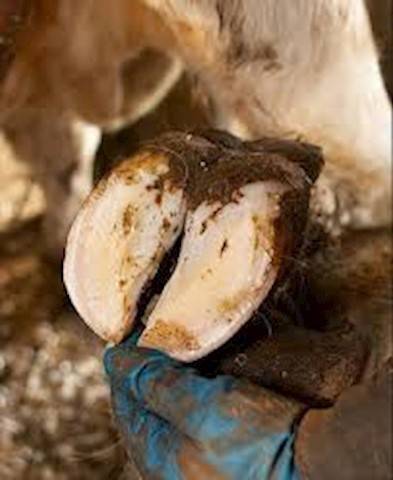
Two cows had sole ulcers, a lesion caused by excessive pressure on the tissue called the Corium, which lies under the sole horn. 

The ulcer usually occurs in a very specific location on the inside wall of the outer claw of the hoof. The area is so specific due to the presence of a bony process on the inside of the pedal bone within the hoof that cause pressure on this exact location.

The hoof itself is suspended by ligaments which relax around calving time just as the ligaments in the pelvis do; if there are excessive standing times or poor underfoot conditions, this bony process then applies pressure resulting in ulcer formation. 

A cow's hoof also contains a fat pad that has been linked with increased ulcer formation when cows are in too low body condition due to lack of cushioning in the foot.

The concept behind the treatment for sole ulcers is to relieve that pressure point that is causing the wearing of the sole and exposure of the sensitive corium tissue. I pared the sole in a way that the edges of the ulcers were freshened up and the tissue around the ulcer was higher to relieve the pressure.

Application of a shoe on the unaffected inside claw is essential to allow the ulcer to heal as all the weight is now temporally on the good claw. The secret to shoes, in my opinion, is a very dry hoof, and using the knife to cross-hatch the good claw’s sole to increase the grip for the glue. 

Allow the cow to stand for 5-10 mins in the crush once the glue has hardened before the pressure of walking is applied.

White line disease

The other cow has white line disease or a 'drop' as it is colloquially known among farmers. It happens due to damage to the junction between the sole and the outer horn which is, in fact, the weakest point of the sole.

It is here that a sharp stone may piece the white line and cause a tract through the sole into the hoof underneath. This can be extremely painful for the cow as an abscess forms within the hoof, and the subsequent pressure that builds up with extremely painful for the cow.

Luckily, the solution to this pain is to find the entry point and release the pressure, which is usually seen as pus existing the hoof, sometimes in a very spectacular fashion along with sound effects.

Again the key to the treatment of white line disease is to relieve pressure but also to drain the abscess, I applied a shoe to the good claw, also in this case, as I had to remove a substantial amount of horn to allow drainage. She was walking better instantly once the pressure of the abscess was released.

The final cow was a very unusual yet satisfying case, she was lame on her front foot, and it came on very suddenly. 

On first inspection of the hoof, I couldn’t see anything obvious, but right in the lower inside corner, there was a very thin nail sticking into her hoof. I can only imagine how uncomfortable that was for her, I removed it and opened a drainage point for any infection that may have been caused by the nail. Of course, I kept it and took photos for Instagram as this is something you don’t see very often. Again the importance of lifting feet early to inspect is highlighted in this case.

All cows received pain relief, I always treat all lame cows that I lift with Ketoprofen which is a non-milk withdrawal, non-steroidal anti-inflammatory that is available from your vet on prescription. I am a huge advocator of pain relief and lameness in cows, especially with the convivence of no milk withdrawal, particularly handy in summer months with possible relief milkers on the farm.

The addition of Biotin to the ration of dairy cows can help strengthen the hoof to prevent sole lesions, and, as always, it's essential to discuss regular foot bathing protocol with your vet to prevent infectious causes of lameness.

Let’s ensure that our cows will be walking into the paddocks as spritely as I will walking up the steps of the plane to Italy for my Honeymoon. Who knows I may see some cows on my travels.

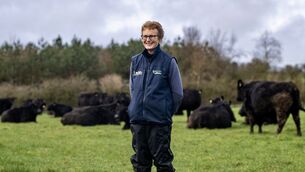
  • Hazell Mullins BVM BVS, is a large animal vet based in Carrignavar, Co Cork.

More in this section

Farming

Newsletter

Keep up-to-date with all the latest developments in Farming with our weekly newsletter.

Cookie Policy Privacy Policy Brand Safety FAQ Help Contact Us Terms and Conditions

© Examiner Echo Group Limited