The Canadian tech firm using bees to apply fungicides
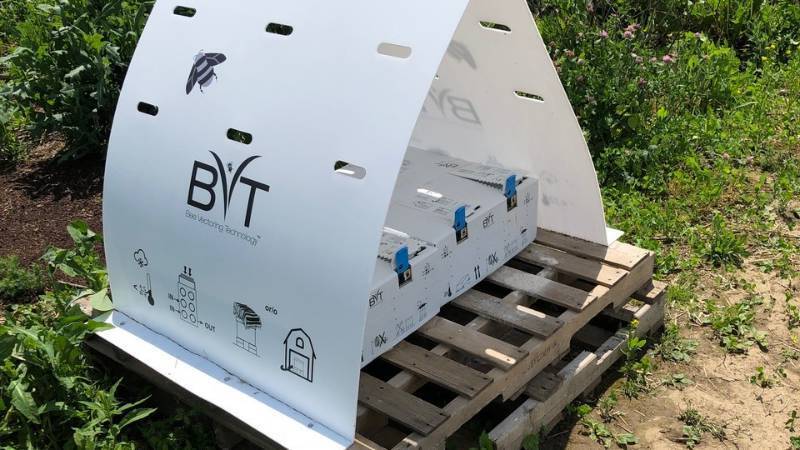
One of the hives designed by BVT (Bee Vectoring Technologies) in situ.
With so much attention on pollinators, it was probably inevitable that some clever agricultural innovator would ask the question, why not use bees to deliver biological control agents to flowers and certain crops?
It was the team at Bee Vectoring Technologies in Canada that spotted the opportunity, and they have since been recognised with awards for innovation in the fields of precision application technology and biocontrol.
BVT's idea was to use bees to naturally transfer biological control substances to plants. These substances then protect the plants against diseases and pests.
When leaving their hive, commercially-reared bees travel through a dispenser, coming into contact with Vectorite, the company's specially formulated powder made from all-natural material. Vectorite adheres to bees, and when biological control substances are added to Vectorite, the bees deliver them to plants.
Research staff at Rutgers in New Jersey, one of America's leading public research universities, said their trials showed the BVT technology concretely helped to consistently reduce fungal disease in blueberries, an important crop in many parts of North America.
In the 2022 trial, Rutgers also tracked and evaluated bee health. The results showed that commercial honeybees in the BVT system were healthier than those in fields with a traditional fungicide spray programme.
As an example of biological control or biocontrol (which means controlling pests, such as insects, mites, weeds, and plant diseases, by using other organisms), BVT's system is at the forefront of sustainable farming.
"Essentially, our solution harnesses the power of nature’s best workers, helping growers improve crop quality with a significant decrease in the use of chemicals", said a company spokesperson.
More and more clients recognise the value of a system that works continuously, unlike intermittent spraying of chemicals, which is frequently interrupted by bad weather.
As well as blueberries, it's also suitable for other berry crops, oilseed rape, sunflowers, apples, and tomatoes. BVT also markets CR-7 as a seed treatment on soybeans, which has been shown in trials to result in a yield increase of about 6%.
In 2022, BVT pursued continued commercialisation in the USA, where it enjoyed 25% revenue growth. It earned its first revenues in California, enjoyed major growth in the Pacific Northwest, and 4% growth in Georgia blueberry revenues (the company’s largest market).