Reduced finishing age lowers emissions 14% at Newford Farm
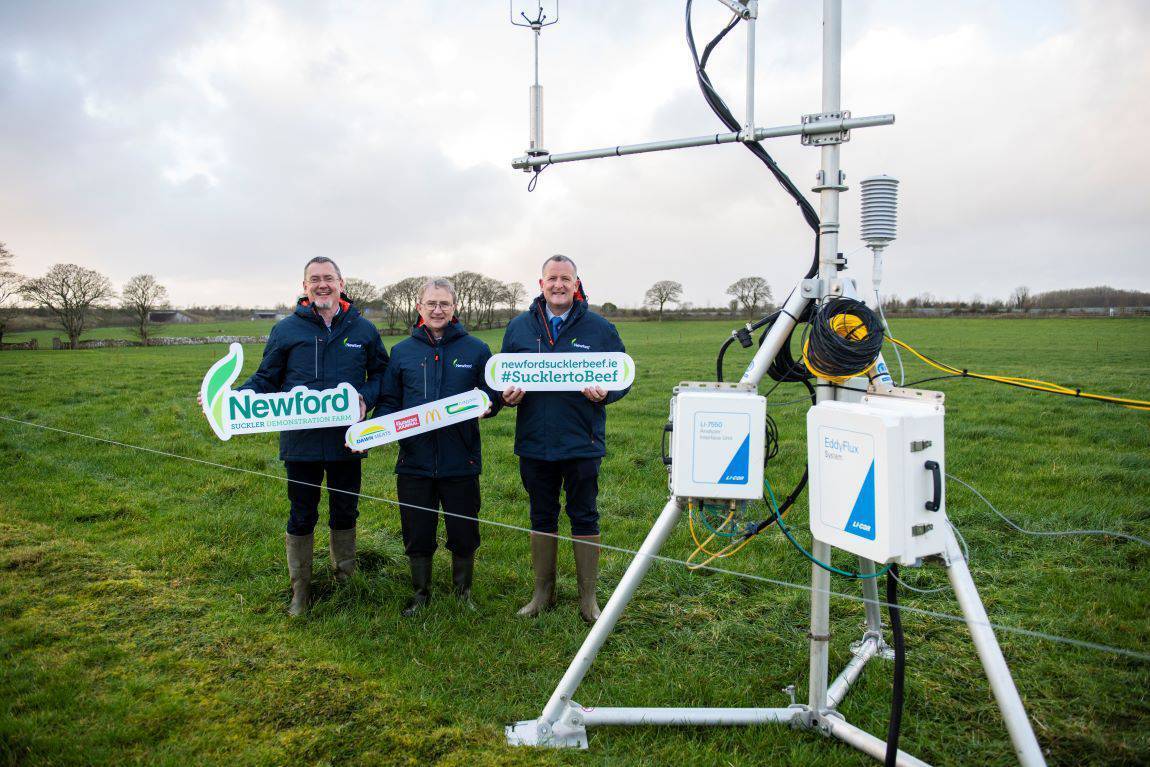
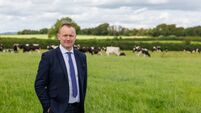
Pictured beside an Eddy Covariance tower being used to quantify real-time greenhouse gas fluxes and meteorological variables are Jim O’Toole, Bord Bia chief executive; Professor Frank O’Mara, Director of Teagasc; Niall Browne, Dawn Meats chief executive.
Newford Suckler Demonstration Farm, in Co Galway, is successfully producing calves that gain weight rapidly and can be slaughtered at lower ages while maintaining beef quality, new results have confirmed.
The calves are delivering carcass weights which meet market requirements, with the latest findings suggesting that if the techniques and methods practised at Newford were implemented at scale nationally, they could drive significant improvement in on-farm efficiency and greatly reduce absolute emissions.
As a result, the farm is achieving a carbon footprint 14% lower than the national average for similar enterprise types.
The 71-hectare farm, which is a member of both the Bord Bia Sustainable Beef and Lamb Assurance Scheme (SBLAS) and the Teagasc “Signpost Farm Programme - Farmers for Climate Action”, and comprises four separate blocks around Athenry.
The project was established by Dawn Meats and Teagasc in 2015, with support from McDonald’s, to demonstrate best practice in sustainable suckler beef production.
The farm has a range of ambitious targets for the herd of 90 cows, which can be classified under the term 'regenerative agriculture'.
Key areas of focus include soil health and carbon sequestration, biodiversity and water quality, grassland management, fertiliser use and multi-species swards, herd health, genetics and breeding planning, and data capture.
The farm's 2021-born suckler cattle have achieved an age at slaughter of between seven and eight months less than the national average.
The average age of slaughter for the heifers was 544 days (17.9 months), compared to a national average of 808 days (26.6 months), while still achieving ideal carcass weight (296kg) and grades (R3).
Similarly, the average age of slaughter for the steers was 623 days (20.6 months) compared to a national average of 834 days (27.4 months), while still achieving ideal carcass weight (358kg) and grades (R3).
The figures were announced as representatives of Dawn Meats, Teagasc and Bord Bia gathered at Newford Suckler Demonstration Farm in Athenry, Co Galway, to hear an update on the learnings from the farm’s seventh year of operations.
The farm’s breeding strategy produces calves which gain weight rapidly and deliver carcass weights and confirmation that meet market requirements.
Cow type at Newford differs from the norm, comprising mainly first-cross early maturing Angus/Hereford cows, bred from the dairy herd, for their excellent milk yield potential off grass, to minimise the need for use of bought-in concentrates.
Niall Browne, Dawn Meats chief executive, explained that progress on key sustainability metrics and regenerative practices has been accelerated in recent years through the range of Marginal Abatement Cost Curve (MACC) measures implemented at Newford and data-driven decisions made daily on farm management.
Professor Frank O’Mara, director of Teagasc, said the challenge facing cattle farmers is "significant" in terms of economic, social and environmental sustainability.
"The performance of the Newford Suckler herd during the first phase of this joint initiative over the last seven years, has demonstrated what can be achieved in terms of animal performance, profitability and environmental sustainability. We are delighted to continue this initiative into a second phase," he said.
Jim O’Toole CEO Bord Bia, added: “It is encouraging to see the Newford Farm is producing prime beef cattle that meet customer specifications in terms of weight, age and carcass grading, while reducing the carbon footprint of the farm. Recent analysis of Origin Green data shows that beef members have on average, reduced their carbon footprint by 8% since 2014-2016.
"Collaborative on-farm initiatives have identified opportunities to further reduce greenhouse gas emissions. These improvements allow Bord Bia to communicate a strong, sustainability position to customers of Irish beef."