How Tirlán aims to become ‘co-op of the future’
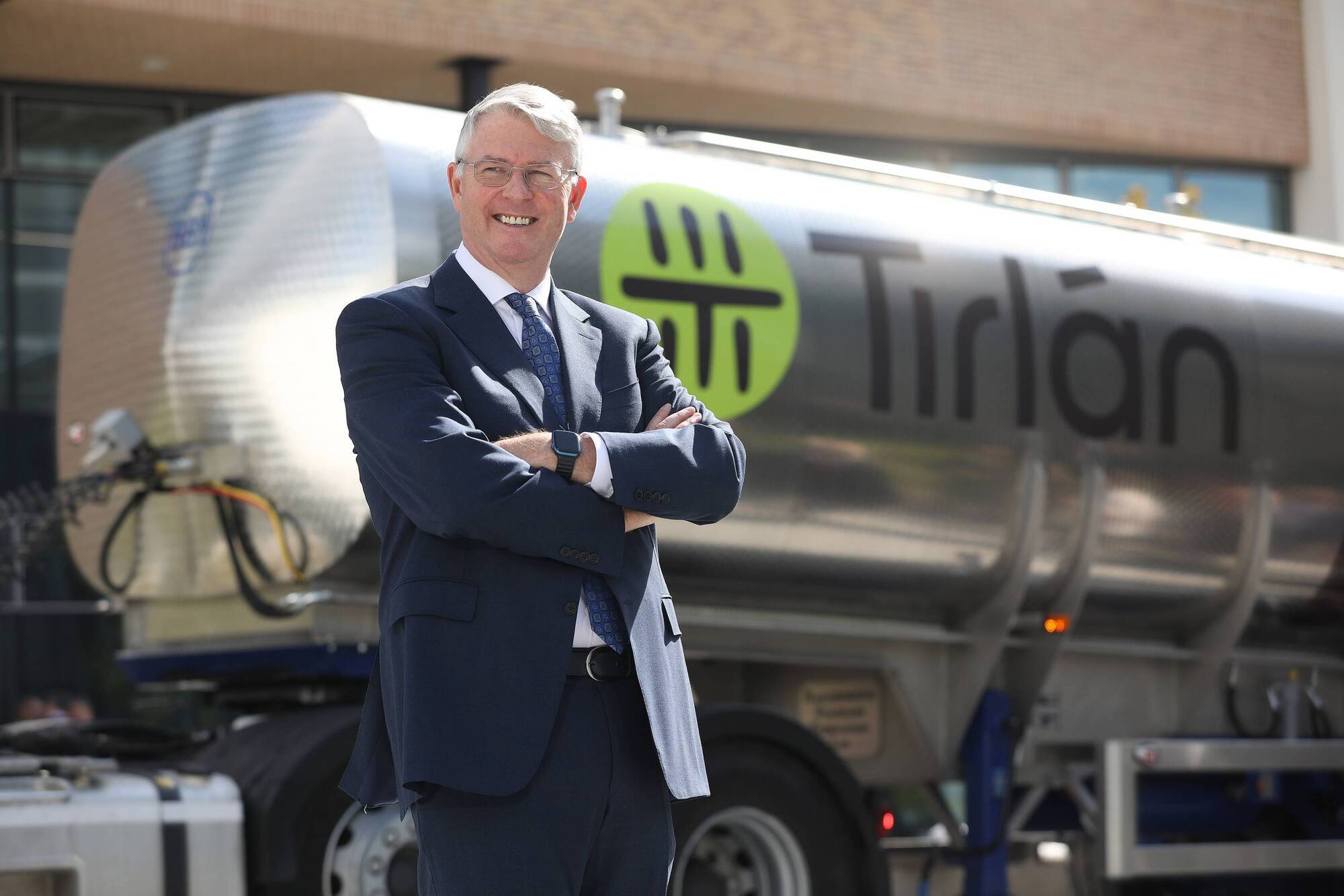
Jim Bergin, chief executive of Tirlán. Picture: Julien Behal
Reinventing a €3bn wheel is no easy feat – especially when the fortunes of more than 11,000 farming families depend on it - but with decades of experience from its legacy firm Glanbia behind him, Tirlán’s new chief executive Jim Bergin is raring to go with the challenge ahead.
With a new name fresh off the press and a promise to put a single shareholder – the Irish dairy farmer – first, Mr Bergin explained his ambition was to rebuild the business as “the co-op of the future”.
But his first big challenge as chief executive will be to unite the hearts and minds of his farmer suppliers and shareholders.
“The big challenge for us now is to embrace the co-op ethos with a single shareholder,” Mr Bergin said.
"The two most important stakeholders from our organisation's point of view are our employees and our farmer shareholders. Now, again, our farmer shareholders in Ireland are also our customers, our suppliers and our shareholders, so [the launch] was very important.
"The big issue for us is alignment with our farmer shareholders – before, we were an organisation where we had two sets of shareholders.
"We are very clear, and history will guide us on what we do, but in terms of our commitment, we have one set of shareholders now, and that’s our priority.
"It will allow us to have a single focus, with one shareholder, and we will have a business that is fully aligned all the way from the farm gate to the cream we sell to China."
Now that the firm’s new corporate identity has been revealed, a “huge corporate rebuild" is underway to develop the firm’s purpose, vision and values, and develop a new business strategy - both of which are expected to be completed by the end of the year.
"We have started out with the co-op as a modern company, so we have restructured our board," Mr Bergin added.
Tirlán’s board will comprise 20 people made up of 14 farmer representatives, four executive directors and two independent non-executive directors.
The new board structure will also include seven subcommittees: Strategy, ESG (Environmental, Social and Governance), Rules, Remuneration, Nominations, Representative review committee, and Corporate ID.
But how will the new business be structured?
"From an organisational point of view, a PLC gives a return to its shareholders through profit growth – growth in EPS, which reflects in the value of shares so that they get capital appreciation and then a dividend. And then a co-op, returns are paid out on the product prices and the dividend – so it’s very clear that that’s the model," Mr Bergin said.
“The co-op itself was effectively a holding company – an investment vehicle for 34 years. It had seven staff," he said.
"So now, there are three streams of activity within the business – you have the core business, which is the previous joint venture with Glanbia Ireland – that’s the €3bn business. We have our investment activity – and we have two elephants within that – we have the investment – our 31.9% of Glanbia plc, which is worth €4.1bn today. And then, in our SGM, we were given permission to create an investment fund of €150m.
"This can be used for investments to create a third income stream to support our returns to our shareholders, whether that’s in product prices or dividends.
"We are clear it needs to be a consistent cash income, so that sets a level of parameter if you like. We have engaged Ernst and Young, who are working on a framework for that investment fund at the moment."
New ways of working will be encouraged with the firm's headquarters relocating to a new collaborative hub in the old Brewhouse in the centre of Kilkenny.
"We are setting out to create the co-op of the future," Mr Bergin explained.
"We are carrying out a very significant review of our representative structures, and we have consulted with organisations all over the world – in Oceania, in the US, and in Europe.
"We have met a number of co-ops in Europe, and consulted with ICOS, and with other co-ops here in Ireland. Particularly to address the issue of gender balance and encourage youth.
"To add diversity to our structures and embrace people who may have different views. It has benefits for creative thinking as well."
Co-ops in Ireland tend to be seen as traditional organisations, however, Mr Bergin explained they were well placed to take on the challenges of a modern world where the environmental and social obligations of businesses have come to the fore for many shopper and buyers.
“The co-op’s day has come because people are so much more aware and expect companies to act responsibly."
“Co-ops are already doing a lot of this," Mr Bergin said. "And that’s important, particularly in today’s world of social media and responsibility and people’s ability to connect things – the co-op model delivers on that because our supplier, customer and shareholder is the same person. We need our advisory council
“Whether it’s supporting an underage game, a golf classic or a raffle, co-ops are really part of the fabric of rural society.
“The co-op’s day has come because people are so much more aware and expect companies to act responsibly."
Such is the importance of sustainability that the firm's new cheese plant, which is currently under construction and due to be completed by March 2024, will include a water filtration system so that water can be reused several times in the plant before it is disposed of.
A considerable amount of work has also been carried out to develop collapsable, reusable timber crates to ship the resulting cheeses in.
Even the firm's new name, meaning land of abundance, is a nod to a greener, more sustainable future for Irish agri-food.
“Those two words [Tirlán] – they really mean something to us," Mr Bergin added.
“Our focus on the land is a big deal to us because we are in the decade of sustainability, and Irish farmers are so connected with their homesteads so that’s our focus.
“Ireland is, from a food-producing point of view, a land of abundance; we export 90% of what we manufacture."
But what will the big changes underway mean for those farmer suppliers and shareholders?
Mr Bergin said he envisages a future "less about volume, even though there will be growth through productivity and science".
"It'll be less about milking more cows and capacity, and it will be more about science and performance and getting better performing cows, with better conversion," he said, explaining that farmers had already reacted well to the launch of the new business.
"It was really important for us to be as inclusive as possible [with the launch]; we had all of our employees in different sites, and the portfolios were out the door at each one of the sites, then we had a board meeting, an advisory council – we have 88 farmers on our advisory council, and we had brilliant feedback from them.
"Some of them I would know very well - and they wouldn’t be afraid to tell me the truth, for sure!"
And will history prove that taking back control has been a good decision for those farmers?
“Absolutely,” Mr Bergin said. “I think it was a great decision; particularly because of the organisation they can have going forward - the co-op of the future. I really think the co-op’s time has come back again.
“In 1988, the farmers of Waterford took their business public; the co-op had a subsidiary that went public. The farmers at Avonmore had a subsidiary that went public. Since then, we have given out over €800m in value to members and the Co-op still has an investment worth close to €800m in Glanbia plc.
So that shows that the PLCs have created that kind of value. And you have the small medieval city of Kilkenny, which now has the headquarters of a €3bn company.”