Researchers developing light technology to act as pesticide alternative
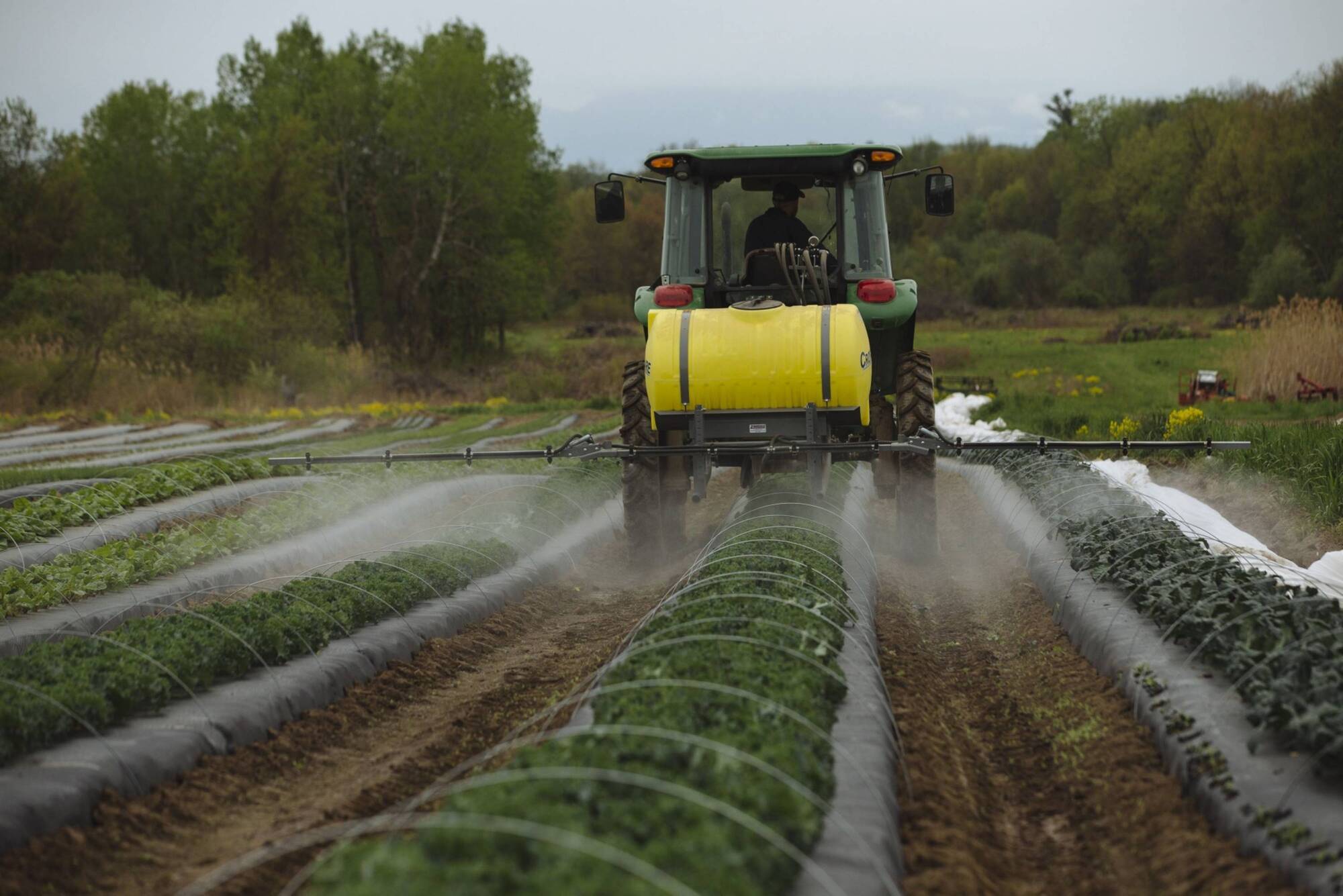
The environmental impact of the chemicals used in pesticides has led to increasing pressure to find alternatives. Picture: Angus Mordant/Bloomberg.
Two universities are collaborating on research to develop light technology to monitor crops for pest infestations and plant disease.
Harper Adams University and Aston University will be creating photonic ‘nose’ to assess plant health.
The researchers will use strawberries to test the new technology. The strawberry is the main soft fruit crop grown in Ireland and it is worth an estimated €47m per annum. However, the crop is vulnerable to potato aphid which has the potential to wipe out an annual harvest.
Professor David Webb, Aston University, said: “Better invertebrate pest and plant disease monitoring technologies will significantly help cut crop losses. However, most electronic noses use electrochemical sensors, which suffer from sensitivity issues, sensor drift or ageing effects and lack specificity."
Prof Webb added: "We intend to address this by building on the fast-moving technology of photonics - the science of light - whilst collaborating with scientists in other disciplines.”
Each year as much as 40% of global crop production is lost to pests, according to the Food and Agriculture Organization of the United Nations. Plant diseases are estimated to cost the global economy over $220bn (€215.8bn), and invasive pests cost at least $70bn (€68.7bn).
Crops are typically treated with pesticides however, the environmental impact of the chemicals used in pesticides has led to increasing pressure to find alternatives.
An alternative method used by farmers is implementing integrated pest management to create an early warning system. This monitors crops for the build-up of insects and diseases, this minimises economic, environmental and health risks, as opposed to spraying plants with chemicals.
Integrated pest management systems try to combine physical, cultural, biological and chemical tools as a method of minimising the overall levels of plant protection products used and maintaining this usage at a justifiable level.
However, its use so far is unreliable and very costly.
The new research uses recent developments in lightwave technology that can analyse low levels of volatile organic compounds released by plants and indicates the general crop health.
The researchers will also make use of machine learning hardware, which makes it practical to implement artificial intelligence in commercial settings.
Dr Joe Roberts, lecturer at Harper Adams University, said: “With the projected increase in the global population there is increasing pressure on the agricultural sector to achieve higher crop yields. Reducing crop losses within existing production systems will improve food security without increasing resource use."
“We intend to establish an interdisciplinary community of agricultural science, optical sensing and machine learning experts to develop novel plant health monitoring platforms that enhance agricultural production through localised pest and disease monitoring to detect hotspots," Dr Roberts continued.
The 12-month research project by the two universities is to receive £200,000 (€240,000) in funding from the Biotechnology and Biological Sciences Research Council and the Natural Environment Research Council.
The grant is the maximum amount given from the councils' molecules to landscapes project, which funds interdisciplinary solutions to ‘real world’ challenges.