Beef2022: Efficient farms are most profitable and sustainable
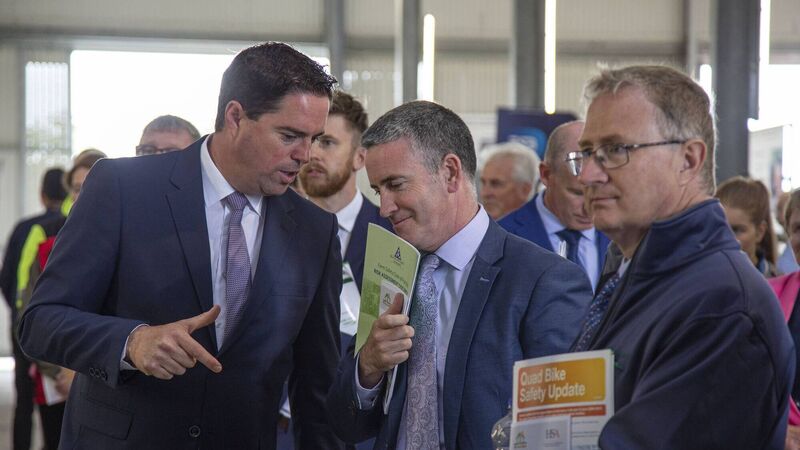
Minister of State at the Department of Agriculture Martin Heydon and Damien English, Minister of State for Business, at Teagasc's Beef2022 open day.
Making sustainable beef farming profitable was the main theme of Teagasc's flagship beef open day, Beef2022 — with the event demonstrating that the most efficient farms are the most profitable and produce beef with a low carbon footprint.
The event, which took place at the Teagasc Beef Research Centre in Grange, Co Meath on Tuesday, showed how the on-farm application of new technologies can help beef farmers increase the profitability and environmental sustainability of farm businesses.
Speaking at the event, Teagasc director, Professor Frank O'Mara, said profitability and meeting environmental obligations were the two biggest challenges facing the industry.
"It is worth emphasising that sustainable farming is, first and foremost, economically viable farming," he said.
"Improving farm viability has been, and continues to be, the overarching objective of our beef programme.
"The Teagasc National Farm Survey figures for 2021 show large percentage increases in beef farm incomes, albeit from a low base.
Incomes on ‘cattle rearing’ farms increased by 29.7% to €10,937, while incomes on ‘cattle other’ farms increased by 5.7% to €16,416.
"Although, the increases were encouraging and welcome, the overall incomes are still very low. The increases in input costs which were emerging towards the end of 2021 have accelerated in 2022.
"It remains to be seen if these large input cost increases will be sufficiently covered by the significantly increased beef prices currently being received by farmers.
"The rapid escalation in both input and beef prices in the past 12 months raises many questions as to what this means for our ‘blueprint’ system and for farm incomes in Ireland, and these issues will be extensively discussed today."
Paul Crosson, Teagasc beef enterprise leader, said: "Technologies in relation to grazing management, animal nutrition, beef genetics, reproductive management, animal health, farm planning and reducing the environmental footprint of beef production systems will be essential to increase the competitiveness and sustainability of the Irish beef sector.
“Management can improve the performance of cattle enterprises, through more efficient use of available resources, boosting both economic and environmental returns.
"Optimising the performance of animals at pasture and reducing the age of slaughter can improve farm economics per hectare and reduce greenhouse gas emissions.”
The Teagasc research programme is seeking to develop the ‘next generation’ of solutions to further reduce the environmental footprint of beef. In particular, Teagasc has invested heavily in research to mitigate methane emissions from beef cattle, which predominantly emanate from ruminant digestion. The early results from this are very promising and communicated in the signpost village at Beef2022.
The increases in input costs facing beef farmers, which were emerging towards the end of 2021, have accelerated in 2022. It remains to be seen if these large input cost increases will be sufficiently covered by the beef prices currently being received by farmers.
The options open to farmers to mitigate the impact of rising costs on farms were outlined at the Beef2022 open day.
These include strategic marketing of animals to avail of high beef prices, selling non-productive and inefficient performers, completing cash flow budgets for your own farm, managing inputs more efficiently, and concentrating on grazed grass as the cheapest feed available.
Specific options outlined to reduce inputs include soil testing, using protected urea fertiliser instead of CAN, using low-emissions slurry spreading methods, incorporating clover into grass swards and increasing grass utilisation.