Renewable island: Farmers play vital role in Ireland's eco goals
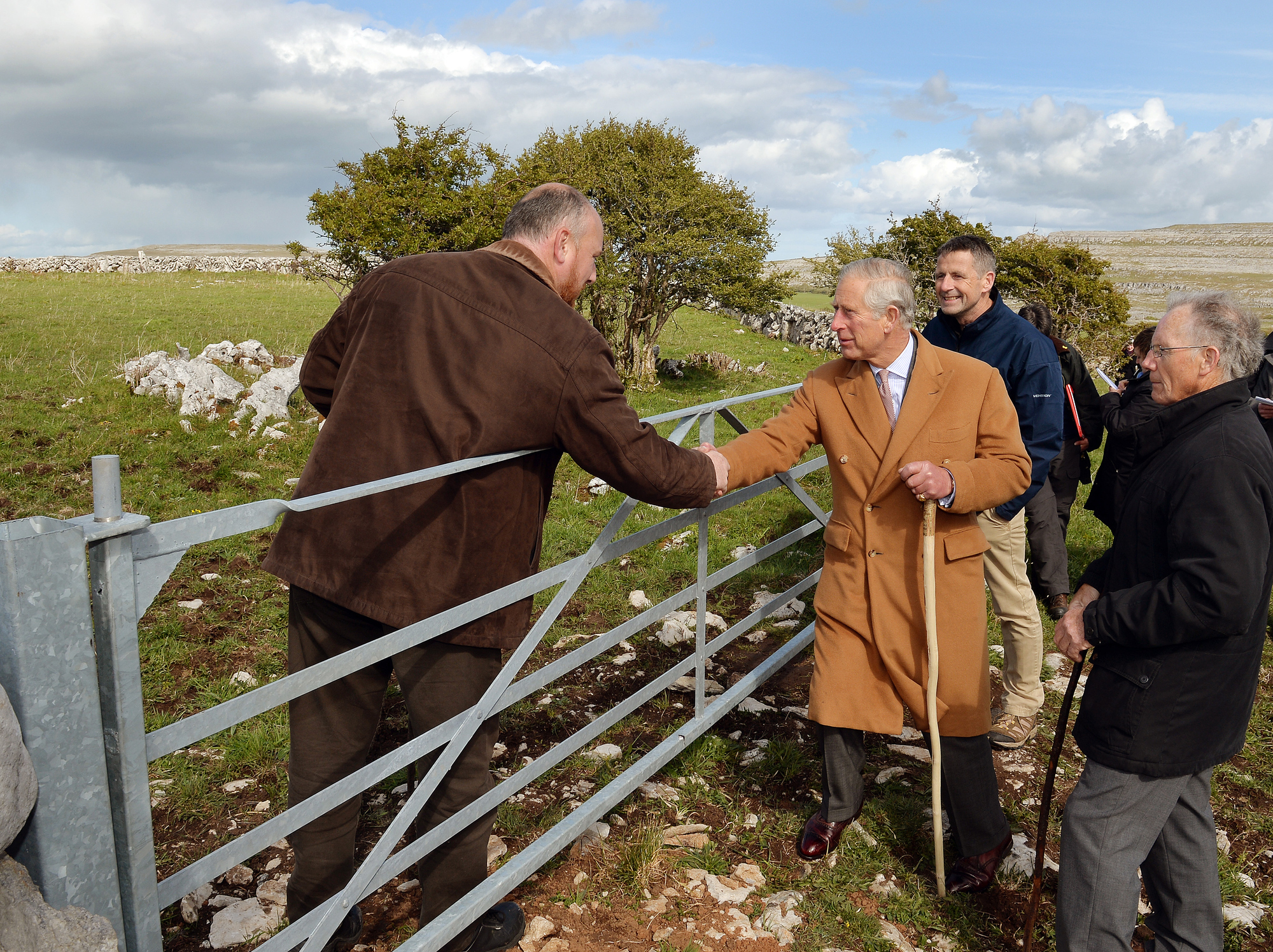
Prince Charles, Prince of Wales, shakes hands with farmer Oliver Nagle, with his father Pat looking on during the royal visit to The Burren, an ancient and dramatic stony outcrop famed for its rare plant life, biodiversity and archaeology. Photo: John Stillwell, WPA/Getty
Farming sustainability is summed up by Pat Nagle, his son Oliver and their families in Corofin, Co Clare.
"We’re more than happy to give society what they want as long as we can make a living while doing so," say the Nagles.
In other words, sustainable farming and sustainable income.
Farming on the banks of the River Fergus, they run a 35-cow suckler herd. In keeping with local traditions, they move cattle onto "winterage" pastures in the limestone uplands of the Burren (which helps to preserve this region’s unique flora and fauna), and also rely on grazing the callows, the seasonally flooded wetlands.
The Nagles are one of the case studies described in the Food Vision 2030 industry strategy which envisages Ireland becoming a world leader in Sustainable Food Systems.
CLIMATE & SUSTAINABILITY HUB
Long-term participants in agri-environmental schemes, the Nagles have carried out measures for cleaner water, more flowering plants, and preserving the beautiful Burren landscape. They receive an annual ‘results-based’ payment; better environmental field scores yield higher payments.
Another case study farmer is Eugene Sheehan who runs a 300-sow farrow-to-finish pig unit with his son Ciarán near Mitchelstown, Co Cork.
Eugene has implemented management and biosecurity practices that have helped improve pig health, performance and sustainability of the farm, enabling control of most of the endemic disease issues, a reduction in the use of antibiotics by 90%, removal of zinc from pig diets, and a reduction in production costs by over 9%.
The Sheehans were one of the first pig farms in Ireland to use a biosecurity scoring tool introduced by Teagasc.
Eugene says it took almost two years and a lot of hard work to see the benefits of all the changes, but running the farm became easier and more profitable.
The two case studies include much of what is needed for improved sustainability at the raw material end of the food industry.
Better sustainability is not a new target for farmers. In line with the principle of sustainable development launched by the Rio "Earth Summit", the 1992 reform of the EU's Common Agricultural Policy, overseen by the Irish Agriculture Commissioner, Ray MacSharry, began incentivising environmentally compatible farming practices, through direct payments.
Cross-compliance (environmental and other rules farmers had to obey in order to get full direct payments) followed in the Fischler Reform in 2003, which consolidated central roles in the CAP for food quality, environmental protection, animal health and welfare, and rural development. The 2013 reform increased direct support to farmers, tied to long-term sustainability objectives (viable food production, balanced rural development, and sustainable natural resource management and climate action).
Now, in keeping with the EU's Green Deal bid for a climate-neutral continent in 2050, the new CAP to start in 2023 aims for a better targeted and more efficient achievement of climate, environment, and animal welfare targets, with the Member States required to explain in their strategic plans how they will make use of the CAP, in accordance with their local conditions and needs.
For example, current new CAP proposals include every farm in Ireland having at least 4% "space for nature", in order to qualify for their share of EU direct payments).
The new CAP must deliver on issues such as EU agriculture's more than 10% share of total greenhouse gas emissions; pollution due to fertilisers; soil erosion; biodiversity loss; and use of almost 44% of available water.
Other issues to tackle include the rapidly ageing and majority-male farming population (31% older than 65 and women less than 32% of the workforce); and food quality and related increases in nutrition-related diseases.
With Irish farmers depending heavily on almost €1.2 billion of EU-funded direct payments to support farm incomes and reward good agricultural and environmental practices, in addition to the Department of Agriculture, Food and the Marine's budgeted spending of €1.858 billion, the CAP has always played a huge role, with its social, economic, and environmental approaches towards sustainable agriculture.
Along the way, the REPS agri-environmental scheme which the Nagles in North Clare got involved in started in 1994, and by 1998, about 43,000 farms (Ireland has about 137,000 farms) covering about 1.5 million hectares, representing 31% of Irish agricultural land, were in REPS (the Rural Environment Protection Scheme).
Running alongside REPS, various farm modernisation schemes helped to protect the environment, including about 14,000 livestock farmers availing of grant aid for control of farmyard pollution, totalling about €150 million.
Funded jointly by Ireland and the EU, REPS was the first nationwide scheme to encourage farmers to protect the natural and cultural heritage. Any farmer could apply for the scheme's five-year plan for environmental protection which must include pollution control measures. The basic scheme offered a farmer £5,000 (punts) per year, equivalent to €6,350.
But actual payments averaged only €5,700, due to penalties for non-compliance with requirements.
Since 1994, it has been compulsory for each EU member state to have agri-environment schemes. In Ireland, REPS 1, 2, 3 and 4 were followed by the Agri-Environment Options Scheme (AEOS 1, 2 and 3) introduced in 2010; and the Green Low Carbon Agri-Environment (GLAS 1, 2 and 3) scheme, which started in 2015.
Arguably, few sectors have been pushing for sustainability as long as farmers. Since 2011, Environmental Impact Assessment regulations applies to the restructuring of land holdings, use of uncultivated land or semi-natural areas for intensive agriculture, and land drainage works.
The long-established sustainability focus on agriculture is good news, because it plays a key role in protecting Ireland's climate and environmental credentials. As the predominant land use, it has economic and historical importance relative to other industries. It exerts the most pressure on water quality, and agriculture, forestry and fishing activities have impacted biodiversity on land and sea.
Ireland has the EU's third-highest bovine population, and dairy herd expansion since 2015 has brought particular environmental pressures (we are the tenth biggest dairy exporter in the world).
Agriculture is our largest contributor to greenhouse gas emissions, accounting for around a third, and generates 99% of the ammonia emissions which damage our air quality.
The Food Vision 2030 strategy for the agri-food industry (which received Government approval and was launched last August) acknowledges that significant and urgent improvements in its environmental footprint are needed.
The envisaged payoff includes the improvement of Ireland’s reputation as a sustainable producer of quality food.
The strategy envisages grass-based livestock production remaining as the core source of Ireland’s agri-food output, which is mainly export-orientated (food and drink exports increased 60% from €8.9 billion in 2010 to €14.2bn in 2020).
The strategy includes climate-neutral food system targets by 2050, with verifiable progress achieved by 2030, in emissions reductions, carbon sequestration, improvements in air quality, restoration and enhancement of biodiversity, improvements in water quality, development of diverse forests, enhanced seafood sustainability, and strengthening Bord Bia's Origin Green food and drink sustainability programme.
Alongside Food Vision 2030, the 2021 Climate Action Bill sets targets in five-year carbon budgets for each sector, including agriculture. Overall, the agriculture sector is required to reduce emissions by between 22% and 30%, by 2030. The sector is on notice that any increase in methane emissions from increased livestock numbers will jeopardise the achievement of carbon neutrality by 2050.
Arguably, the 2030 Agri-Food Strategy is an aspirational wish list which can be easily derailed in an industry as volatile as food production. And environmental NGOs said their recommendations were insufficiently reflected in the draft strategy, leading to their representative withdrawing from the strategy team in 2021.