Govt launches EU-funded LIFE project to encourage farmers to revive ‘the bird of the meadow’
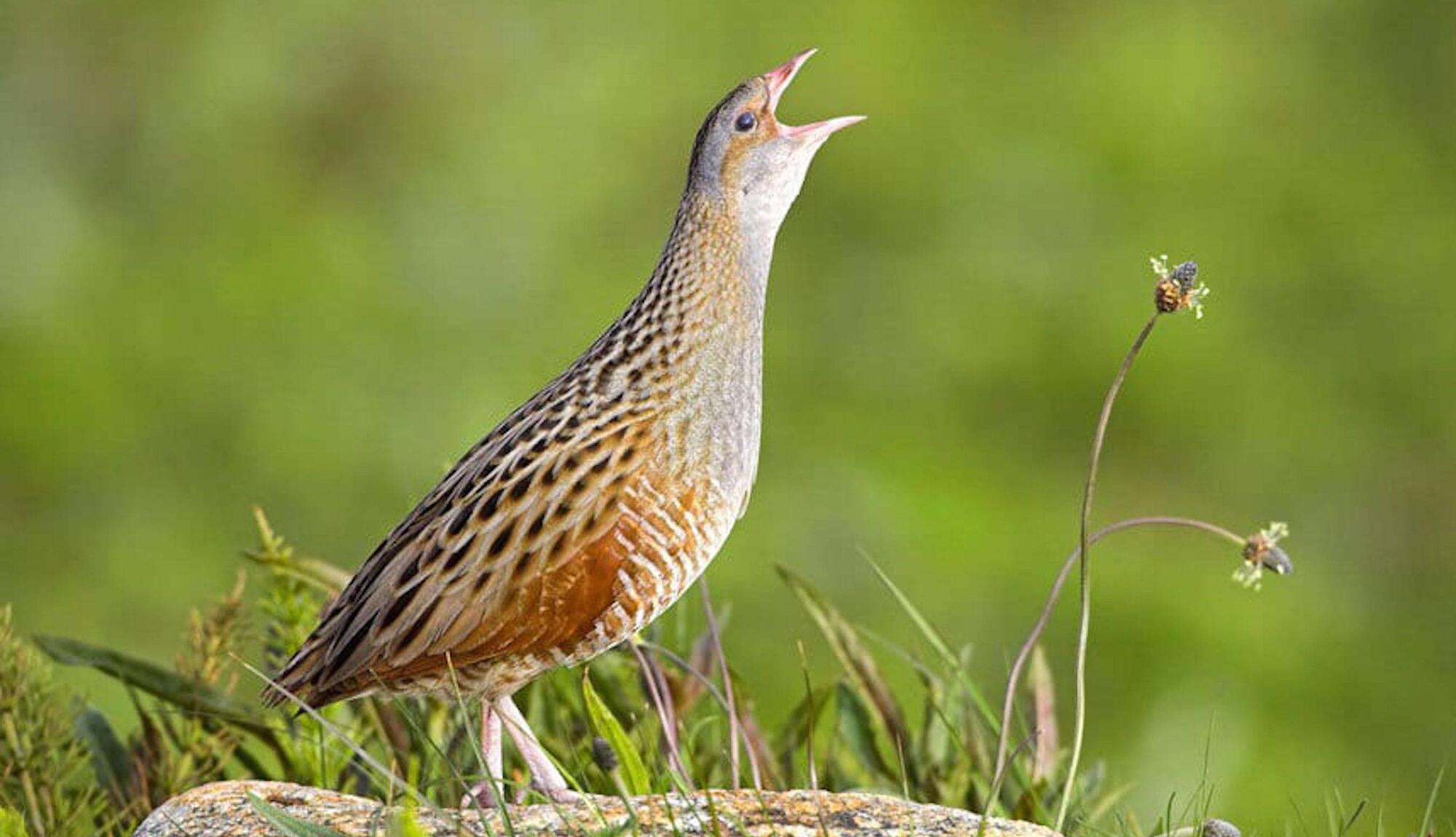
The population of the corncrake, once synonymous with the Irish countryside, has declined by 85% since the 1970s.
FARMERS have a big role to play in protecting the endangered Corncrake when mowing meadows during the summer.
The bird, which breeds in Ireland from April to September before migrating to Africa for the winter, is in danger of global extinction due in most part to intensive farming practices. Early mowing to make silage and mechanised haymaking practices have destroyed nests and driven the corncrake from old habitats.
The population of the corncrake, once synonymous with the Irish countryside, has declined by 85% since the 1970s. Listed for special protection under the European Union Birds Directive, the species is now effectively confined to Connacht and Donegal, including offshore islands.
Supporting the corncrake in these remaining strongholds is now deemed critical to its survival in Ireland. Back in the 1960s, the country had an estimated 4,000 individual corncrakes, but last year only 188 calling males were recorded.
However, a new €5.9 million European Union-funded LIFE project aims to revive the fortunes of “the bird of the meadow” and ensure it remains a part of rural landscapes for years to come. Overseen by the Department of Housing, Local Government and Heritage, it was launched by Ministers of State Malcolm Noonan and Pippa Hackett.
The project team will operate at coastal and island locations in Donegal, Mayo and Galway as well as associated farmland. Over a five-year period, it will work collaboratively with farmers and landowners to improve the landscape for the highly endangered bird.
Measures will include creating and maintaining areas of early and late cover, wildlife-friendly mowing of grass, provision of refuge areas during meadow harvesting and incentivising later cutting dates. The aim is to deliver a 20% increase on the 2018 population of corncrake recorded in Ireland by the end of the project.
Locally-based field officers will provide guidance, direction and support to landowners, while community engagement personnel will work with stakeholders to establish the corncrake as an asset to the areas it frequents.
Knowledge exchange groups and targeted school programmes will be utilised to highlight the needs of the corncrake and create awareness of its endangerment.
The project is collaborating with the Department of Agriculture, Food and the Marine, Galway-Mayo Institute of Technology, Údarás na Gaeltachta and Fota Wildlife Park in Cork.
It will explore innovations such as flushing bars fitted to tractors to scare birds away from mowers, thermal imaging drones to find nests, and passive acoustic monitoring using high-tech microphones in an attempt to help locate the highly elusive birds.
Minister Noonan said the call of the corncrake was once a ubiquitous sound in meadows and grasslands across the island of Ireland. However, rapid changes to farming practices spelt doom for the bird.
“The award of this funding demonstrates the ongoing importance of the EU LIFE programme in supporting conservation projects that have a regional or local focus, particularly in rural or peripheral areas,” he said.
Minister Noonan said the funding will allow the Department to put measures in place to help secure the future of the species, which remains a high conservation priority at a national and European level.
Given that the corncrake relies so much on habitats used for agricultural reasons, Minister Hackett said she was delighted the Department of Agriculture, Food and the Marine is a key partner in the project. That involvement reflects DAFM’s increasing awareness that a more co-operative approach to agri-ecology is needed in our landscape.
“I was delighted to be able to secure additional funding recently for the results-based element of the Corncrake LIFE project.
“The use of scorecards to help steer and inform farmers as to what is on their lands is a very practical way of helping to advise farmers how to manage their practices to the benefit of the environment,” she said.
Dr John Carey, National Parks and Wildlife Service, which manages the project, said the efforts will focus primarily on a combination of habitat creation and restoration, although some new and innovative approaches to corncrake conservation will be explored.
“The project will be developing knowledge exchange groups with farmers and advisors to share information on how to create and maintain high-quality corncrake habitats and ensure that landowners can maximise their potential to receive rewards under the results-based pilot scheme,” he said.
Joanne Masterson, Teagasc Adviser in Galway and Clare, writing last year, stressed the importance of corncrake-friendly mowing, saying: “Up to 60% of chicks are killed when mowing from the inside in. Corncrakes are shy secretive birds and are reluctant to break cover and move to open ground.
“Corncrake-friendly mowing is to provide birds with continuous cover as they escape from the mower into a neighbouring field or refuge area,” she said, stressing the need to maintain a slow mowing speed (between 5-6km/hr).
“If mowing is carried out in an appropriate way, it will have a major impact on the survival rates of both chicks and females,” she added.
Oonagh Duggan, BirdWatch Ireland, also urged farmers in places where there are corncrakes to use practices like centre-out mowing, which would give the chicks an opportunity to get out of the way of the mowers.
“There are ways to help, but we need more habitats, and we need more farmers doing this. The key issue is that there is not enough funding to target methods and help farmers to move in this direction,” she recently told a meeting of the Joint Oireachtas Committee on Agriculture, Food and the Marine.