Farm Finance: Asking all farmers to grow crops is akin to asking an electrician to plumb a house
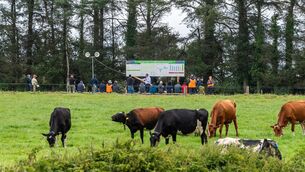
"One more cow, one more sow, one more furrow under the plough" was the slogan attributed to the then Minister for Agriculture Mr Patrick Hogan almost 100 years ago
One more cow, one more sow, one more furrow under the plough. This was the slogan attributed to the then-Minister for Agriculture Mr Patrick Hogan nearly 100 years ago after the Great Depression in a clarion call to farmers to expand production against the backdrop of the economic shock to the country.
Fast forward to today and Minister for Agriculture Mr Charlie McConalogue is seeking to encourage farmers to expand the area under tillage for 2022.
The loss of Ukraine and Russia and major suppliers of grain to the European Market has already caused severe disruption to grain markets, with wheat prices rocketing last week to over €400 per tonne, which is over double the long-term average price of wheat over a five-year average.
As covered here last week, the cropping area of Ukraine is truly immense, and the lack of supply from this region is coupled with the fact that producers in other countries may well curtail production as a result and drive significant increases in inputs, particularly fertiliser, but also including agrochemicals and more recently diesel.
As with the fertiliser crisis, the risk is that farmers could find that cereals are simply not available to purchase at any price where scarcity becomes an issue. Ireland’s arable area has declined over the past number of decades from a high of 550,000 hectares in 1980 to just below 300,000 hectares in 2020.
Meanwhile, the amount of cereal grains imported into the country has exceeded over one million tonnes for each of the years 2013 to 2020 with as much as 2.4m tonnes imported in 2018 when the country was dealing with a fodder crisis.
Of the quantity imported, two-thirds are in the form of maize meal. As covered here last week, 27% of Ireland's maize imports are sourced from Ukraine. Given that it may be difficult to source alternative suppliers as our European counterparts will equally be affected by the lack of supply, the deficit in imports to be made up by domestically wheat, barley and oats could easily exceed half a million tonnes.
These figures do not take account of indirect sources of grains to Ireland such as milled flour.
To make a meaningful impact on Ireland’s domestic production and reliance on imports, any such scheme to be introduced by the Department of Agriculture should seek to increase the area under cropping by a minimum of 100,000 hectares.
Bear in mind that many Department of Agriculture schemes are undersubscribed and the scheme should be large enough to take account of this. Nearly 100 years ago, the vast majority of farms were mixed enterprises where farmers typically grew their own oats, barley and wheat, beet and potatoes to feed horses and other livestock.
As such, each farm by themselves or within their own community was effectively self-sufficient. The change to production dynamics was relatively easily implemented at farm level as farmers already had the knowledge, experience, machinery and skills to answer the call.
In the intervening period, farms have typically become specialised in one discipline only, asking a dairy farmer to grow barley would be akin to asking an electrician to plumb your house.
This time around the production from by inexperienced farmers facing higher input costs may also hamper the expectation of production.
Back in 2018, when Ireland last faced a fodder crisis, it was relatively easy for Ireland to import fodder from our nearest neighbours. Now that Brexit has happened the prospect of sourcing grains from the UK becomes a much bigger challenge as a result of customs paperwork, but also as a result of phytosanitary certification.
This leaves Ireland in a very exposed position should a fodder crisis develop. Having sufficient fodder production in place in the form of silage, hay and haylage will in itself obviate the risk of a fodder crisis, which in itself will avoid an overbearing reliance on imported grains.
The two-pronged approach must ensure that the diversion of land to grain production doesn’t come at the expense of fodder production.