Much more may be asked of agriculture, IFA meeting hears
The IFA's annual meeting took place at a key moment for Irish farming with the sector facing the enormous task of producing food while cutting its impact in the environment, Kathleen O'Sullivan reports
Much more may be asked of agriculture, IFA meeting hears

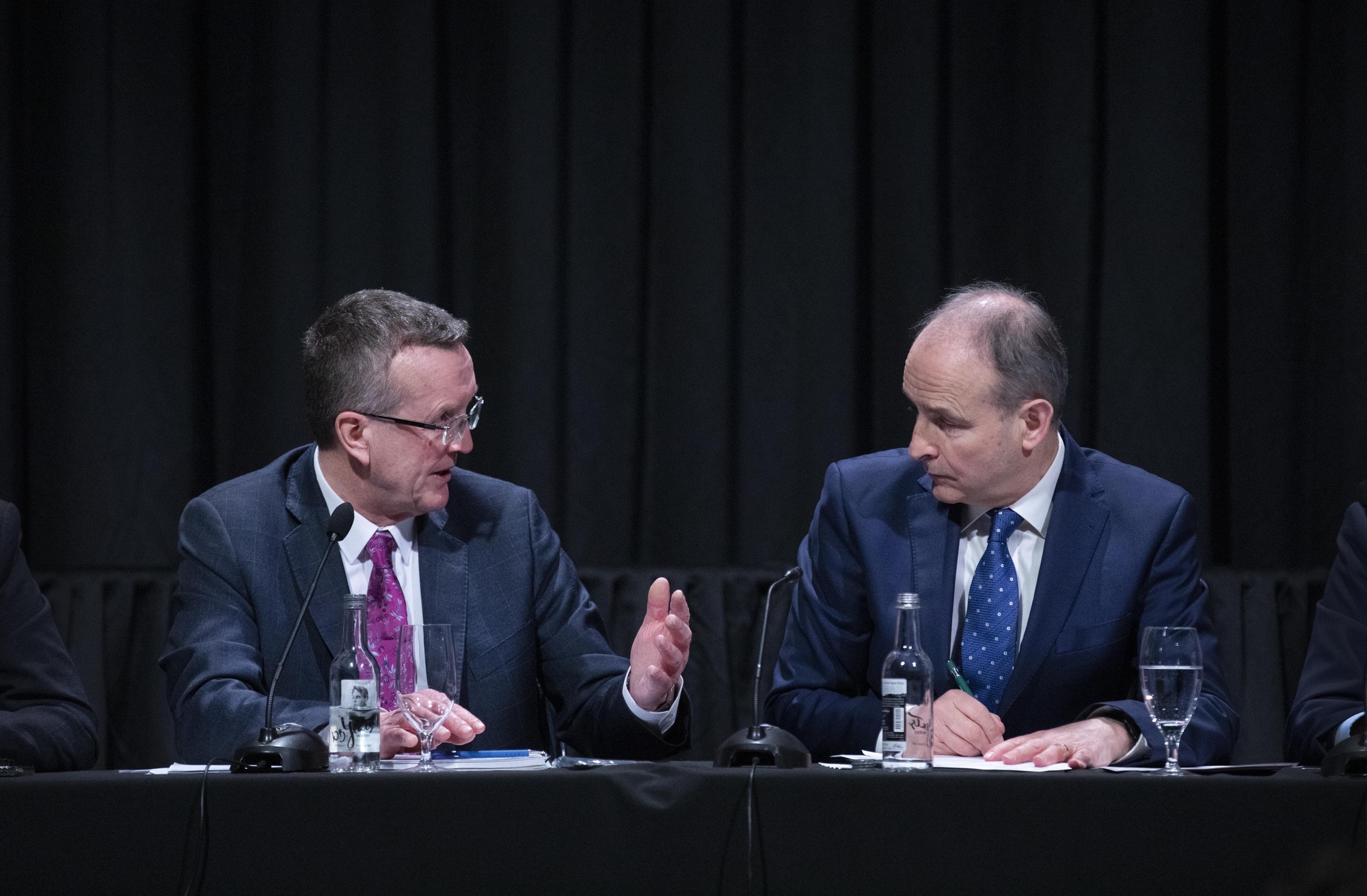
Taoiseach Michéal Martin listens to questions from IFA president Tim Cullinan at the 2022 IFA AGM in Dublin. Picture: Finbarr O’Rourke

More will “inevitably” be asked of agriculture if proposed measures prove insufficient to reduce emissions, Taoiseach Micheál Martin told the Irish Farmers Associations’ AGM.

However, the Government was warned that farming should not become a “twilight sector” in a bid to reduce the country’s emissions.

Brian Rushe, deputy president of the IFA, urged the Taoiseach, and Minister for Agriculture Charlie McConalogue, to involve the farming sector in the climate action decision-making process and to not leave primary producers behind.

Mr Martin stressed that the Government “will stand behind its farmers” and that he “will not downplay the challenge of decarbonisation” that Ireland is facing.

Addressing the association’s 67th AGM last week, Mr Martin said agri-food’s performance during the pandemic has “highlighted once again the resilience of this sector”.

“Ireland has a long and proud history of agriculture, and I believe we can reinvent and secure this tradition for the 21st century,” he said.

Farming is 'not a soft target'

Agri-food exports, which fell by just 2% in 2020 at the height of the pandemic, rebounded in 2021, Mr Martin noted.

“The average family farm income increased for the third year in a row in 2021 with dairy, sheep and tillage performing strongly,” he continued.

“Indeed, the challenges of the pandemic intertwined with the fallout of Brexit, make the resilience demonstrated by the sector all the more impressive.”

He said the sector has a “crucial and inescapable role to play” in meeting the challenge of climate change and biodiversity loss while creating resilient farms for “generations to come”.

“Climate change is a threat to all of us and to our way of life,” he said.

“We must all play our part and change how we live, how we travel, how we generate and use electricity, and how we produce food.”

He told the AGM that farming is “not a soft target” when it comes to the focus on reducing emissions.

Agriculture has been allocated a reduction range of between 22-30% in the Climate Action Plan 2021, but Mr Martin said he believes it can be achieved.

“We are aware of the growing questions that are being asked of the agricultural sector about its emissions,” he said.

“These questions will only grow and intensify in coming years as all sectors are asked to play their full part in what has to be a great national effort.

“We are at a crossroads for Irish farming and for forestry.

“Threats and opportunities abound but our choice now is to either honestly address the challenge that climate change poses for the sector, and together harness the opportunities that this changing context presents, or, as some voices counsel, to resist what I see is quickly becoming irresistible.

“Farmers know their land better than anyone and are well placed to lead in meeting our climate ambitions.”

More may be asked of sector

He said that the Government will “empower farmers with a science-based approach, backed by robust research”.

“Farm practices that enable farmers to produce world-class food while addressing emissions from the sector are key.

“These will involve less, and more targeted use, of chemical nitrogen while maintaining our position as global leader in grass growth through multi-species swards.

“Other measures include improving the genetics of our herds to reduce emissions and improve productivity.

“We will also incentivise increased organic farming and diversification into forestry, biomethane, and energy production.

“We are leading research to bring new technologies and feed additives on stream.”

He confirmed that more will “inevitably be asked of the sector” if these measures alone “prove insufficient to meet the emissions reductions that are required”.

Meanwhile, Mr McConalogue explained to the AGM that if we permit emissions to increase, “we will be faced with an even bigger challenge in the coming years, one that will put even more pressure on farmers”.

“We have to stabilise emissions rapidly so that the tools at our disposal and the technologies in development can deliver the reductions to the level required,” he commented.

“The need to stabilise emissions rapidly is particularly relevant to the dairy sector, which has undergone a very significant expansion over the last decade with the lifting of quota constraints.

“The dairy sector makes a hugely positive contribution to rural life and the rural economy — that will not and should not change.

“While our grass-based dairy products are among the most carbon-efficient in the world, and that efficiency is improving over time, we need to act now to ensure that total emissions from the dairy sector do not increase beyond their current level.

“In doing so, we have to think about how we ensure that there is space for generational renewal and new entrants to the sector, or for those with marginal enterprises to improve viability, and space to encourage innovation and value addition.

“But this must take place within an overarching framework that provides certainty around stabilisation and then reduction of emissions from the dairy sector.”

World leaders

Stephen Arthur, IFA dairy committee chairman told the AGM that, as farmers, “we are not going to accept any quotes and we’re not going to reduce our cows either after five years” of investment.

“Farmers are out there five, six, seven years into 20-year investment plans on their farms, they backed themselves, they invested, they followed the rules,” Mr Arthur said.

“We’re world leaders in what we do.

“We became very smart at what we [do], research kept pace, and we’re doing a great job.”

He told the Taoiseach and Mr McConalogue that there is “good science coming through — but you are not waiting for it deliver”.

Since the AGM, Mr McConalogue has announced that he is setting up a Food Vision Dairy Group to produce a plan this year to manage the sustainable environmental footprint of the dairy sector.

Meanwhile, Mr McConalogue also said he has been “closely monitoring” the rise in fertiliser prices over the past six months.

He said it is something he is “seriously concerned about”.

“Obviously, we are at the hands of global energy markets when it comes to domestic fertiliser prices but I have raised the issue consistently at European level in relation to abolishing tariffs.

“I have written directly to the commissioner on this,” he said.

More in this section

Farming

Newsletter

Keep up-to-date with all the latest developments in Farming with our weekly newsletter.

Cookie Policy Privacy Policy Brand Safety FAQ Help Contact Us Terms and Conditions

© Examiner Echo Group Limited