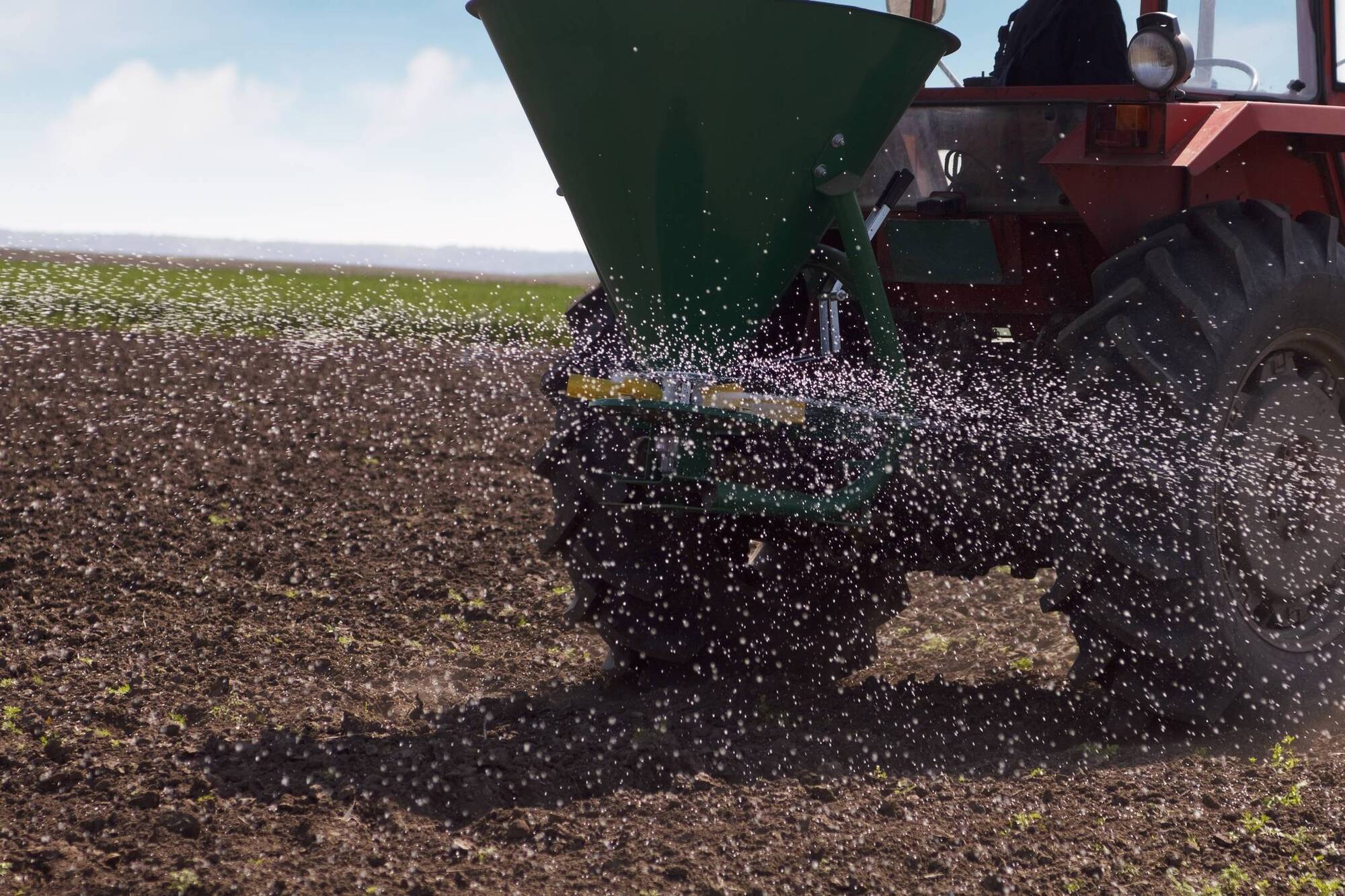
Changes to how every farmer in Ireland uses chemical fertiliser appear now inevitable as the Department announces nitrous oxide emissions will be a top priority for national emissions reductions over the next three years.
Experts say early action and high levels of take-up will be required across as many as 135,000 farms to drive momentum towards a new, lower emission model of beef and dairy production.
All farmers will be required to sign up to a new national fertiliser register of compliance, while chemical nitrogen allowances will be reduced.
Supports such as training and advisory services will also be put in place to underpin the sector’s climate action target, the Department of Agriculture, Food and the Marine has said.
The recently-published Climate Action Plan 2021 sets out a commitment for the agriculture sector to reduce its overall emissions by between 22% and 30% by 2030, to bring emissions into the range of 16-18 megatonnes.
Despite the significant challenge ahead, the Department has said the sector is “not starting from a point of inaction”, and build on progress already achieved.
Bill Callanan, chief inspector with the department, said that the biological nature of the sector, coupled with the high level of methane in the emissions profile, results in “unique challenges”.
Mr Callanan told the Oireachtas joint committee on environment and climate action that in the “absence of new technological innovations, as long as the sector produces food, feed or fibre, there will always be residual emissions”.
“Food production is a biological system and the climate act makes it clear that the social and economic role that Irish agriculture plays in society must be considered at all stages of the carbon budgetary process,” Mr Callanan said.
Chemical nitrogen use is responsible for around 40% of nitrous oxide emissions on Irish farms.
“To ensure early action in the first five-year carbon budget, there will be a significant focus on reducing nitrous oxide emissions in agriculture, mainly associated with the use of chemical nitrogen fertiliser,” he continued.
“The big focus is around nitrous oxide, in terms of reducing the dependence on nitrogen in the system artificially and also reducing crude protein in the animal feed diet, which is another source of nitrogen.
“We have set out objectives in terms of reducing nitrogen usage overall by 20% - it may have to be reduced further.
“This will be done by reducing fertiliser usage, changing fertiliser type, etc. Those will all contribute to that.
“If we were to take a pro-rata expectation, we would have to be delivering something close to two megatonnes in the first budgetary period to contribute to the overall economy-wide commitment of 51%.”
The Climate Action Plan 2021 outlines that chemical nitrogen use on Irish farms must be reduced to a target level of 350,000 tonnes by 2025, with a further reduction to an absolute maximum of 325,000 tonnes by 2030.
However, Mr Callanan said it is “critical” that nitrogen is not replaced with feed imported from abroad.
He stressed that reduction has to be done “in a way that does not really result in unintended consequences”.
“Internationally, a huge amount of dairy and beef is now indoors. It is not a system we want to see in Ireland,” Mr Callanan added.
“A pastoral-based, rain-fed, grass-based diet is environmentally much more acceptable.”
Approximately half of the fertilisers used in the country are used by dairy farmers, while tillage farmers also use it, Mr Callanan noted.
However, he said that the spread across beef is “quite varied”.
The government has committed to increasing the land being farmed organically from the current figure of 74,000 hectares to 350,000 hectares by 2030.
Mr Callanan said this will account for a contribution of 0.3 MT CO2 equivalent.
“To explain why the change to an increased level of organic farming is not as big a factor as perhaps it might be thought, it involves the removal of fertiliser,” he said.
“Every reduction of 10,000 tonnes of fertiliser used decreases the climate impact by 0.07 MT CO2 equivalent, which is a relatively modest amount.
“Our overall footprint in this context is approximately 85% driven by emissions from livestock.
“The rest comes from fertiliser use. Some fertiliser emissions will be removed because of the increase in organic farming, but the major element of emissions comes from animals.”
Mr Callanan explained, that as a result, environmental ambition and change at farm level will require a combination of policy instruments, such as financial incentives.
“For example, through the Common Agricultural Policy strategic plan, through market-driven support for farmers by food processors and food companies or regulation with an initial focus on reducing nitrogen use, or through the roll-out of new emerging technological solutions and innovations,” he said.
“Early action and high levels of take-up will be required across our 135,000 farms to drive momentum towards achieving the required ambition in the context of managing emissions from our dairy herd and transforming our model of beef production.”
Food Vision 2030, the 10-year strategy for the Irish agri-food sector, requires the Department of Agriculture to produce detailed plans by quarter two of this year to manage the sustainable environmental footprint of the dairy and beef sectors.
Mr Callanan stressed that reductions in methane are “more challenging as the technological advances are not [currently] available in the marketplace”.
However, he said progress on methane is expected to accelerate in the second five-year carbon budget — 2026-2030 as this changes.

Looking for a thoughtful gift?
Irish Examiner Gift subscriptions are now available.
Already a subscriber? Sign in