The politics of Dutch farming complicates matters at the Hague
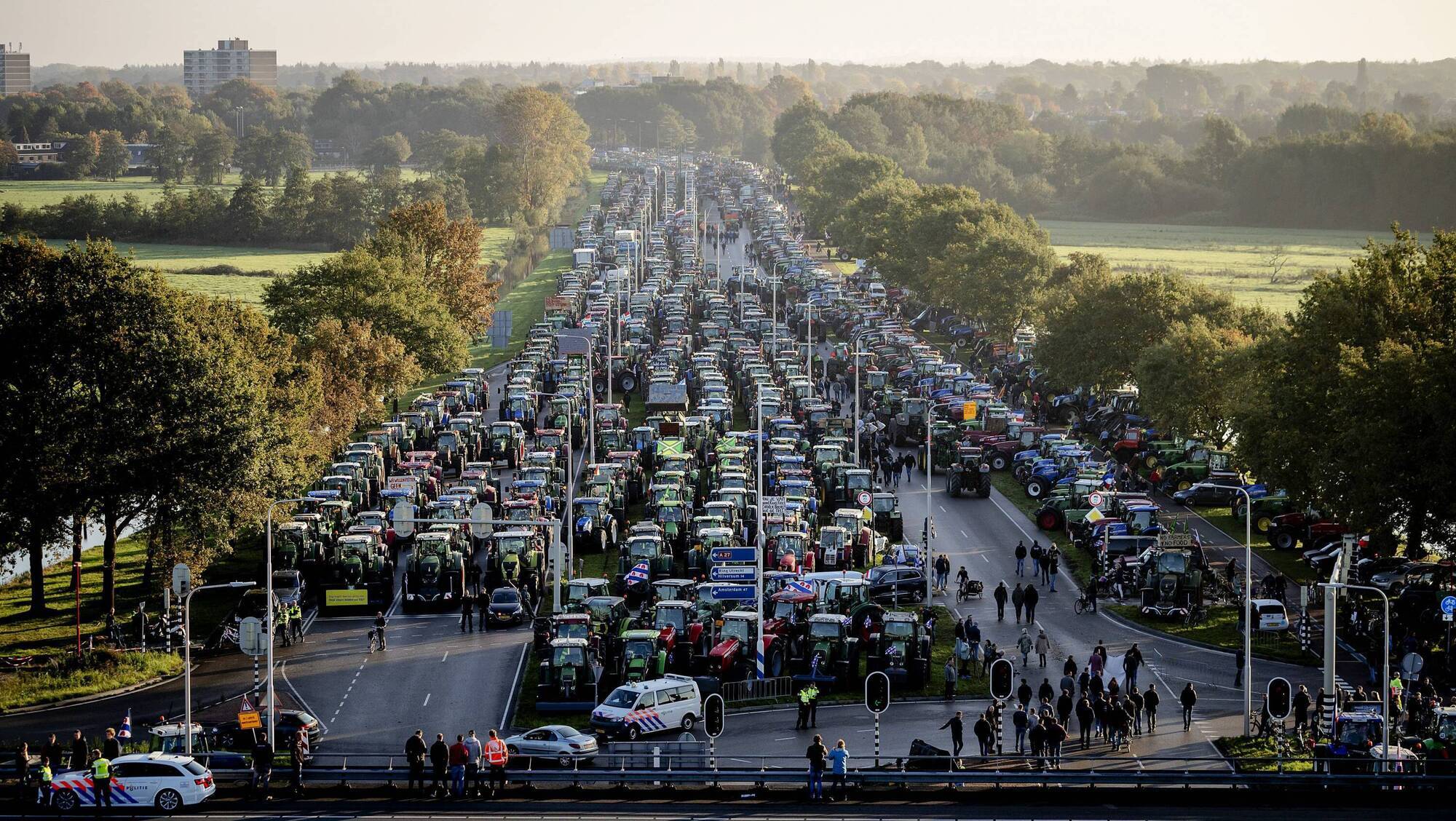
Dutch farmers gather with their tractors near the headquarters of the National Institute for Health and Environment to protest the nitrogen policy rules in October 2019.
European farmers may yet look back on the coming into office of the new government in the Netherlands as a momentous day.
The government was sworn in on January 10, an unprecedented 299 days since the country's last election.

Agriculture was probably one of the thorniest topics in the coalition negotiations, because more and more Dutch politicians have been talking about massive cuts in animal numbers, land buyouts, and even compulsory acquisitions.
Dutch agriculture has been under pressure from the government and the EU for several years. It was the EU that enforced an 11% reduction of dairy cows in 2017 and 2018 due to runaway phosphate pollution.
In 2019, the highest Dutch court ruled that permits for construction projects and agricultural activities which emit large amounts of nitrogen were in breach of EU legislation. To fix this, an estimated 70% reduction of nitrogen emissions is needed by 2035.
Some experts say that requires the number of Dutch livestock to be halved.
This small country with a population of 17.5 million has nearly four million cattle, 12m pigs and 100m chickens. Statistically, the Netherlands is the world's second-biggest agricultural exporter, after the United States.
Agriculture generates 16% of Dutch greenhouse gas emissions. That is low compared to Ireland’s 35%, but only because of a high level of industrialisation, and because also crammed into the Netherlands are a huge flower producing industry, one of Europe's biggest airports at Schiphol, a dense road network, and many huge industries.
It looks like agriculture could be the one to lose out, now under intense pressure from every direction.
It is focused on excess nitrogen in the atmosphere. Nitrogen oxides from combustion engines, farms, livestock, and fertilisers is blamed for damaging forests, soils and waterways, and as a greenhouse gas.
The construction industry generates a lot of nitrogen oxide and other pollutants, but huge construction projects are needed to tackle a housing shortage.
By pushing the agricultural sector to reduce pollution, the government could resume building projects held up by nitrogen emission laws.
Earlier this year, the government issued a voluntary pig farm buyout scheme. But only 278 were eligible, the government had anticipated some 430.
The new government wants to spend €25 billion by 2035 on rural investment, subsidising ecological farming, and supporting the transition to circular agriculture.
Forced reductions in livestock, favoured by D66 and left-wing parties to cut pollution, did not make it into the agreement. But voluntary buyouts would be financed from the €25bn fund.
Farmers near protected nature areas will be under the most pressure to retire, diversify, retrain, innovate, or relocate.
The main Dutch farmers’ organisation, LTO, welcomed spending plans but said it should be spent to encourage farmers to change, not compensate farmers who retire.
The new coalition government has the same four parties as the government that resigned one year ago after wrongly labelling thousands of parents who claimed childcare benefits as fraudsters.Â
The People's Party for Freedom and Democracy (VVD) led by Prime Minister Mark Rutte had seemed ready to buy out farmers. The Christian Democratic CDA no longer rejects the idea of forced farmer buyouts. And the D66 Progressive Democrats is open to farmer buyouts to combat nitrogen pollution problems. It has said the land acquired will be returned to a natural status or designated for nature-inclusive agriculture.
Farmers have fought back, with two years of sometimes militant protests, often blocking highways and causing the worst ever Dutch traffic jams.
They stormed the Groningen provincial assembly, driving a tractor through the door of the local government building. That might now backfire on them, because Groningen provincial council executive Henk Staghouwer is the new Agriculture Minister.Â
Owner of a chain of bakeries, he succeeds farmer’s daughter Carola Schouten.
The new government’s most vehement opposition may include the Farmer-Citizen Movement (BBB) newcomers led by former agricultural journalist Caroline van der Plas. She is BBB’s only existing elected representative, but the party is projected to gain up to 10 seats in the next elections.
Her father, Wil, was a sports journalist, and her mother, Nuala, emigrated from Ireland in 1961, and became a councillor for the CDA.
Ms Schouten said: "If we downsize farming here in the Netherlands, it’ll just move to other countries that are less sustainable than we are. Every cow we lose here will be replaced by two or three somewhere else in the world.Â
"So if we need to reduce carbon dioxide, nitrogen, ammonia, let farmers here come up with innovations to make production cleaner.”
Dutch farmers will hope that works out. Belgian and German farmers will watch closely also. They have similar agricultural pollution problems, and fear their governments would follow any Dutch example of getting tough with farmers.
In 2021, the government closed a Belgian poultry farm due to elevated nitrogen emissions levels. Germany has nitrogen emissions in the Ruhr and the Rhine areas as high, if not higher, than in Belgium and the Netherlands.
German farmers fear environmentalists could successfully take a nitrogen emissions case to the Court of Justice of the European Union, which could bring emissions-heavy projects in construction and agriculture to a standstill, as it did in the Netherlands.