Co-ops rule out playing any regulatory role related to the proposed Chemical Fertiliser Register
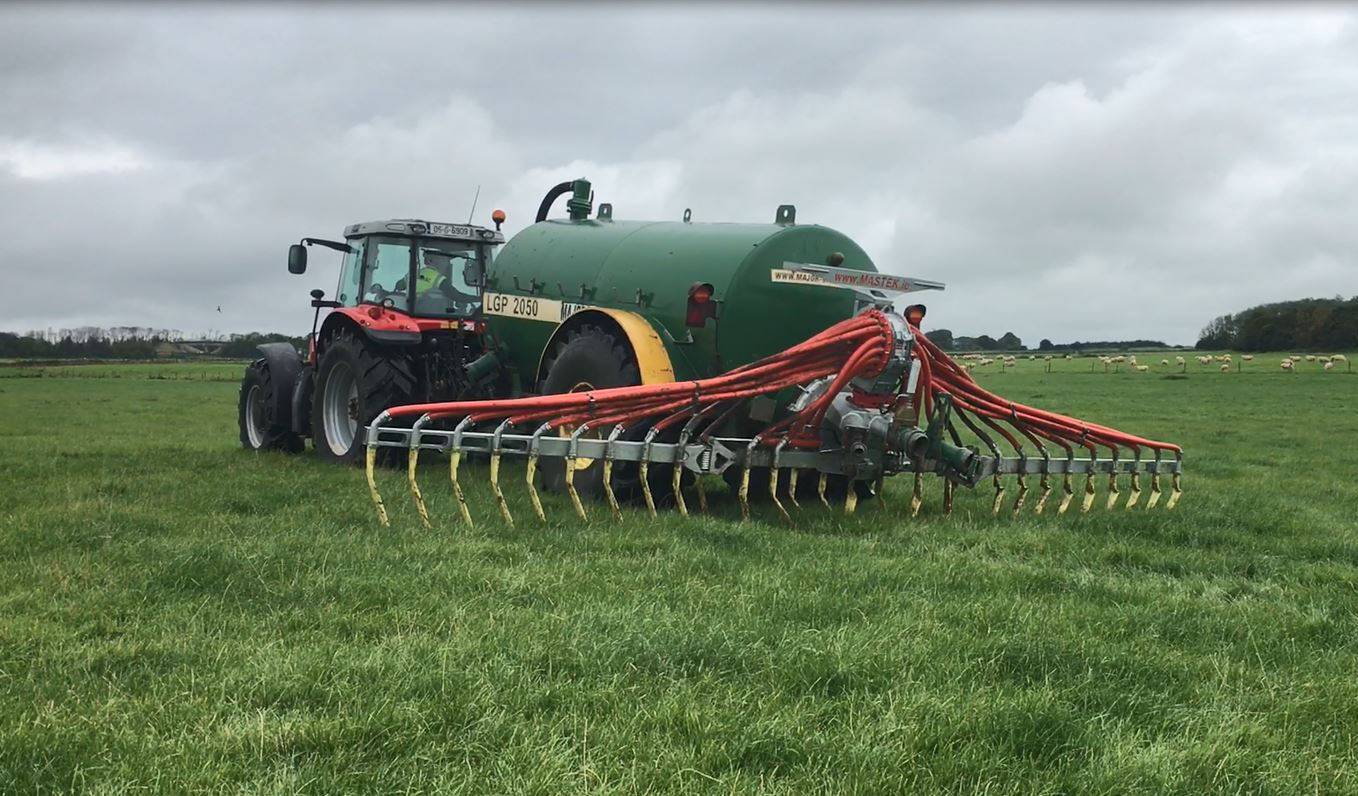
ICOS also wants lead-in times of at least three years to allow for new investments in slurry capacity, given the shortage of construction workers and building costs inflation.
Co-ops have objected to many of the measures proposed in Ireland’s draft Nitrates Action Programme.
And they have ruled out playing any regulatory or compliance role related to the proposed Chemical Fertiliser Register, although acknowledging it will require co-ops to record chemical fertiliser sales against individual farmers’ herd numbers.
ICOS, the co-ops’ representing body, has called for greater lead-in times for many of the proposed measures and has proposed alternatives to measures they disagree with, which include all four proposals to extend closed periods for spreading of chemical fertiliser, slurry and soiled water.
ICOS emphasised a need for additional support for slurry storage as part of the new CAP, saying this should include:
- 60% grant aid for all farmers investing in slurry or soiled water storage.
- Grant aid for farmers currently non-compliant, using national funding, subject to them future-proofing their farms by expanding their slurry capacity by 20% beyond regulations.
- Slurry storage and soiled water investments should be allocated outside the €80,000 investment ceiling.
- A new tax relief measure, similar to stock relief, for slurry storage or soiled water investments.
- Accelerated capital allowances through taxation.
ICOS also wants lead-in times of at least three years to allow for new investments in slurry capacity, given the shortage of construction workers and building costs inflation (DAFM should review TAMS on an ongoing basis to allow for costs inflation).
The co-ops revealed DAFM had not formally consulted with them on the chemicals register, which was “disappointing considering legislation is in the process of development according to the draft document”.
ICOS has completed a training needs analysis including preparation for the introduction of the new register.
ICOS supports full compliance with nitrate regulations and accepts greater levels of enforcement are needed to protect the sustainable image of Irish dairy farming.
But they are opposed to the proposal that all slurry must be applied by September 30, 2022, and by September 15, in 2023 and subsequent years.
The proposal is not based on Teagasc modelling reported in July 2021, said ICOS, which proposes instead that at least 80% of slurry be spread by September 15, and the remainder by October 15.
ICOS also opposes the proposed extension by about 18 days of the closed period for chemical fertiliser, suggesting the current period be maintained, with addition of precision management and weather advice around the timing of the first spring nitrogen application.
ICOS accepts the proposed review of nitrogen allowances, including a 10% reduction nationally, but cautions against 15% reduction for certain areas, until time is allowed for greater adoption of technologies such as clover.
The proposal that spreading soiled water be prohibited between November 15 and January 15 is opposed by ICOS, which notes the impact of spreading soiled water in December was not examined in Teagasc modelling. ICOS said this proposal appears to be an indirect measure to target slurry storage capacity concerns and compliance with the current regulations. But the nutrient content of soiled water is far less damaging to water quality, and the DAFM should provide for alternatives such as sprinkler systems, not subject to any closed period. “At the very minimum, the ban on spreading soiled water should be reduced to four weeks from December 15 to January 15, with an exemption for milk producers active during the winter”, says ICOS.
On the proposal that low emissions slurry spreading (LESS) be introduced for all farmers above 100 kg of nitrogen per hectare from 2023, ICOS said the key issue is availability of grant aid, and support for farm contractors, before a measure becomes mandatory.
ICOS agrees that more LESS is required, but says it is more difficult when soil trafficability is poor, and would necessitate extra slurry storage to cater for when soil and weather are unsuitable for land-spreading. And a longer lead-in period is justified, considering LESS equipment supply challenges.
Grant aid for LESS should be continued, and reinstated for derogation farmers, says ICOS, to enable farmers to transition in a just and fair manner.
ICOS supports a proposed review of the ASSAP programme, noting that in 1,810 ASSAP farm assessments up to December 2020, 96% of farmers engaged and 92% agreed appropriate actions to remedy risks to water quality. “The DAFM should recognise and reward farmers that are participating in the ASSAP programme by providing them priority access to GLAS, TAMS and CAP Eco Schemes under the new CAP,” says ICOS.
It is proposed that soiled water must be collected separately from slurry on all holdings, but ICOS maintains this should not be required if a farm has ample storage for slurry and soiled water. “Appropriate grant aid and lead-in times must be provided to enable farmers invest in new soiled water storage, where required”.
“There should be no need to build unnecessary capacity for soiled water”, is the ICOS response to a proposal that all holdings producing soiled water must have at least four weeks storage, by December 31, 2024.
“Ensuring all farmers reach compliance levels for slurry storage must be the number one priority for the Department of Agriculture when it comes to water quality,” adds ICOS.
On external slurry stores, it is proposed that in 2022, all newly constructed stores must be covered, and existing stores be covered as soon as possible, but no later than December 31, 2027.
This may be costly and difficult structurally, notes ICOS, and due regard must be taken of health and safety risks, and TAMS grant aid must be provided, with a separate grant ceiling for slurry storage and soiled water works. ICOS acknowledged that DAFM has clarified that external slatted areas are not included under this proposal.
It is proposed for short term grazing that only land within 30km be considered in stocking rate calculations, and that commonage and rough grazing currently permitted for the 170kg N/ha allowance on nitrates derogation farms be reduced below the 170kg threshold.
ICOS questioned the use of arbitrary limits in policymaking and said genuine situations in relation to the 30km limit must be treated accordingly.
It is proposed for 2023 that farmers stocked over 170kg must demonstrate clear separation of slurry and clean water in the yard. ICOS said most farmers do this, and are required by cross-compliance rules to divert all clean water to a clean water outfall and prevent clean water from becoming soiled.
ICOS said proposed banding of livestock excretion rates is requested by the EU Commission, so it is likely to be implemented, but recommends that the 89 kg nitrogen figure is maintained for at least two years. Otherwise, some farmers in higher bands would face considerable change without a lead-in time.
ICOS supports the proposal that the dairy industry supports achievement of water quality targets through financial incentives, but said co-ops should not be asked to take on any related compliance role.
On the water quality risk posed by sewage or other industrial sludges, ICOS noted using sewage slurry is a major Sustainable Dairy Assurance Scheme non-compliance, and said dairy processors are committed to working with appropriate regulatory bodies in relation to industrial sludges.
ICOS welcomed the phosphorous build-up proposal, saying it will allow farmers to achieve optimum soil fertility for sustainability.
ICOS acknowledged the green cover on tillage ground proposal, recommending some flexibilities where needed.
ICOS accepted proposals that more soils be soil tested for organic matter, and that soil testing must be as accurate and reliable as possible.