Innovative grass project key to dairy progress, with eco benefits
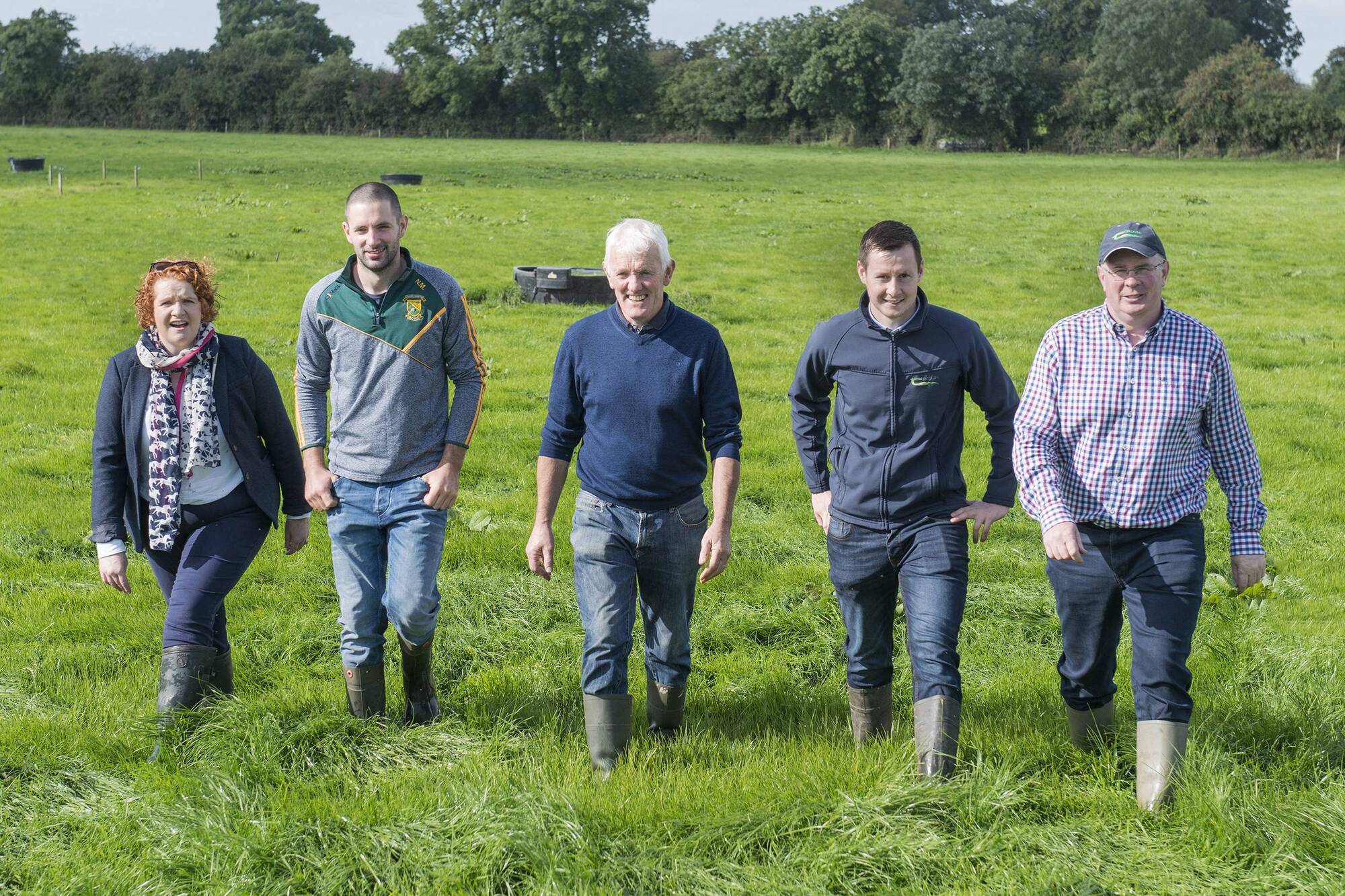
Pictured at a Teagasc Grass10 open day on the farm of Niall Moloney, 2018 Young Grassland Farmer of the Year in Crecora, Co Limerick are: Majella Moloney, Teagasc regional manager, hosts Niall and Jerry Moloney, John Bergin, Teagasc Kilmallock, and John Maher, manager, Grass10. Photo: O'Gorman Photography
, manager, Grass10, Teagasc, outlines the main benefits of this innovative programme
There is a strong relationship between the amount of grazed pasture in the diet and the costs of milk with operating costs of production declining with increased reliance on grazed pasture.
Recent Teagasc analysis has indicated that net profit per hectare is increased by €173/ha for each additional tonne of grass DM utilised on dairy farms.
- The Grass10 campaign promotes sustainable grassland excellence.
- The objective of the campaign is to achieve 10 grazings per paddock per year, utilising 10 tonnes of grass dry matter (DM) /hectare.
- The number of farmers recording grass measurements and using PastureBase Ireland to manage grass on their farms has increased significantly over the campaign.
Teagasc launched a multi-year Grass10 campaign (four years, 2017-2020) to promote sustainable grassland excellence on Irish livestock farms (dairy, beef and sheep). The Grass10 partners are Grassland Agro, AIB, FBD, Department Agriculture Food & the Marine and the Irish Farmers Journal.
As well as working closely with all partners and Teagasc advisory programme, the Grass10 programme worked closely with the Grassland Science Department in Teagasc. The primary objective of the Grass10 Campaign was to utilise 10 tonnes of grass DM/ha/year using 10 grazings per paddock on grassland farms.
The following farm practice changes were prioritised:
- Improving grazing infrastructure.
- Soil fertility — improve soil pH, P and K levels.
- Increase the level of reseeding.
- PastureBase Ireland (PBI) usage.
- Improving grassland management skills.
The number of farmers recording 20 or more grass measurements and using PBI to manage grass on their farms has increased by over 100% since the Grass10 Campaign begun. About 2,000 users now record grass measurements on a regular basis using PBI.
Increasing the level of PBI usage has been one of the key objectives of the Grass10 campaign. The level of regular pasture measurement needs to increase to gain greater improvements in grassland management. There has been a strong focus on training of farmers to become PBI users particularly through the Grass10 courses.
From Teagasc National Farm Survey data, grass utilisation per ha increased by 0.3 tonnes (7.7-8.0 tonnes of DM/ha) on dairy farms over the last few years. This corresponds to a grass production of 10.7 tonnes of DM/ha annually.
The estimated 10.7 tonnes grass grown on dairy farms is much lower than the 13.6 tonnes of DM/ha recorded by dairy farms measuring on PBI, indicating that there is still significant potential to grow more grass on the average dairy farm. There was a significant improvement in soil fertility over the period with about 20% of soils now at optimal soil fertility compared to 10% at the start.
About 45 farmer training courses were delivered over the last two years and the venue for these courses was on farm using the concept of a ‘Grazing Coach’. The aim of these training courses was to up-skill farmers in grassland management and to enable more farmers to improve their grassland management decision making. The courses took the Grazing Coach format, where grass course members attend the same farm every month and monitor grazing decisions and performance throughout the year. The Grazing Coach selected is a farmer who wants to learn, but has the potential to improve grass production and grazing efficiency on the farm.
The Grass10 newsletter is dispersed to over 1,500 industry stakeholders and 4,000 PBI users weekly. It is a very successful communication tool for the Grass10 programme. It is produced every Tuesday using the grass measurements taken by farmers obtained from PBI.
Also included in the newsletter is the predicted grass growth for the upcoming week. Farmers' daily grass management decisions are of huge importance to ensure good quality feed availability for the cows during the grazing season.
Being able to predict grass growth for the following week at farm level would help farmers to better anticipate variations in grass growth. The Moorepark St Gilles Grass Growth (MoSt GG) model is a dynamic model working at the paddock and farm level. The model takes into account soil type, weather and the grazing management practice to predict farm grass growth.
Grass10 launched a grassland competition to recognise those farmers who are achieving high levels of grass utilisation in a sustainable manner. The Grassland Farmer of the Year was launched in 2017 to coincide with the Year of Sustainable Grassland supported by the Department of Agriculture, Food & the Marine, in collaboration with the other stakeholders as part of the Grass10 campaign.