‘The Irish grass-fed dairy sector is the envy of the world’
Mike Brady, agricultural consultant, predicts a bright future for Irish dairy, including an innovation response by researchers to emissions challenges. He talks to Aisling Kiernan
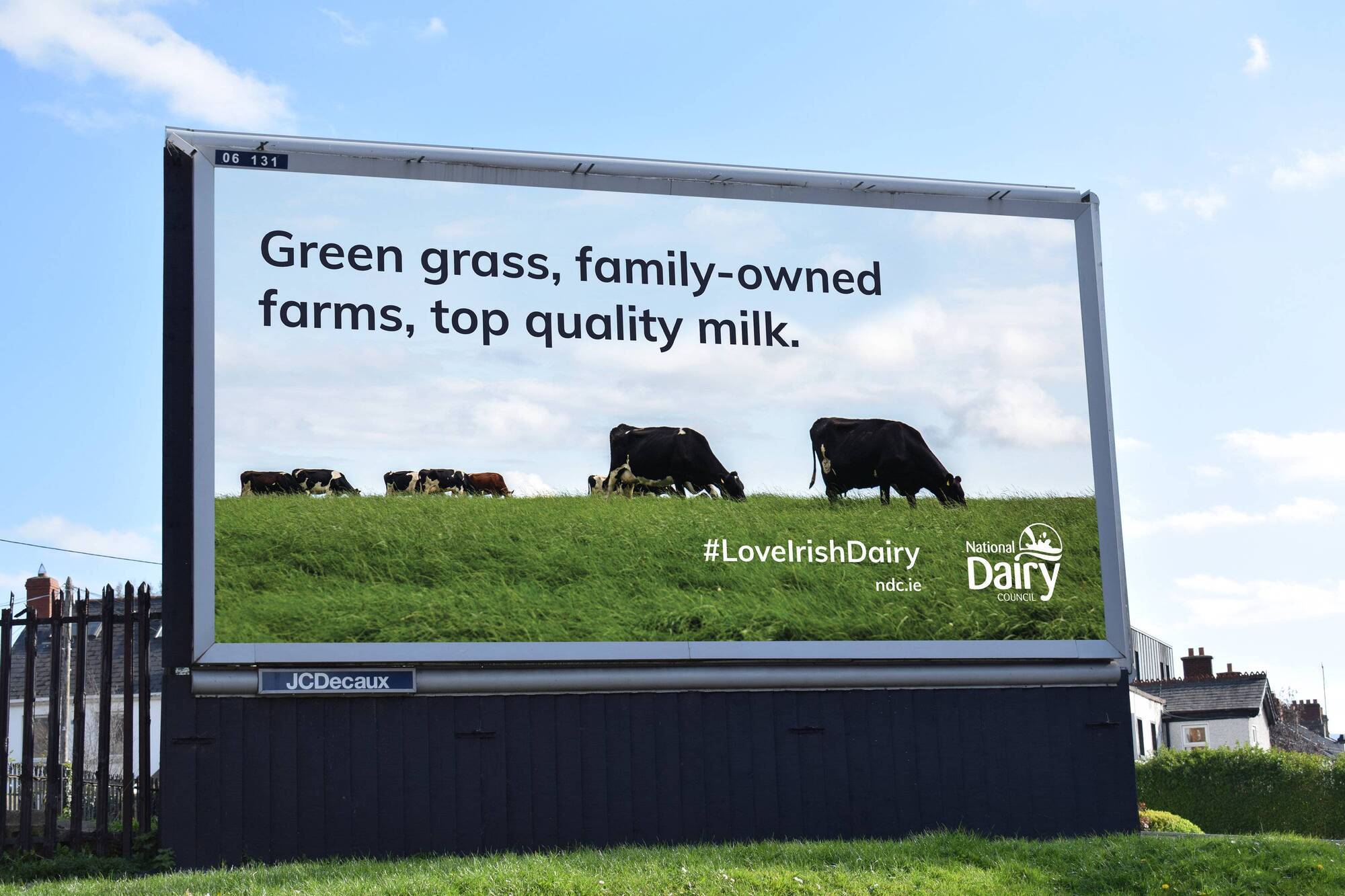
 A National Dairy Council billboard campaign celebrating Irish dairy farmers and their grass-fed Irish cows working together to sustainably produce top quality milk and dairy products.

A National Dairy Council billboard campaign celebrating Irish dairy farmers and their grass-fed Irish cows working together to sustainably produce top quality milk and dairy products.

“We have a great industry — one that is the envy of the world. We have a climate and land that is suitable for milk production, educated farmers, excellent research and advice, and we have a Government that is backing the industry. That is the perfect scenario.” 

These were the sentiments expressed by Mike Brady about the dairy sector in Ireland and the strides it has taken to become a world leader over the last 30 or so years.

Mr Brady says that dairy farmers are “absolutely flying at the moment” and everything is going really well.

Milk price is always a contentious issue but the last few years have seen a good market and this it seems is down to the fact that there has been five years of consistently good prices.

Other than that, he adds, there are very few negative factors affecting the sector at the moment ... and that includes the Covid-19 pandemic.

Mike Brady of Brady Group, the Cork-based agricultural consultant and land agents.

“The last year, where there was a bad price for milk was 2016 and then we had good milk price in 2017, ‘18, ‘19, ‘20 and ‘21 — so that’s five years in a row of respectable, above-average milk prices,” added Mr Brady.

“There was a drought in 2018 which did affect things a little bit but other than that it’s all good.

“Lots of lads have expanded and they are making money. The Covid-19 pandemic had zero effect on farming; when the pandemic actually hit in March 2020, dairy farmers were in the middle of calving season and their lives went on as normal.

“In fact, they didn’t really know there was a pandemic until June of 2020 because they were so busy on the farm.

“It just didn’t impact the business side of things.” 

Meanwhile, 25% of the cows in Ireland are in Cork followed closely by Tipperary. There are also a substantial number of cows in Limerick and Kerry.

And, Munster it appears is at the top of its game in terms of dairying.

Mr Brady says that the “positives” in relation to the sector include good weather — which means the grass is growing — good milk price and no market disruption or disease outbreaks.

He added, however, that there are concerns around the uncertainty of the environmental agenda, ie, greenhouse gasses, water quality, biodiversity, and animal welfare; and with regard to the lack of labour.

“Farmers are finding it very difficult to get labour on their farms at the moment, it’s a particular nightmare on dairy farms, to be honest about it,” he continued.

“I actually looked at EU unemployment stats; there is youth unemployment of 17% most of which is in Greece, Italy, Spain, Croatia and you never see southern Europeans working on Irish farms.

“It’s nearly always those from northern European countries.

“I don’t know why that is; maybe northern Europe is where we need to go searching for labour now.” Mr Brady went on to say that he is not worried about the environment because as far as he is concerned farmers in Ireland are “doing everything right” when it comes to this.

He also says that science will “win out” in the end and stocking rates will more than likely reduce here.

“Personally I’m not concerned about the environment and Irish farming because science will win out at the finish line on this and we have a great system here,” he added.

“Teagasc — in general — is doing a lot of research in the whole area at the moment.

“When I’m talking to my clients now we are factoring in that stocking rates are going to have to be reduced.

“We are going to be using less Nitrogen and that is going to have a knock-on effect.  But we will be exploring other elements like clover, multi-species swards, and better ways of utilisation of Nitrogen to grow grass.

“I am hopeful that the greenhouse gas matter will get sorted too. At the moment a vaccine is being developed in New Zealand; there is research being undertaken on seaweed extract and I think that there will be a combination of solutions to all of this.” 

“One way to solve the greenhouse gas problem here would be to provide an attractive scheme for suckler farmers to get out altogether and then cap the number of dairy cows,” suggests Mike Brady. “There is the problem solved overnight! Politically that would be a hot potato, of course…” 

With regard to the national herd, Mr Brady says the dairy sector is being blamed for the difficulties there, but added, “Everyone is blaming dairying because of its expansion but the numbers in the sector have only come back up in recent times to what they were in 1984.

“At that time, Ireland had about 1.4 million dairy cows and we have just surpassed that figure in 2021.

“Suckler cows went the opposite way; in 1984 there were 750,000 suckler cows then it went up to over one million and now it's back down under one million again.” Mr Brady went on to say that suckler farmers are very “touchy” about the situation at the moment.

He highlighted Professor Gerry Boyle of Teagasc’s comments last week when he said that they should consider dairy beef instead of suckler beef.

In rugby terms, Mr Brady pointed out that the request was a bit like asking a Munster supporter to start supporting Leinster.

“Beef farmers are very emotional about things but at the end of the day, if you take the emotion out of it, Professor Boyle is talking facts. At the same time, comparing beef farming to dairying is not good either because they are two different beasts altogether.

“Most beef farmers are at it part-time and while they don’t like to hear this: effectively it is a hobby, whereas the dairy farmer is full-time at the job.

“On the beef front, the contribution to the economy is huge but the contribution to the individual farmers is poor.  However, it's not all about economics either.” 

 Meanwhile, the basic goals of sustainable agriculture include environmental health, economic profitability, and social and economic equity.

Mr Brady highlighted the importance of this when it comes to assessing the overall situation here in Ireland.

“We are getting a lot of disdain over greenhouses gasses because 35% of emissions are from agriculture,” he continued.

“There are reasons for that; if we had a lot of heavy industry we would be down at 10% or 11% like our British counterparts and there wouldn’t be half the pressure on us then.

“But it’s there and we have to deal with it; we have to look at all of this on a global scale first and I think that is where a lot of the environmentalists are going wrong.

“There is no point in us being the best in the class and cutting our national herd if it means that the USA, for example, is going to expand by putting more 3,000 cow units with animals indoors and supply world demand.

“That will lead to carbon leakage and that is not right at all.” 

He also pointed out how the situation needs to be examined from a global perspective first, then on a country basis, followed by farm basis and lastly from a sectoral perspective.

“One way to solve the greenhouse gas problem here would be to provide an attractive scheme for suckler farmers to get out altogether and then cap the number of dairy cows,” added Mr Brady. “There is the problem solved overnight! Politically that would be a hot potato, of course…” 

Markets 

According to Mr Brady, there is very little happening in terms of land sales at the moment. Even letting land has slowed and the agri expert says this is because of the Common Agriculture Policy (CAP) reform and the uncertainty that is there around the allocation of entitlements.

“There isn’t a lot going on land wise at the moment - the volume of land coming for sale over the last two years has significantly decreased,” he continued.

“There just isn’t a lot of land coming onto the market and one of the reasons for that is because a lot of farmers that are thinking of retiring and letting out their land are holding off until they get their allocation of entitlement under the new CAP which is starting in 2023.

“I would expect a lot of land to come onto the market for letting then.

“If you are a dairy farmer that is thinking of getting out and you are going to lease your land for seven or 10 years, at the moment the Government is out on ‘armchair farmers’ who are letting out their entitlements.

“So fellas are afraid that if they let out their land this year with their entitlements, they will lose those entitlements by not getting a new allocation in 2023.

“Lads are hanging in there, waiting until they get their allocation and then they will let the land.

“If the CAP reform was decided there would definitely be more land for letting.” 

Concerns 

Meanwhile, some farmers have raised concerns about the need for additional ground as a result of measures being implemented under the Nitrates Action Programme (NAP).

Mr Brady says they should seek advice from their agricultural consultant so that they are aware of their options and other measures that can be taken if the need arises.

One such measure is to reduce cow numbers but there are other factors to consider before doing that.

“They could contract rear replacement heifers - get another farmer to rear the heifers and keep the same amount of land. With this method cow numbers don’t need to be cut,” he continued.

“Options vary from farm to farm; if a guy is contract rearing his heifers and is already very highly stocked and can’t get any extra land, then he has a problem for sure.

But it's not all about getting extra land; while it is a solution, it’s not the only solution.”

 Sector 

The dairy sector processes approximately seven billion litres of milk per annum, supplied by 18,000 family farms, many of whom are owners of the primary business.

Since the abolition of quotas, Ireland is on the road to becoming a global leader in the development of a high value, environmentally sustainable dairy industry based on our extensive grass-based dairy system.

Irish dairy companies have invested hundreds of millions towards this goal, resulting in over €4 billion worth of exports in dairy products, ingredients and nutritional products per annum.

Irish dairy is exported to 155+ markets world wide with international markets beyond the EU becoming increasingly important.

Irish primary dairies continue to be 100% Irish owned entities, and the quality of the country’s produce is reflected in the fact that three of the world's major specialised nutrition companies have chosen to base key secondary processing sites in Ireland.

Mike Brady, Brady Group (Agricultural Consultants and Land Agents) provides leading edge, independent and impartial advice to landowners, agribusiness and related sectors.

More in this section

Farming

Newsletter

Stay ahead of the season. Sign up for insights, expert advice and stories shaping Irish agriculture.

Cookie Policy Privacy Policy Brand Safety FAQ Help Contact Us Terms and Conditions

© Examiner Echo Group Limited