Winter grazing of cattle on the Burren continue a centuries-old tradition
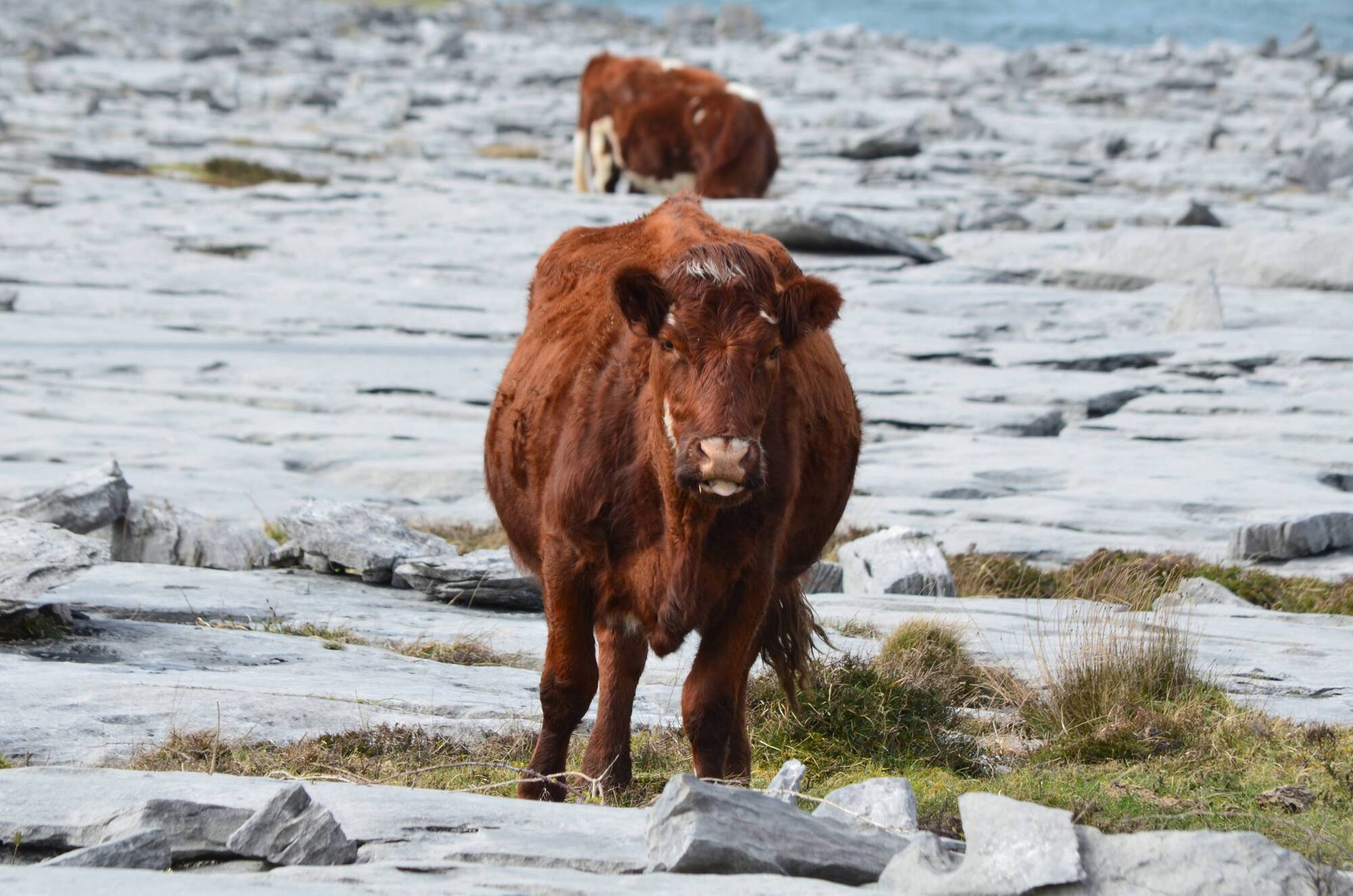
Cows grazing on the Burren in County Clare. By doing so, they continue to produce exceptionally good, healthy free-range livestock which are in great demand from buyers across Ireland and beyond.
HEAVY rain, high winds, reduced grass growth, muddy fields and shorter daylight hours are always signs of winter.
Every year, farmers have to judge the vagaries of the weather with decisions on when to bring their cattle indoors, move sheep to lower ground and ensure all their livestock have sufficient fodder supplies.
But the reverse has existed for thousands of years in the Burren of Clare, where farmers mark the end of summer by herding their cattle onto winter pastures in the limestone uplands where they spend the winter grazing.
It is thought the Burren farmers initially adopted this practice in response to the shortage of water in the summertime.
But they found that the warmth of the limestone and the ample grazing on the rocky winter pastures provided an ideal and low-cost ‘outwintering’ environment for their stock.
Winter grazing by cattle, at a time when most flowers are dormant, enables the Burren’s renowned complement of flowers and insects to flourish unhindered in summer.
It is also critically important to the conservation of the extraordinary array of monuments built by farmers in the past, as it slows down the encroachment of damaging scrub.
Dr Brendan Dunford, Programme Manager with the Burren Programme, said the practice of winterage is not only unique and intriguing.
“It is a big part of the reason why we have so many monuments, flowers and stories here in the Burren today.
Witnessing the cattle browsing on the herb-rich winterage pastures, drinking from the calcium-rich springs, or enjoying the 'dry-lie' of the limestone captures the very essence of this 'fertile rock',” he said.
Roughly 1,000 farm families live and work in the Burren region. Many of them continue to follow the pastoral traditions of their ancestors, particularly the outwintering of cattle on the rough terrain.
By doing so, they continue to produce exceptionally good, healthy free-range livestock which are in great demand from buyers across Ireland and beyond.
But these traditions also have a wider relevance: winter grazing systems have been scientifically proven to be critical to the survival of the Burren’s famous flowers and fauna.
They also support a burgeoning eco-tourism industry and contribute greatly to the Burren’s emerging identity as Ireland’s learning landscape.
Now officially recognised as part of the Intangible Cultural Heritage of Ireland, the Burren's farming tradition will be celebrated at a Winterage Weekend (October 20-24).
It will highlight the importance of farming in the Burren and give the general public an insight into the work that farmers do to help manage the heritage soul of Ireland.
A community-led initiative coordinated by the local landscape charity, Burrenbeo Trust, with voluntary support from Burren Irish Farmers Association and the Farming for Conservation Programme.
It is run on a shoestring budget with the support of many individuals donating their time and other local resources, such as venues, to the event.
The Heritage Council and the Department of Agriculture, Food and the Marine and FBD Insurance also provide support.
Each year the Burrenbeo Trust also organises a Winterage School as an opportunity for farmers, scientists, policymakers, and advisors to come together and discuss high nature value farming.
It forms part of the broader festival of events to celebrate and support pastoral farming and its importance to our rural communities and heritage Activities at next month’s Burren Winterage Weekend will be in line with Covid-19 guidelines. They will take place online with some 'real-life' local events, which will have to be pre-booked due to the limit on numbers.
The weekend will also highlight the national Farming for Nature initiative, set up four years ago to source, share and celebrate the stories of farmers who manage their land in a way that sustains nature while providing a livelihood for their families.
Organisers say there is widespread awareness of the environmental damage can be done by the wrong type of farming but not as much discussion about those farmers who are doing a great job.
This year Farming for Nature will introduce 23 Ambassadors. They will join a network of 43 others chosen since 2018.
Sponsored by Bord Bia and supported by a range of farming and conservation interests, the project recently revealed its first cohort of seven Ambassadors for 2021. Short films of a cross-section of these farmers can be viewed on www.farmingfornature.ie The Ambassadors will also be featured at the Winterage Weekend. The public is invited to view their stories and vote for their favourite one by visiting the Farming for Nature website.
Voting closes at midnight on October 22 and the winner will be announced the following day. The sixteen additional Ambassadors will be profiled over the coming month.
Project coordinator Brigid Barry said this year’s nominees come from right across Ireland and include beef, sheep, horticulture, and tillage farmers.
They manage a wide range of very valuable habitats including species-rich grasslands and heaths, wetlands, woodlands, and hedgerows.
Dr Dunford, founder, and volunteer with Farming for Nature said the Ambassadors provide a powerful and timely testimony as to how farming and nature can, and must, work in harmony – and that simple actions can make a big difference.
“These farmers deserve our respect, gratitude and support. They embody all that’s great about rural Ireland and they offer great hope at a time of climate and biodiversity crisis,” he said.