Macroom farmers set up first co-op for sharing machinery
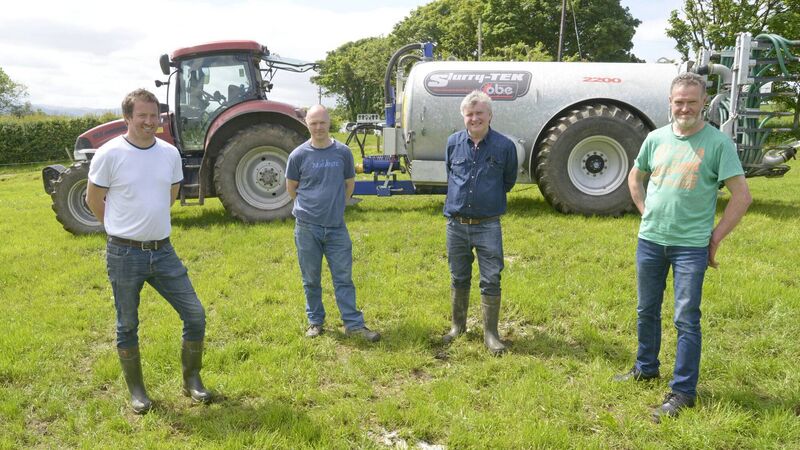
Colm Kellleher, Patrick McSweeney, Brendan Hinchion, and John Wood, the four founding farmers at the launch of Comharcummann Gleann na Laoi, Ireland’s first farming machinery co-op, are pictured with their first purchase in Cill na Martra, Co Cork. Picture: Denis Boyle.
Access to more modern and efficient machinery at a lower cost to the member: large modern machinery is beyond the financial scope of the average individual farmer, and is a major cost for agricultural contractors.
- The cost of machinery is shared through the co-op structure and reduces the financial burden on each individual member.
- Access to machines that are only occasionally used on a farm: For example, a stone cart for land drainage, post driver, or a cattle trailer.
- Collaborating with other farmers can ease the workload at busy times: The machinery co-op structure encourages farmers to work together and help each other out in times of need.
It also has the ability to hire full-time employees to work across a number of farms in the co-op.
This benefit can also reduce rural isolation even on busy farms by increasing social interaction through the co-op.
: the co-op sets high standards in the safe use of the machinery, with compulsory training courses in the correct and safe operation of the machines.
It also includes an annual NCT of the machine by the machinery dealer, and on-going safety checks before and after use by the farmer members.
This approach empowers the farmer members to take personal responsibility for the safe use of the machine.
: Access to more modern machinery has many environmental benefits.
Technology advances can ensure reduced compaction of soils and less carbon dioxide release during routine tillage operations.
In livestock farming, the use of low emissions slurry spreading (LESS) equipment can help to reduce ammonia losses to the atmosphere.
This has the added benefit of helping the farming sector to reach 2030 carbon emissions and ammonia targets while also reducing fertiliser costs, as more nitrogen is retained in the soil.
: membership of a machinery co-op can reduce the set-up costs for young farmers starting out, as they can prioritise their available set-up capital for livestock and farm infrastructure rather than machinery.
The Department of Agriculture, Food and the Marine has included registered machinery co-ops under the Targeted Agricultural Modernisation Scheme (TAMS II) as eligible applicants for LESS equipment and for various machines under the tillage scheme.
In order to set up a co-op, a group of at least seven members must come together with a common purpose in mind.
Two documents are required:
- A machine-specific sharing agreement: This first, critical, document is a set of rules created by the members themselves for the purchase, usage, and maintenance of the machine;
- The co-operative statutory rule book: members must create a rule book to satisfy Irish and international regulations that govern co-ops. The Irish Co-operative Society (ICOS) has created a rule book specially tailored to the needs of machinery co-operatives.
At the launch of Comharcumann Gleann an Laoi, Darragh Walshe from ICOS said: “The co-operative model in Ireland has experienced significant success in the agricultural sector and ICOS is constantly exploring ways in which the model can serve farmers.
“This work has become increasingly relevant amid the challenge of climate change and the co-operative model offers the agricultural sector the opportunity to meet a challenge such as climate change and maintain sustainable, self-sufficient livelihoods.
“Self-sufficiency and sustainability are at the heart of co-operative values and Comharcumann Gleann an Laoi machinery co-operative delivers on both of these metrics. Comharcumann Gleann an Laoi is a superb demonstration of the co-operative model’s capacity to provide solutions in a broad range of areas throughout the agriculture sector and beyond.”
Decisions are made on the basis of a democratic voting process and each member has one vote in any decision regardless of the number of shares they own in the co-op.
A board must be formed and members of the co-op must elect a chairman, secretary, and treasurer to run the co-op on an on-going basis while also implementing the rules of machinery sharing as created by the members.
A co-op is registered with the Friendly Societies Register, which is maintained by the Companies Registration Office.
It is a corporate entity that enjoys limited liability in the same way as a limited company.
Co-operative finance Based on the individual usage of the machine, the co-op will hire the machinery to the members.
The members will contribute up to 20% of the machine purchase price as share capital. The capital is also proportionately divided based on usage.
The remaining capital balance is financed with the bank.
The machine is then hired by the members who have invested share capital for a fixed fee per unit of measurement (per day, per hour, per load, per hectare).
The rental fees ensure that the co-op will have funds available to repay bank loans, cover running costs including repairs and maintenance, depreciation of the machine, and administration costs.
Donal Casey of Bank of Ireland stated that the bank was delighted to support the innovative machinery co-operative with its first investment.
“The availability of Dairyflex through Dairygold enabled the co-operative to access finance for the slurry tank at 3.55% unsecured.
“Dairyflex has now been extended to seven co-ops nationally, equating to greater than 50% of dairy farmers in Ireland.
“Investment in low emissions slurry equipment is one of many actions farmers can take in making their contribution to lowering emissions from agriculture and we are delighted to support any investment that improves the overall sustainability of food production.”
Machinery co-ops have been included as a business structure that is eligible to apply for grant aid in respect of LESS equipment and also under the tillage scheme.
The application by the co-op is made using a reference number that can be obtained from the TAMS II section of the Department of Agriculture, Food and the Marine (DAFM), Johnstown Castle, Co Wexford.
Oliver Molloy from the Dept. of Agriculture said DAFM are pleased to be able to provide support to the Comharcumann Gleann an Laoi co-op.
“Initiatives like this machinery co-op can provide an important framework to help support collaborative farming structures.
"We would like to acknowledge the work and effort that the co-op members and Teagasc have committed to establishing the co-operative and hopefully it will provide inspiration for others to do likewise.”
To set up a machinery co-operative, the following steps are required:
- Identify an existing discussion group (or a group of like-minded farmers) with at least seven members who are committed to the formation of a machinery sharing co-op;
- The farmers in the group must identify a common need in terms of machinery use Identify a key influencer within the group to drive the process forward;
- Start with one project, one machine. The group defines a bespoke rulebook for use of the machine by members, the rules are enforced by the co-op chairman;
- Complete the ICOS business plan template;
- Create a financial plan based on usage of the machine (estimated usage in hectares, volume, kilometres, etc by each co-op member);
- Share capital contribution (Between 5% and 20% of purchase price, the total is divided by proportional usage by members);
- Project co-op income in rental fees, repairs and maintenance costs, loan repayments, depreciation, and admin costs;
- Engage with ICOS to create a legal framework for the co-opand register the co-op with the Companies Registration Office (including seven special members forming the co-op board; election of a chairman, secretary and treasurer);
- Engage an accountant to oversee taxation and preparation of annual accounts for the Companies Registration Office.
Thomas Curran of Teagasc says that the help and support received in France was exceptional. Some key people organised visits and technical meetings to learn more about the practical operation of CUMA.
They welcomed the interest from Ireland and encouraged staff to engage with the study visit, provide information, and support as required.