CAP reform deadlines loom as MEPs disagree with agriculture ministers in Brussels talks
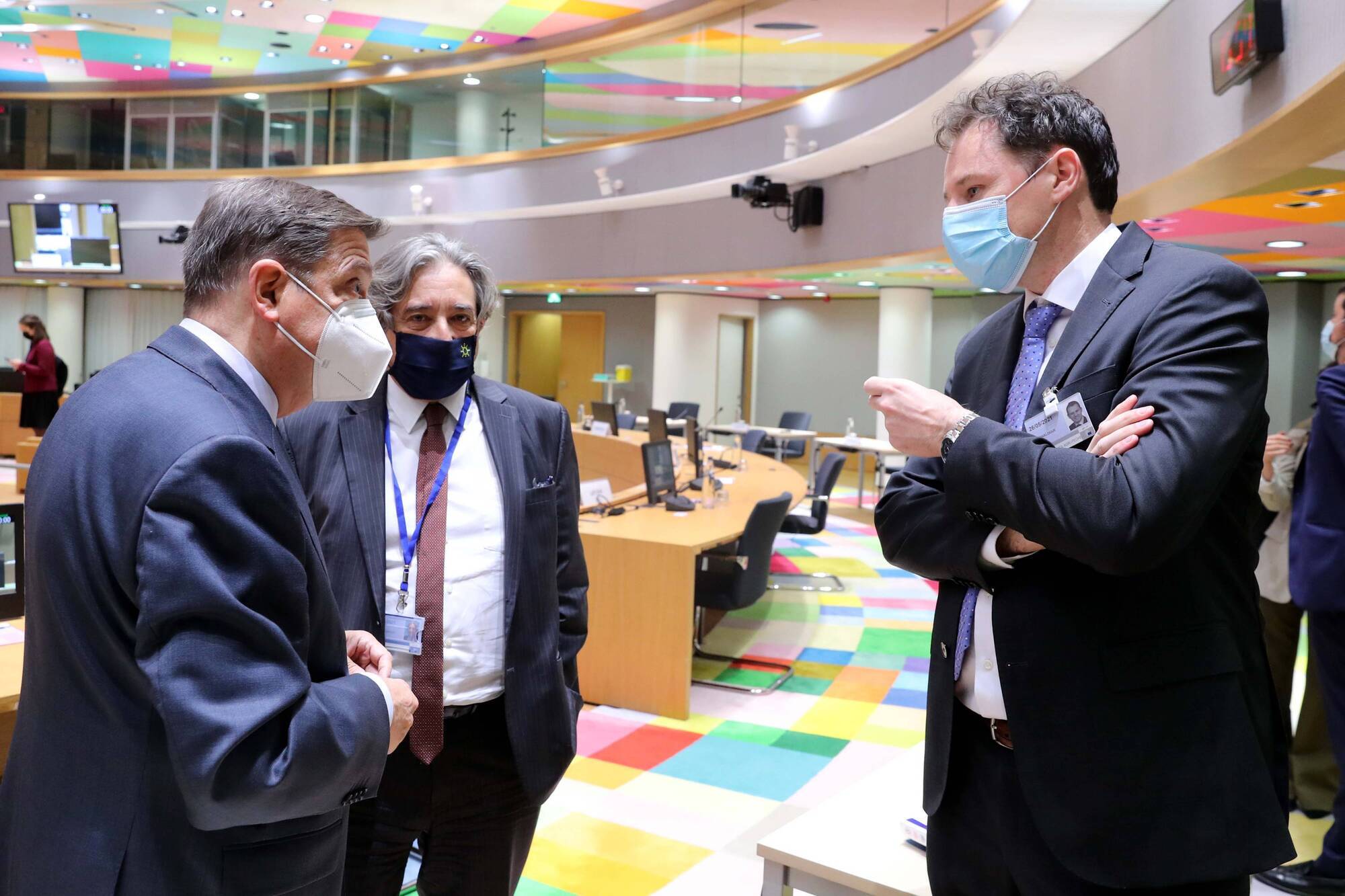
Taking part in this week's EU Agriculture and Fisheries Ministers Council meeting, from left, Spain’s Minister for Agriculture, Fisheries and Food Luis Planas Puchades; Portugal’s Minister of Maritime Affairs Ricardo Serrão Santos; and Ireland’s Minister for Agriculture, Food, and the Marine Charlie McConalogue. Picture: European Union
The odds against progress in Brussels this week towards a CAP reform have lengthened.
Agreement on the reform is required between the member states and the Parliament, in negotiations overseen by the EU Commission.
However, the positions of the member states and the Parliament have moved further apart, with MEPs now united against the Council of member states’ agriculture ministers.
MEPS’ attempts to push “green” ambitions in the CAP reform have met steadfast opposition from ministers, and disagreement remains on many major CAP reform issues.
MEPs have said if they agreed to the CAP reform in its present state, it would only be rejected by the full European Parliament in plenary voting on it.
Either side will have to make significant concessions if talks are to continue into Thursday night, and onto Friday, although negotiations between the member states and the Parliament were originally scheduled only for Tuesday and Wednesday, with agriculture ministers of the 27 member states originally scheduled to finish their monthly meeting this evening.
With €270 billion of spending at stake, the largest single part of the EU’s multiannual financial framework, early agreement was never anticipated, but European Commissioner for Agriculture Janusz Wojciechowski is now coming under intense pressure to knock heads together to agree a reform in time for Member States to prepare their CAP strategic plans by the end of this year. Missing that deadline could lead to delayed implementation of the CAP reform further into 2023.
The Commissioner has called for a compromise to ensure a successful transition to a much more sustainable agriculture in Europe, a stance which puts him more on the side of the European Parliament than the agriculture ministers.
On Wednesday, he tried to reassure ministers that a proposed 10% redistribution of CAP payments to farmers would not be radical, only giving those with up to 100 hectares gains of up to 7%. Farmers over 100 ha would lose slightly, and farmers above 1,000 ha would lose the most (5%), said the Commissioner.
He has also urged member states to be more ambitious on ring-fencing for agri-environmental measures.
But most member states, including Ireland, will fight to give themselves as much leeway as possible to spread EU funds as they see fit, and they have strongly rejected any attempt to force them to impose mandatory capping and redistribution of CAP funds.
On the other hand, the European Parliament insists on capping or redistribution, to make the CAP reform fairer in terms of funds distribution per hectare.
Ireland’s Agriculture Minister Charlie McConalogue has said it is vital for member states to retain as much decision making as possible. He has promised full engagement with all farmers across the country, and with all stakeholders, about what approach Ireland will take domestically, after the CAP reform negotiators decide how much CAP funds will be diverted to eco-schemes, and how much of the remaining farmer income support funds will be subject to convergence (transfer of funds from the higher paid per hectare to the lower paid per hectare).
“It is important that we get as much power to set our own destiny as possible, so that we can engage with everybody’s ideas, and talk to all farmers, then make our own call later this year. First, we will have to see what is the minimum level at European level.“