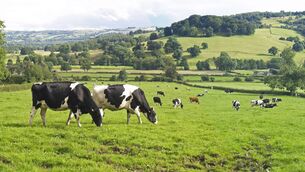
Livestock farmers have got used to submitting photos for Bord Bia quality audits, since in-person farm inspections were ruled out by Covid-19 lockdowns.
Their phone cameras are likely to become an even more important tool, as time goes on, if the work of the Walton Institute in Waterford bears fruit.
The cameras may be fitted with a geo-tagged photo app which is being developed by a multi-disciplinary team made up of the Walton Institute (formerly the Telecommunications Software & Systems Group, formed as part of the Waterford Institute of Technology), Teagasc, and the Department of Agriculture, Food and the Marine (DAFM).
Photo app
The geo-tagged photo app is part of the modernisation of the integrated administration and control system (IACS) which is at the heart of the European Union’s Common Agricultural Policy (CAP).
Administering and controlling payments to farmers under CAP is done through IACS, making it an important cog in the CAP’s support for farmers.
The app will be used to resolve CAP payment claim queries, by enabling farmers to send digital photos of their land parcels directly to the paying agency (which is the DAFM in Ireland), which will reduce the need for inspections, and accelerate claim processing.
Development of the app is part of the three-year NIVA project to deliver digital solutions that will ultimately reduce the heavy CAP administrative burden for farmers and paying agencies.
“Our app is one of nine innovations in this project, with different countries working on each,” said David Hearne of the Walton Institute’s Creative Design Unit.
“Other areas include decision support systems, machine data, and a solution for simplifying payments, but in the end they will all come together in one ecosystem, which will be used by paying agencies across Europe.”
Although it won’t be the first geo-tagged photo app on the market, Hearne explains that what sets this one apart is the user-centric, multi-actor design.
“We take the approach that we don’t know what the users want.
“We can’t decide what’s best for a farmer in the west of Ireland who needs to send a photo to the Department of Agriculture.
“So the project started by gathering data about the needs of all stakeholders, not just in Ireland but across Europe.
“It’s an iterative process, so when we’d developed the first version of the app, it was tested by users across Europe, and their feedback informed the next iteration, and so on.
“The fact that farmers and other stakeholders have been involved from the beginning gives them a sense of ownership, and that should result in a higher adoption rate at the end,” says Hearne.
“Currently, our app is being tested across nine EU countries with over 200 users, and other solutions being developed under NIVA will likewise be tested across different countries, so there’s a lot of interaction, integration and learning across the project.”
“It’s a great opportunity to be involved in projects that can actually change people’s lives.
“With NIVA, we’re reducing the burden on farmers, so we’re making a difference.”
The NIVA (New IACS Vision in Action) project has received €10.5m in funding from the European Union’s Horizon 2020 research and innovation programme.
There are 27 partners in the NIVA project, led by Wageningen University & Research in the Netherlands.
No obligation. Ts&Cs apply.