Growers’ spokesman says Ireland on course to fall from 11% to 10% afforestation
Forestry slump setback for climate action
Growers’ spokesman says Ireland on course to fall from 11% to 10% afforestation

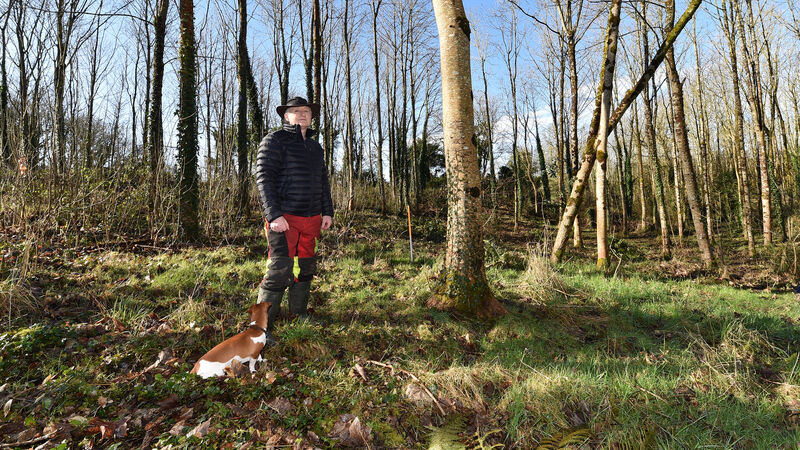
Simon White, Chairman of the Limerick and Tipperary Woodland Owners, in an ash plantation in Co Limerick next to a 25-year-old ash tree affected by ash dieback disease. Picture: Dan Linehan

A forest growers' spokesman warns that Ireland's 11% land coverage with trees will fall to 10%.

"At this rate, instead of increasing our national tree cover from 11% to 17%, which is our aim, we will end up with less than we have now, about 10%," says Simon White, chairman of the Limerick Tipperary Woodland Growers, which works with the Forest Owners Co-Operative Society (FOCS) and other grower groups and stakeholders to lobby for the forest industry.


“We are now 21,500 hectares short of the 32,000 hectares, at 8,000 hectares per year, that should have been planted," says Mr White, who used to have milking cows on his 200-acre farm at Askeaton, Co Limerick, but moved into forestry 30 years ago.

He says that aside from the country’s climate action targets being missed because of the Irish forestry slowdown due to a licensing logjam, there are very real concerns among forest owners regarding tree pests that could come in on imported timber.

“We have a lot of pathogens coming in and, of course, there is also a beetle that threatens the health of our spruce trees. Our industry is based on our conifers,” he added.

“All the conifers are at massive risk if this beetle comes in.

“The beetle lives under the bark, so any lumber coming in from abroad is a risk, if it has bark on it, and so much is coming in from all over the world at this stage that the risk is enormous.

“There is also a pine blight in Ireland, which is a disease that came in.”

He says, “We should be planting 8,000 hectares per year, and we need 5,000ha per year just to keep the 11% of our land that is forested in Ireland. 11%, and when you compare that to 30% of Europe covered in trees, 28% in the UK, we are down the bottom of the list.

“The one area that will make a massive difference to Ireland’s climate action is by having more trees to sequester carbon, providing more habitats, filtering pollution, and producing oxygen.

“We planted 3,500 hectares in 2019, last year it was 2,500 hectares, and this year, nothing has been planted at all so far.

“Trees sequester carbon, and when trees are cut down and used in the construction industry, it means they sequester carbon in homes.

“Farmers need to realise that the only way they are going to balance carbon emissions is to plant more trees, they are under real pressure with that.

“This is the last chance for Ireland, we need political will more than ever to get out of this crisis.

“Somebody is going to have to take the bull by the horns and sort this out.”

Mr White says Project Woodland, the Department of Agriculture’s renamed  and revamped approach to its forestry work, may not be enough to alleviate the difficulties the Irish forestry industry finds itself in.

“We are in an unprecedented crisis in forestry. Involved in this crisis are the issues of ash dieback, the unacceptable importation of huge quantities of lumber which pose an incredible pest risk to our growing forests, and a myriad of forestry schemes, designed in the last century, that are no longer fit for purpose and are causing private landowners to decide against planting trees,” said Mr White.

Why? 

“Because the terms and conditions are so unattractive. Project Woodland ignores these immediate problems. Both the Oireachtas Agriculture Committee, and Jo O’Hara [the consultant whose recent report on forestry licensing is reflected in the Project Woodland approach], have alluded to the need to address these issues, and yet, both ministers have done absolutely nothing to sort out these problems.

“They have been made aware of the issues by so many different stakeholders, and time is running out.

“We now call upon the Taoiseach to lead and direct his ministers to address this crisis, before it deepens.”

More in this section

Farming

Newsletter

Keep up-to-date with all the latest developments in Farming with our weekly newsletter.

Cookie Policy Privacy Policy Brand Safety FAQ Help Contact Us Terms and Conditions

© Examiner Echo Group Limited