There are support schemes to help your business get through the pandemic
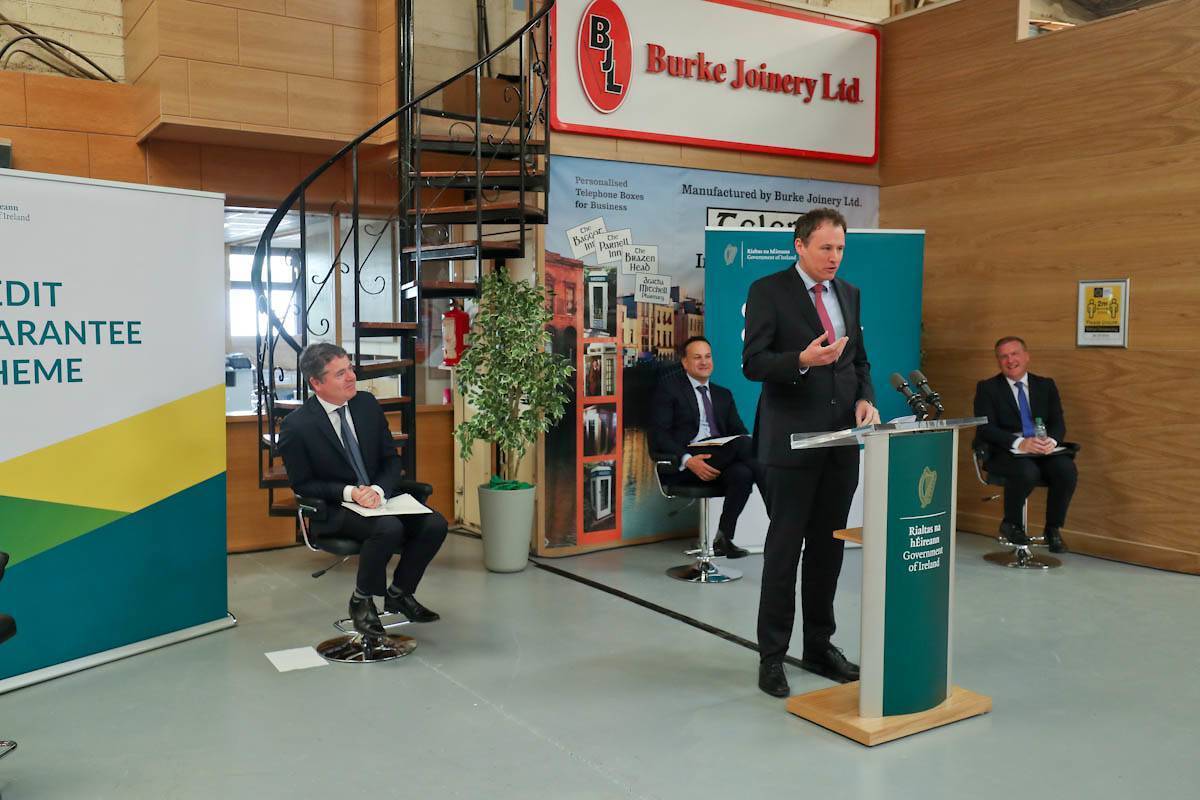
Tánaiste Leo Varadkar and Ministers Paschal Donohoe, Michael McGrath and Charlie McConalogue at the launch of the €2bn Credit Guarantee Scheme, one of the many Government schemes to help businesses survive Covid-19.
A range of supports continues for businesses, including the Employee Wage Subsidy Scheme, Debt Warehousing, and CRSS, as well as the Covid-19 credit guarantee schemes. Here is an outline of some available schemes.
The EWSS provides a flat-rate subsidy to qualifying employers based on the numbers of eligible employees on the payroll.
It provides up to €410 per week per employee, where an employer’s business has been impacted by Covid-19 to such a degree that the turnover and projected turnover for the six-month period to June 2021 is at least 30% below that which was achieved in the six-month period January to June 2019.
An employer must register in advance for the scheme, it is not possible to backdate applications. An employer must maintain tax clearance during the period of application.
Employers also benefit from a reduced rate of PRSI, at just 0.5%, as opposed to the standard rate of 11.05%.
Employers must continually assess whether they qualify for the scheme and, if turnover is likely to breach the prescribed limits, employers should consider deregistering from the scheme.
This scheme allows businesses to park their PAYE (employer) and VAT liabilities, where their businesses had to close as a result of the current level 5 public health restrictions. Debt warehousing means the liabilities are parked for a period of time, interest-free; that Revenue will not seek payment or enforcement of such liabilities; and that a “super-reduced” rate of interest applies on these debts, at 3%, after the moratorium ceases.
There are effectively three distinct periods, for the scheme rules. Period 1 is the restricted trading period (a time at which a business experienced cashflow difficulty, or temporarily ceased trading, as a result of Covid-19 restrictions).
Revenue debts of VAT and PAYE incurred in this period and in the following two months after restrictions are eased is available to be parked.
Period 2 is the 12 months following period 1, the year in which no interest will apply to VAT and PAYE liabilities.
Period 3 is the time after period 2, when interest rates kick in at 3%, the period in which a business must look to repay warehoused debt.
If an employer avails of debt warehousing for PAYE (Employer) liabilities, a proprietary director cannot claim credit for PAYE deducted, if it was warehoused, and not paid.
As such, the PAYE due becomes part of that director’s income tax liability when filing their tax return, albeit there may be some changes to this position, in light of Revenue’s on-going review of the scheme.
The Covid Restrictions Support Scheme (CRSS) offers support to businesses forced to close or to trade at significantly reduced levels due to restrictions imposed on them due to Covid-19. The business must have been required to prohibit or considerably restrict customers from accessing their business premises.
Eligible businesses can make a claim to Revenue for a payment known as an Advance Credit for Trading Expenses (ACTE). An ACTE is payable for each week a business is affected by the restrictions.
The ACTE is subject to a maximum weekly payment of €5,000. The ACTE is equal to 10% of the average weekly turnover of the business in 2019, up to €20,000, plus 5% on turnover over €20,000.
In the case of new businesses, the turnover is based on the average weekly turnover in 2020. The ACTE is subject to a maximum weekly payment of €5,000.
The Covid-19 Credit Guarantee Scheme will facilitate up to €2 billion in lending to eligible businesses.
The scheme offers a partial Government guarantee (80%) to participating finance providers against losses on qualifying finance agreements to eligible SMEs, small mid-caps, and primary producers.
Loans under the scheme range from €10,000 to €1m, for terms of up to five-and-a-half years. Financing will be offered through a range of products, including term loans, working capital loans and overdrafts.
Loans of up to €250,000 under the scheme are available unsecured (unless this is a requirement of the product feature, as for asset finance, invoice discount facilities, etc).
The initial product supported for the scheme is a term loan.
The scheme is operated by the Strategic Banking Corporation of Ireland (SBCI) through participating finance providers.
An applicant first applies through the SCBI for an approval number and then approaches their preferred lending institution with their approval number. to make a loan application.
The business must have experienced an adverse impact of at least 15% in actual or projected turnover or profit, due to Covid-19. Some farmers will be able to access the scheme, particularly if they were not able to meet projected turnover targets due to mart shutdowns and restricted access to mart facilities. The Covid-19 Credit Guarantee Scheme operates under the State Aid Temporary Framework, scheduled to stay in place until June 30, 2021.
Loans under the scheme must be used for:
n Working capital/liquidity (for example, paying for stock, wages, other overheads).
Investment (such as re-fitting premises, new equipment)
In some circumstances, the Scheme will permit participating finance providers to refinance and rollover finance agreements. For example, under the Scheme, an overdraft or short-term credit facility taken out because of Covid-19 pandemic impacts, could be rolled into a term loan in the scheme. Any provision for potential refinance/rollover must be agreed with your finance provider as part of the initial finance agreement.
Interest rates on scheme loans will depend on individual characteristics such as size of the loan, term of the loan, and profile of each business. However, interest rates are likely to be much lower than traditional unsecured borrowing.
- Chartered tax adviser Kieran Coughlan, Belgooly, Co Cork.
- (www.coughlanaccounting.com)