A ‘hole-in-the-heart’ calf
Many years ago, when I was a young fellow, I decided to follow Leeds United.
We had a lot of interesting and successful years. Alas, the last 15 have not been kind to us. It must be penance for any transgressions I may have committed.
The reason I bring this up is to mention a professional footballer called Asa Hartford.
A very promising young footballer, he was to be transferred to Leeds United from West Bromwich Albion in 1971.
The deal was done, but Asa failed the medical due to a heart condition. Reportedly, he had a “hole in the heart”.
The deal collapsed, but eventually he moved to another club. His career blossomed,and he went on to win 50 caps for Scotland. So his medical condition obviously did not do him any harm.
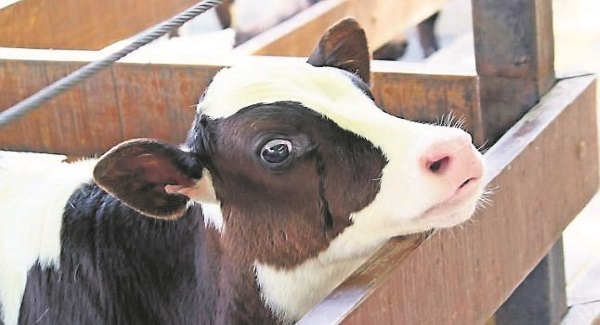
I mentioned Asa Hartford to a client of mine recently, having examined a calf for him. He had a number of calves coughing during the same visit, but he showed me this particular calf who was panting like the clappers. He revealed he had previously given this calf some antibiotic that he had left over, but the treatment seemed to have no effect.
During the examination, I noticed this calf had a temperature on the low side of normal, and that his lungs sounded congested. When I listened to his heart, I discovered the reason for all this. There was a sizeable murmur. I explained the situation to my client and introduced him to the story of Asa Hartford. I did this to show him that all was not lost yet.
So what is a hole in the heart and what causes it? During development of the unborn calf (or any other animal or human), the unborn calf receives all its oxygen from its mother’s blood.
In reality, the cow is breathing for the calf. This travels in through the navel cord vessels to be pumped around the calf’s body to help it grow, as oxygen is needed for the working of the body.
This oxygenated blood does not need to pass through the calf’s lungs, as they would be unable to add anything to this blood. A very small amount does pass through the lungs, in order to keep the lung tissue alive, but the vast majority of it goes through a shortcut to the main blood vessel, the aorta, to be passed throughout the body.
This shortcut is an ingenious part of nature. It is called the ductus arteriosus. As the calf grows in the womb this vessel grows too, but as it comes nearer the time of birth, this ductus arteriosus starts to close over, so that more and more blood begins to flow through the lungs, and they begin to develop further and prepare for the moment of birth when the calf will have to breathe by itself and oxygenate its own blood.
I am amazed, when I think of this and how nature gets it right every time, well, almost every time. In a very small percentage of cases, the ductus arteriosus fails to close and we have what we call a patent ductus arteriosus, commonly called a “hole in the heart”.
The severity of the clinical signs varies according to the amount of opening that is left but we usually see an animal that is caught for breath, unable to drink as well as it should. The heart rate speeds up to try to compensate for the lack of oxygen going around the body. The calf tends to spend most of its time lying down. Some of these animals are lucky, but the vast majority of them don’t make it.
It is proposed that premature birth may be one of the risk factors for this condition.