Merry Mill has a winning formula with gluten free oats
The Scully family in Laois are the first in Ireland to grow, harvest, as well as mill organic, gluten free oats into porridge and a fine oat flour on the home farm.
I spoke to Kevin Scully of the Merry Mill.
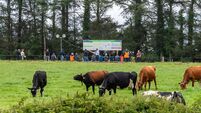
A: We are in Vicarstown, Co Laois. We have a beef enterprise on the farm with Wagyu crosses and Hereford crosses — and also the gluten-free oats business. In all, 15 of our 90 acres are in oats this year.
A: Originally, the oats were to feed the cattle, with peas as a combi crop. Our land is good for oats — oats like moisture, hence the Scottish tradition of growing oats. My land is half wet and half dry. But even back in 1961, the farm here won an award for having the best barley in Laois. So its good land for growing grain. We’ve had tillage since at least my Granduncle’s time in the 1930s.
I’ve been growing oats for 10 years, and I really feel that healthy soil with good bacteria is key — it’s like a plant immune system. The land has been improving year on year. The crop has to get up and get growing, ahead of the weeds. The right nutrients, via well composted farm yard manure — that’s key.
A: Like the Wagyu, it’s about adding value and control over the end product. I’ve also no competitor at present and gluten free is a unique selling point — the main supplier for health food stores is from Canada. The oats retail at €4.19 to €4.50 for 400 grams in shops.
I’m only starting now, but with gluten free organic oats milled on my own farm I’m not competing with either Flahavans or even Kilbeggan oats. We’ve only been selling a few months, but it took four years to get to this stage. I did a feasibility study, business plan, courses and I went to the Czech Republic to look at a mill, before buying a mill from Austria. The design is based on an old watermill and runs at a very slow speed, in order to protect the nutrients. I put it together after retro fitting a shed on farm. There’s a lot of aspects to a mill: aspirators, cleaners, de-hullers, gravity separator table, and de-stoner.
Barra is the type of oat we grow — the hull comes off handy. There are better yielding oats, but it’s a good all-rounder, and very disease resistant. The yield is 1.8-1.9 tonnes to the acre, whereas conventional is three to four tonnes per acre. You loose half the product in the milling, so one tonne of oats produces half a tonne of porridge.
A: An honesty box beside the mill, and the local post office are the first routes — we post out to people. We sell into local health food stores, and we’re moving into cities too.
A: Absolutely. Growing any other tillage crops would be a contaminant for my produce. My rotation is oats and back into grass. I do three years oats and then grass and red clover, for weed control. Grass isn’t a contaminant for oats, in gluten terms.
A: Health and Safety Authority use the EU standard, which is below 20 ppms — parts per million. It’s tested in a lab. I’ve full control over the process from start to finish. I have my own combine and mill, we grow and pack it here; everything is controlled — you can’t outsource anything. To get the classification below 20 parts per million is hard — you’d only need 20 rogue grains. My tests are typically below five ppms, the machine can’t read any lower.
For further info, email — themerrymill@gmail.com