Beef marts: Beef processors in a very strong pricing position
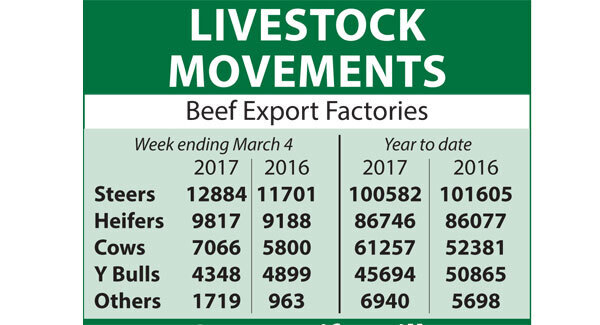
The supply last week continued to deliver over 35,800 head to factories, a very high level for early March.
It is never easy for farmers to bargain hard with processors on price, when the supply remains well over the long standing benchmark of 30,000 head, where it has been for most of the year to date.
There has been very little movement in prices at the factories for this week.
The base for steers continues to be quoted at 375-380 cents/kg.
It is hard to accurately gauge the breakdown of prices across that range.
Generally, a higher percentage of steers supplied to processors in the south of the country are understood to be priced towards the lower end of the price range, with the reverse applying further up the country.
As usual, heifer prices are a shade stronger than steer prices, with very few being bought for less than 390 cents/kg, and some finishers successfully negotiating deals for a few cents/kg above that.
Nevertheless, given the strength of the intake, processors are in a very strong position to keep a tight rein on prices.
The vibes from the cow trade continue to be more positive, with a firm trade and good levels of demand.
The base range for O/P-grade cows is 315-320 cents/kg, and the heavier R-graders are making up to around 345 cents/kg this week.
The latest retail sales figures for beef in the UK showed that volume sales were up 3% for the quarter to the end of January, due to shoppers purchasing beef more often, and average value increasing marginally.
In the UK, the cattle trade has eased again over the past week, with strong supplies reported, and the demand best for in-spec cattle.
Prices for the R4L-grade steers averaged equivalent to around 440 cents/kg (when VAT is included), at an exchange rate of 85.4p sterling for €1.
In France, the market has depressed due to low demand, which being met mostly by sufficient domestic supplies.
In Italy, the market remained relatively stable last week.
In Germany, demand remained strongest for cows, while the trade for young bulls eased on the back of strong supplies.