News Q&A: How to improve drainage capacity and lifespan
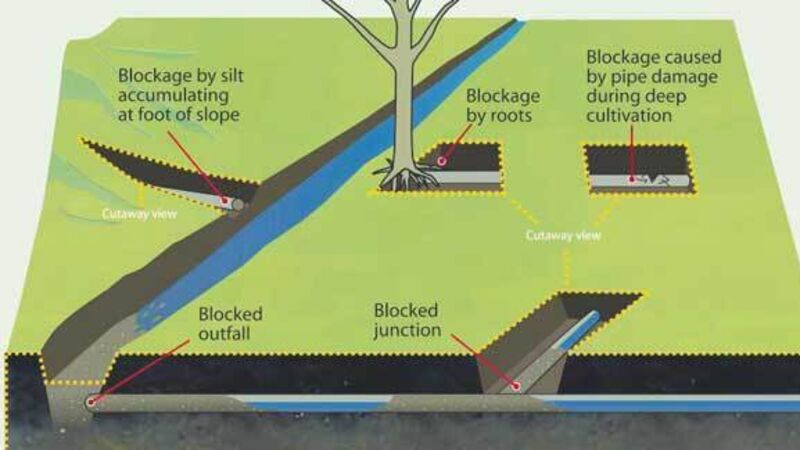
Teagasc advisers recommend that a maintenance plan should be adopted following the installation of any drainage system.
Maintenance vastly improves the capacity and the lifespan of the drainage system.
A regular maintenance programme should include assessment of the whole network, focusing in particular on likely areas for blockages (see graphic above), and on adequate upkeep.
To protect fish eggs and small salmonids, maintenance of open drains likely to contain these species should be carried out between mid-May and mid-September.
Hedgerows adjacent to drains should not be cut between March 1 and August 31.
The performance of drainage systems will deteriorate over time, due to a variety of blockages.
Fine soil particles: Silt and clay particles are many times smaller than aggregate or pipe slits, they can enter pipes and settle, in low flow conditions.
Iron ochre deposits: These are predominantly “rust”, and occur naturally in certain soil types.
Plants and their roots can thrive in open channels, at the pipe outlet, and deep within the system.
Collapse/sedimentation of open drains, due to flow conditions, undercutting of banks, or livestock damage.
Clean and upgrade open drains before field drain installation, to ensure good outfalls and consistent flows.
Use simple layouts with few junctions, use manholes as access points. The upstream end of field drain pipes can be brought to the field surface and capped to allow access.
Mark the locations of field drain outlets and manholes in the field and on maps, to help locating them afterwards.
Always use pipes, to allow for maximum water flow and for maintenance by jetting/rodding.
Ensure the aggregate used above the pipe is washed and 10mm-40 mm in size.
At present, there is no evidence to suggest that membranes help, on top of aggregate, or around pipes.
Open drains should conduct surface water during rainfall, be deeper than in-field drains, and where possible, should drain groundwater all year round.
Open drains should be clean, and as deep as possible, with a graded profile.
The bank slopes of open drains need to be appropriately graded to prevent collapse.
If such grades cannot be achieved, then piping of new open drains may be necessary.
When cleaning open drains, take care to protect field drain outlets from damage. Spoil from such works can be spread on adjoining land, but must not impede water.
Jetting is an efficient way of cleaning piped drains.
A hose fed through the pipe washes and flushes sediment, iron ochre and debris from its internal walls, perforations and adjacent stone fill.
Some models can extend to 300m up the pipe.
Rodding is a more labour intensive and less effective alternative.
This information comes from a leaflet produced by the Teagasc Crops Environment and Land Use Programme, and Animal and Grassland Research and Innovation Programme, which can be downloaded from the publications section of the www.teagasc.ie website.
A free downloadable practical guidebook to land drainage is also available via the Teagasc website (search for “Land Drainage”); and the Teagasc Manual on Drainage and Soil Management is available from Teagasc offices or can be ordered via the website.