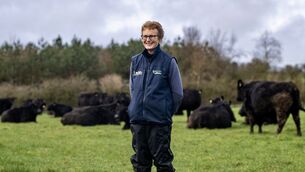
Stephen Cadogan: EU has cleared way for each member state to help farmers

Not too many people are in farming for the money. And they are certainly not in it for a steady income.

Stephen Cadogan: EU has cleared way for each member state to help farmers

Statistics for average farm income in 2015 show German farmers earned 66% less than their average income for the previous five years, and 75% less than in 2013.

Farmers in Finland earned 70% less than their average for the previous five years, and 64% less than in 2013.


The income slump is 58-65% in Denmark, 51-65% in Slovakia, 16-22% in Luxembourg, 26-32% in the UK, 12-23% in Belgium, 13-19% in Austria, and 12-19% in Poland.

The Eurostat figures show Irish farmers earning 19.5% more than they averaged in the five years before 2015.

However, as if to emphasise the unreliability of farm incomes, it looks like the average Irish farm income will take a dive in 2016, dragged down by low dairy income.

Dairy farmers here can only console themselves with the knowledge that things are even worse in other, usually more prosperous member states.

Commenting recently on the farm income crisis across the EU, Mairead McGuinness, a Vice-President of the European Parliament, said: “There is something very rotten in our society today if those who produce food are so desperate on their farms that they are committing suicide.

“We do have to ask ourselves what state we are in that we have to eat food three times a day and those who produce it are so desperate.”

How hard it is for society to reward farmers is also being demonstrated in the US.

Their Farm Bill spending will be $956 billion over the next ten years, including $130 billion for crop insurance and commodity programmes, to protect farm incomes.

Nevertheless, US income from farming has fallen by 50% in the past two years, having peaked at historically high levels in 2013, with the billions of government spending not providing much of a safety net.

In his recent review of farm income trends, CAP reform expert Alan Matthews says the average EU farm income figure across member states and farming systems has proven remarkably resilient, with the 2015 figure close to the average level in previous years.

However, that’s no use to farmers in the member states where incomes have diverged wildly from the EU average — states such as Finland, Germany, Denmark, Slovakia, Luxembourg, the UK, and Austria.

Mr Matthews says it seems clear from these figures that help for farmers whose incomes have been slashed is better coming from the individual member states rather than the EU as a whole.

And this is the rationale behind the decision at the March 2016 Agricultural Council to allow a temporary acceptance of state aid that would allow member states to provide up to €15,000 per farmer per year.

That decision also seems tailor-made for our own Government to introduce and agri-taxation tool like the ICOS “5-5-5” scheme, while respecting EU state aid rules.

ICOS is looking out primarily for our dairy farmers, who are enduring the fourth significant downturn in the global dairy market since the removal in 2005 of comprehensive EU market support.

Since then, external forces such as weather, geopolitical matters, currency, feed and oil prices, disease and macroeconomic factors conspired to cause dairy income volatility.

ICOS says better EU support, more fixed price schemes, and a European dairy futures market are also needed to protect dairy incomes.

The milk price in recent years ranged from 25 to 40c/l. For an Irish farmer producing 400,000 litres of milk annually, with the current income averaging system, his income ranges from €8,170 to €56,170 across the milk price range. But the ICOS proposed “5-5-5” scheme would narrow that income range to €23,170-48,170.

An Irish government adopting this proposal could be the first to solve the global enigma of unreliable farm income.

Or if it wants to use a model already working well elsewhere, our government could opt for the Australian-style Farm Management Deposits Scheme, which is supported by ICMSA, now that the EU’s State Aid rules stumbling block has been removed.

Without such a measure, warned ICMSA this week, income volatility is wrecking dairy farm incomes and posing a terminal threat to our family farms.

More in this section

Farming

Newsletter

Keep up-to-date with all the latest developments in Farming with our weekly newsletter.

Cookie Policy Privacy Policy Brand Safety FAQ Help Contact Us Terms and Conditions

© Examiner Echo Group Limited