Huge, 937-acre forestry holding sold in Co Kerry
“All I can say is that it is healthily above the guide price.”
So says Edinburgh-based selling agent, Patrick Porteous, of UK forestry specialists, John Clegg & Co, of a 937-acre (379ha) forestry land portfolio in Kerry that he is selling jointly with Ganly Walters.
He is tight-lipped about the agreed sale price. The price quoted is €1,400/acre, (€1,375,000), so it’s unsurprising that it would be comfortably exceeded, given that forestry land is regularly achieving €4,000 per acre — even for an offering of this size.
This holding vastly exceeds the average forestry land parcel (about 8ha) in Ireland, and such larger sizes could become more common.
Private ownership of forestry land in Ireland is rising steadily and is at 47%.
It’s still an underdeveloped market, compared with most other countries in the EU, and although we’ve never had so much woodland in 350 years, the current rate of 11% of total national territory is still well below the 17% that experts consider will be needed to have a domestic, international-scale forestry industry.
“In the UK — and in Scotland, in particular — we would be used to trading in larger-scale properties,” says Patrick, speaking from a country where the average forestry-land sale is 150ha
“We got a lot of interest for this property — quite far and wide across Ireland, and we had a bit of interest from the UK, as well, and a little bit from the Continent. It was quite well-received and it just reflects how popular an investment forestry is just now.”
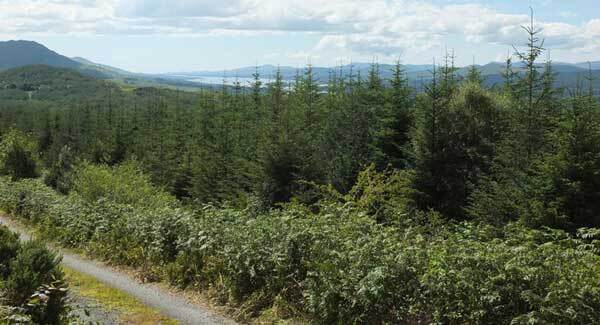
The total holding is spread over a broad area in Co Kerry — mostly between Killarney and Tralee, in four separate lots in the townlands of Curraghmore West (318 acres), Goulnacappy (279 acres), Gurtnacurra and Gooragweanish (217 acres) and Derrylahan (123 acres).
Sitka spruce is the predominant species, but there is also a variety of other species, including Lodgpole Pine and Japanese Larch.
The property is managed by Lissarda Forest Limited. All the lots come with sporting rights, with the potential for the development of woodcock hunting and deer-stalking, as well as the possibility of trout fishing in the Goulnacappy portion (Lot 2).
As we’re talking about elevated sites in the Kingdom, most of the lands are in stunningly beautiful locations.
The lands were planted over a ten-year period, between 1987 and 1997, with the 318-acre Curraghmore West parcel being the oldest plantation.
“Forestry has always been quite a safe investment, because it always has a longer-term growth cycle and, at any stage during the term, you can value it and sell it on in the marketplace… Obviously, you’re not going to sell it until it’s mature, but it does have a value at every stage.
“Investors like the idea, because it’s got various tax advantages. It’s a market that’s continuing to grow: Globally, timber is increasing in demand, with an increasing population. There’s a lot more timber being used now in buildings.”
Patrick says that the consumer market is also valuing a lot more of the “lower-grade product” that used to get left on-site.
Forestry prices vary greatly, according to the nature and number of interested parties, Patrick says: “Some people are looking for a 2% return and some are looking for a 5% return, and that will affect how much they can bid for it.”
The identity of the buyer is unknown. Going by the numerical advantage of queries (including a lot of representatives of Irish unit funds, according to the agent), it is most likely to be Irish buyers, and all that is known at this point is that they have Irish representation.