Q&A: ICOS 5-5-5 plan to protect dairy incomes, Martin Keane, ICOS
ICOS President Martin Keane said, “We have devised the “5-5-5” scheme in order to comply with EU state aid rules and we urge the incoming Government to address this matter in the programme for government and budget 2017.”
He said the co-op movement supported the milk price in 2015 to the tune of €100 million.
“However, the ball is now with the incoming Government to play its part by introducing a practical and worthwhile agri-taxation scheme such as the ICOS 5-5-5 Income Stability Tool.”.
At the 5-5-5 launch, ICOS Dairy Committee Chairman Jerry Long said, “It’s deeply frustrating to experience another damaging market downturn without appropriate agri-taxation measures in place to help dairy farmers.”
“The 5-5-5 scheme will allow a dairy farmer participating in income averaging during a good year to defer a modest amount of income into a recognised fund, in order to draw down this income during periods of low milk prices.”
“The ICOS 5-5-5 scheme aims to improve the current income averaging system, which can have negative consequences for farmers when profits are falling.”
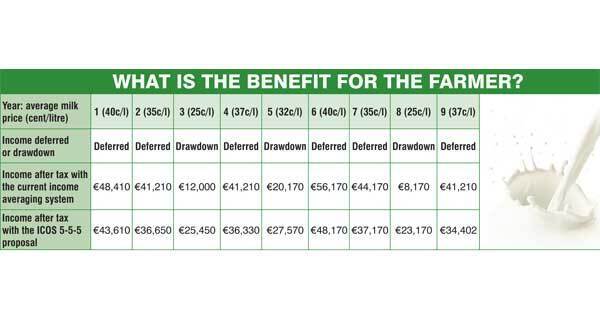
What is the benefit for the farmer?
The ICOS 5-5-5 Income Stability provides a significant levelling effect, especially during years of low milk price.
The taxation scenario outlined above is a new farmer, married with three children, producing 400,000 litres of milk annually, with income averaging starting in year five of this nine-year scenario, during which the milk price ranges from 25c/l to 40c/l.
The impact of the ICOS proposal is clearly evident in years three and eight, with a low milk price of 25c/litre in both these years.
The volatility under the current income averaging system ranges from €8,170 to €56,170 over nine years. The volatility under the ICOS proposal ranges only from €23,170 to €48,170.
Is five-year income averaging not an appropriate agri-taxation measure, which is already in place, to deal with income volatility in the farming sector?
Income averaging was previously available over three years, and in Budget 2015, was extended to five years.
In reality, income averaging is tax averaging. Income averaging as currently conceived derives a benefit by ensuring that participating farmers aren’t forced into paying excessively high rates of tax in any one year.
The tax benefits will arise where profits are increasing. However, these benefits will be clawed back when profits are falling.
Therefore, there is a fundamental weakness in income averaging as a volatility tool, which the ICOS proposal is seeking to address.
Did the Agri Taxation Working Group which reported in October 2014 not discuss the possibility of introducing an income deferral tool?
The Agri Taxation Working Group reported in October 2014, containing 25 recommendations.
ICOS actively participated in the development of these recommendations. Subsequent budgets delivered tangible and positive taxation measures for the farming sector.
However, income volatility did not receive sufficient attention.
The main farming stakeholders, including ICOS, fully supported the introduction of an income deferral tool, as operated in other regions such as Canada and Australia.
However, the Government raised concerns that a measure similar to the Australian Farm Management Deposits Scheme would be incompatible with EU state-aid rules.
That said, the working group report recommended that a risk deposit scheme be kept under review.
Is the 5-5-5 proposal state aid compliant?
ICOS believes that the proposal fully complies with existing EU state aid rules.
EU state aid rules recognise that in some circumstances, government intervention is necessary for a well-functioning and equitable economy.
Exemptions for government intervention are outlined in the Agricultural Block Exemption Regulation, which permits the adoption of the various rural development measures, for example.
In addition, the De-Minimis Regulation permits the granting of aid to farmers to the value of €15,000 over three years.
The De-Minimis Regulation was used in 2015 in order to adopt the super-levy Deferral Scheme.
For the purposes of the super-levy scheme, the interest relief is regarded as a state aid. ICOS believes that this establishes an important precedent for the ICOS 5-5-5 scheme.
We believe that the interest benefits of the deferred taxation would be a state aid. Therefore, the ICOS proposal would fall under the De-Minimis Regulation.
Why 5%, is this connected to EU state aid rules?
5% is a modest figure, but delivers a significant benefit. The resultant fund which a farmer can build up at any one time is never excessive.
This will ensure that the proposal complies with the €15,000 limit over a three year period under the De-Minimis Regulation.
For example, depending on the point in the volatility cycle, the state aid benefit of the 5-5-5 proposal could be the interest value of €20,000 at 3%, which is well under the 15,000 threshold.
Furthermore, the inclusion of a modest figure such as 5% will ensure that a farmer’s De-Minimis threshold is not fully exhausted by one support measure such as income deferral, providing the Government with the flexibility to continue the provision of emergency support, if needed, such as the fodder aid scheme in 2013.
Will this measure solve income volatility in the dairy sector?
This measure on its own will not solve income volatility within the dairy sector, but can play an important role in terms of helping farmers to manage the worst extremes of volatility.
ICOS supports the adoption of a suite of measures to tackle income volatility affecting Irish dairy farmers.
This includes enhanced EU support tools, greater use and uptake of fixed price schemes, development of a European dairy futures market, and the use of agri-taxation.
ICOS believes that use of agri-taxation is a highly important tool, which the Government can introduce while respecting EU state aid rules.