Young farmers’ need for knowledge showcased by new EU report
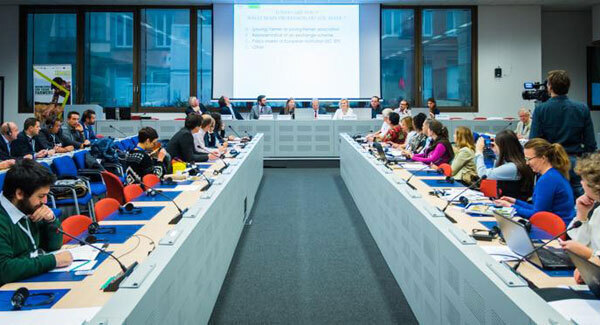
The report aimed at young farmers has 40 years as its cut-off point.
And there I was, a young man of 45, still clinging to the idea that I was wet behind the ears, when clearly, as far as the commission is concerned, I’m past it.
It’s a bitter pill to swallow, and one I will have to take up with Phil Hogan the next time I trundle across his path with my Zimmer frame.
But forge ahead we must, for time is passing me by, as I know all too well now.
The aim of this report, in which 2,205 young farmers were interviewed in all 28 EU member states, was to highlight the needs of young farmers, including their need for knowledge.
It sought to provide an overview of existing exchange schemes available for young farmers, with the objective of improving such schemes.
The availability of land either to buy or rent was confirmed in the report to be the most important need of young farmers, not only in Ireland but across the EU today.
Ireland’s young farmers see the issue of access to land as more problematic than their European counterparts.
Nearly three out of four here said they have difficulty in obtaining land, a similar proportion to the UK, Germany, the Baltic states, Hungary, Slovenia, and the Czech Republic — but less than Belgium’s 82.3%.
In most other countries, only 50%-60% of young farmers find it hard to get hold of land; but it’s a problem for less than 40% in Denmark, Poland, and Austria, and for only 33.8% in Italy.
Funding the purchase of land was also cited as a problem in the report. Difficulty in accessing credit was highlighted not only for young farmers here in Ireland but right across the EU.
In Ireland’s case, participation in workshops, joining a study group, and the ever popular discussion groups, were considered more important ways of gathering knowledge than for other young farmers in the EU.
The 75 interviewees in Ireland had already achieved a high level of vocational education (84% with BSc or higher qualification, compared to only 43.9% in the EU).
Agricultural advisers, veterinarians, and research institutes were also considered to be more important here for young Irish farmers to gather the information they need.
However, seeking out this information from sources like the internet was seen as a less appealing option for young Irish farmers, and this can easily be explained by our dismal internet access.
Even as I piece this article together, my internet connection here in West Cork is hit and miss.
In the EU survey and report, Ireland’s inferior internet services were obvious, with young Irish farmers highlighting a missing or bad internet connection as a real problem in obtaining the knowledge they feel is necessary to run a successful farming enterprise.
Although 71% of Irish young farmers said they search for knowledge on the internet, only 36.6% said they obtain knowledge via e-learning, social media, or e-discussions.
Knowledge on the internet is important for more than 87% of young farmers in the UK, Portugal, Netherlands, Denmark, Latvia, Romania, Croatia, Italy, Bulgaria, and Slovenia.
The e-learning, social media, or e-discussions routes are important for more than 50% of young farmers in Spain, Portugal, Romania, Croatia, and Bulgaria.
Looking at exchange schemes as a way to obtain that knowledge, in general the report showed that young Irish farmers’ awareness of exchange schemes is rather low when compared to other young EU farmers.
Like other young farmers in the EU, Irish farmers who got to participate in an exchange scheme were enthusiastic about them, saying they enhance their networking and management skills.
Nevertheless, young Irish farmers showed less interest in enthusiasm towards exchange schemes.
They highlighted issues like having no replacement staff to run the farm at home, a lack of time, and the language barrier as difficulties they face in exchange schemes.
Although not so well-known in Ireland, exchange schemes in agriculture have existed for more than a century.
Farming by its very nature can be an isolating occupation, but exchange schemes can play an important role by offering those who travel an opportunity to widen their personal horizons, while gaining practical knowledge of farming in different parts of the world.
The importance of the experience of leaving home, of seeing more of the world, and having to fend for oneself, cannot be overemphasised.
On the downside, travel abroad might give some false expectations of life back home on the land.
Living the farming dream in Tuscany for six months is not the same as farming for the rest of your life in wintry West Cork.
I might be old (over 40), but I still have my senses and know that for the past three months, all we have seen here is rain.
Irish farmers young or old often have to work in the mud.
And in this report, I saw no questions regarding young farmers’ attitude towards their working life on the farm.
There were no questions on the work they perform.
Do they perceive it as being dangerous or difficult? No question on their enjoyment of their role as a farmer or on the reasons why they choose a life on the land.
Not much either on the education systems for young farmers. Do they see it as satisfactory for their needs in farming? Nothing either on the isolation that many feel in farm life.
Do young farmers feel isolated or cut off?
There were no questions asked about the long term. Do young farmers see themselves as staying on the farm for the rest of their working lives?
Do they feel any family pressure or responsibility to keep the farm going for the long term? For a report with an aim to document the needs of young farmers, I found a lot of questions remained unasked.
Yes, it is important to be highlighting the needs of young farmers, and while this report is a good start, it’s a long way from offering the complete picture.