Pat Carroll’s robot milking and zero grazing increases output with high-tech dairy farming
The road towards Pat Carroll’s farm, near Rockchapel in north Cork, is dominated by wind turbines and forestry.
It is in not the landscape you would expect around a high-tech dairy farm.
Then you turn a corner on the narrow, grass-centred road, and see white pillars with lush grass in the paddocks.
I had followed the instructions like the man in a recent Eircode advert.
Through the village with the chapel and the GAA hall, the graveyard, a mile and a half before the next turn, and the white pillars.
I had arrived, late as usual, to the home to one of Ireland’s increasingly popular new robotic milking machines.
The soil type of Pat’s 56-hectare block lends itself to zero-grazing.
“Imagine 70 cows grazing that in mid-November, they would have it wrecked,” he says with a chuckle, after meeting me at the patio door in his slippers, and offering a cup of tea.
It is not too many dairy farmers that you call to that have time for a cup of tea and a chat.
The only time issue Pat has is the school run, but that was an hour and half away, leaving plenty of time for Pat to tell me how he plans to go from 72 cows last year to 63 cows next year, but hopes to produce more milk at higher quality, and ultimately at a premium price.
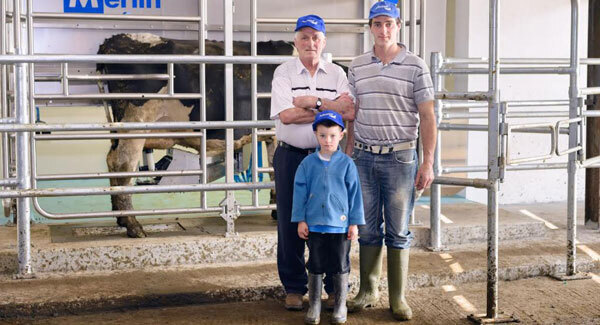
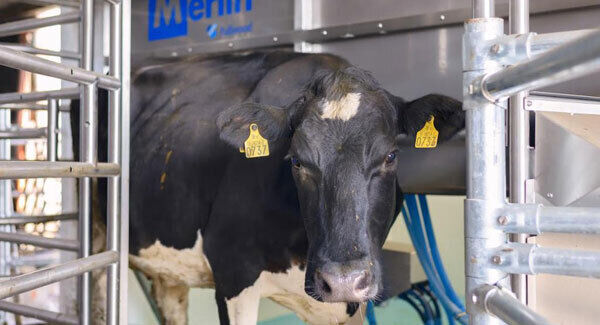
As we walked by the bulk tank on the way to see the new Fullwood Merlin 2 robotic milking machine, we saw the previously used 35-years-old Westfalia 12-unit double-up parlour.
“We milked 72 cows here up until autumn this year,” said Pat.
“We milked twice a day, and the routine took four to five hours each day, depending on the time of the year.”
“The cost of maintenance was averaging out at around 2,000, and it was due an upgrade. In 2013, I priced a four-unit upgrade, that’s two extra units each side, but I got a shock.
"I would have to narrow the pit, add stall work and feeders. I couldn’t see myself out of it for less than €80,000. So I decided to look further afield.”
There was a friend in Cavan that Pat met through zero grazing, who had three robotic machines, and that was where the idea of a robot was first mentioned.
Pat decided to investigate the market. “I spoke to lots of farmers. I spoke to the milk lorry drivers and others too, so I could get the true picture.”
“I had visited farms on different systems. I had heard that the Fullwood Merlin 2 had been on trial in England for three years.
"I went to see that in the North, and decided that was the machine for me.”
“My worry was always running cost.
"I liked that the liners, pulsator and milk pump were the standard from any Fullwood machine, so I could go to any co-op shop and buy parts if I needed them.”
“There is a single belt driving the arm in slow movement, so it has less moving parts. This also means it is quiet, which helps when training heifers” Pat decided to put down a deposit in June this year.
It was installed in August, and the cows were milked through it for the first time on September 10. It was grant aided through TAMS 1.
The installation was done by Robotic Dairy Services from Tipperary, specialists in robotic dairy services.
I wondered about training 70 cows to the new machine. Pat refers to a Volac calf feeder installed in 2008, which might have helped the cows to enter the new device for feeding.
“The first fortnight were long days, I won’t deny that. Now if I have one cow I need to bring to the machine, that would be all. The fact I was training them indoors made it easier”
“I bought in one cow recently, and she never raised a leg.” Pat sees an improvement in temperament due to the cows not being herded.
“I can draw them out at the barrier now, which I could not do before.”
“Some heifers in the old parlour would be cross, and needed a kick bar even when I was washing them. After two or three times in the robot, there was no problem.”
“I may still install an out-of-parlour feeder to help the heifers.”
Pat has never been afraid to feed cows, before the robotic system, more than a tonne of ration was fed per cow.
“The machine can feed to yield, which I could never really do before. It realises feed calculated to their daily yield. Even at this stage, I see a saving in my feed costs.”
Cows are being milked 2.4 times a day, and the robotic machine has 13% free time.
“I am getting extra milk per cow even in the spring calvers. I was told by farmers that the extra milk per cow and the feed cost saving would cover the repayment costs.”
The information like conductivity, heat detection, acidosis and ketosis alerts that the computer feeds back are other tools Pat sees as cost savings, long term.
“I have had three cows so far that showed up potential SCC problems in high conductivity readings. I treated them with Uddermint cream and they recovered perfect without ever needing a tube or milk withdrawal.”
These are the reasons Pat now believes he can reduce cow numbers down to 63, and the farm would still produce the same or more annual production, at a higher value due to milk quality.
“A cow less would save me €1,000 a year, so the less cows I have to produce the same output, the greater the savings, and more money for the household.”
Pat is married to Phyllis, who works part-time. They have four children, Aoife, 11; Adam, 8; Daniel, 5; and Caoimhe, 3. Pat’s parents Paddy and Eily are still on the home farm.
I ask Pat has the robot freed up time for family life.
“My wife laughs that it is worse, with the amount of visitors. I imagine that will ease off when it is less of an attraction.”
“It does mean I have flexibility. We are free to go away for the day. All I need now is somebody on standby if something goes wrong.”
“There’s a great saving there, as before you could be paying up to €100 a day for milking while we are on holiday.
"Now it’s just someone on standby if anything might go wrong. Something small, like, once a cow stood on an air pipe which just needed to be attached again.”
“In the event of a power cut, the machine will restart itself, but the air compressor will need a manual restart so the gates etc will work.”
It has enabled Pat to play a more active role in the childrens’ activities.
“Aoife goes to dancing. Daniel might have a match in Glanworth at 6.30 on a Saturday evening. Before, you would have to start milking at 3pm, if you wanted to go. Now I have the flexibility, which is great.”