Rural crime wave puts neighbours on red alert

So instead of doing a decent day’s work for a decent day’s wage, you and your friends climb into a van, and with darkness descending, head out to rural Ireland in search of easy pickings.
You arrive at a location, and take whatever crude tools you need from the van to break, beat or blow your way into whatever premises that has been selected. A premises perhaps where a young family rest, or an elderly man or woman live in isolation.
You know nothing about isolation, because you never work alone. In spite of what you like to think, you are a coward. And only feel like a hard man when in the company of a band of like-minded thugs.
Such thieves for the past number of years have been a scourge in rural Ireland. They have become a menace and a worry to all who live and work in the country — like Liam Houlihan, a hardworking dairy farmer from Bruree, Co Limerick. He milks 75 high-yielding cows. He is married with a young family. Liam has worked and farmed here all his life. He likes life on the land. He likes the challenge that it brings.
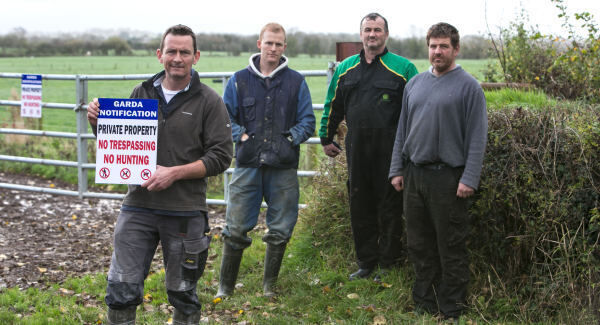
However in recent years, a new challenge has appeared, namely keeping his farm safe form organised gangs of burglars.
Liam explains, “My first break-in happened about two and a half years ago. My farmyard was broken into during the night. Diesel, tools and animal feed were stolen. About two weeks later, thieves struck again.
After the first robbery Liam had everything under lock and key, so for subsequent breaks-ins (there has been a third since), force was needed to gain entry.
And on another occasion late one night, Liam came across two man parked outside his farm gate with lights facing into his yard.
“When you come across somebody at the dead of night, about to enter your yard, all you can do is hope for the best, clear them off, and hope nothing goes wrong.”
“At this stage, you could almost say that every second home in the area has been affected in some way by break-ins. I’ve had my experience, my neighbour across the road has been broken into also, I know of elderly neighbours who have been intimidated, dogs were stolen from another neighbour. Go two doors down and coal was stolen, go three houses back, a car was taken. Go onto a farm back the road and steel from the farmyard was stolen, go down the road to another farm and an old shed that had been taken down and stacked in the yard was stolen. And they are just a few examples.”
This current spate of robberies began in the area about three years ago — coinciding with the onset of unauthorised hare hunting.
“Gangs started arriving from Tipperary, but mainly from Cork,” Liam told me. “You would find them walking the land with dogs and you would have to face them down, explaining that they had no permission to be hunting on the land. On many occasions, this was happening outside of hunting season.
“They would move on, but then a week or two later would be back again.”
“It got to the stage that every time you’d confront these guys, and they were big guys, you could feel the intimidation, you knew you were outnumbered, and that they didn’t give a damn where they were.
With robberies on the increase locally, it was then that local farmers and residents came together as a group to back each other up. A text message would be sent around when support was needed. For example, instead of one farmer approaching, two or three local landowners would confront the hunting packs.
Liam suspects that these so-called hunting groups were scouting operations.
Any suspicious behaviour these days is reported, not only to neighbours but also to the guards, and when a robbery takes place, the neighbours come together and support one another in whatever way they can.
“The guards are doing all they can to assist. And within the last couple of months, the guards have become even more proactive.
“But they can only do so much with regards to rural crime, and it is the courts and sentencing that we need to see overhauled.”
Liam is an strong advocate of the zero-tolerance approach to crime introduced in New York by Mayor Rudy Giuliani back in the early 1990s.
“You don’t tolerate small misdemeanours, because small misdemeanours lead to large misdemeanours. If you live in an area with a tolerance to anti-social behaviour, it will escalate.
“The criminals involved in rural crime, for the most part, are multiple and serial offenders.
“You are dealing with career offenders who are not concerned that they might do jail time, because more often than not, there isn’t any jail time. It’s usually a slap on the wrist they receive, and off they go again. This is where I feel a big problem lies.
“Guards should have the proper resources to respond to these crimes and the court should have proper sentences in place to be used as a major deterrent for these criminals.
“Yes, we are more vigilant these days, that’s life. There is no point in dreaming back to the days when we farmed without a threat of robbery.
“And again, nobody wants to live like Padraig Nally waiting for trouble to arrive. Nobody should have to live a life where they are continually on their guard.
“We are in a situation here where people have to be vigilant, hopefully this is only for a short period, until we are at a stage where those carrying out these crimes are deterred from doing so.
When discussing the subject of rural crime, the gun is never too far from the headlines. Kerry South TD Michael Healy-Rae, a man never afraid to shoot from the hip, has for many years been calling for a relaxation of gun laws to allow rural dwellers to protect themselves.
But what if you hear some rustling downstairs at two in the morning? How many of us will take the gun (licenced to shoot vermin) and point it in the direction of an intruder?
I have a licensed firearm, and have used it to kill a few foxes over the years, creatures that posed a threat to fowl or lambs.
I’m no crack shot, but I know one end of the weapon from the other.
So what would I do if I found a gang of thieves breaking into my home in the middle of the night?
How many of us who own a gun has ever discharged the weapon?
Talking up ‘the gun’ at public anti-crime gatherings is ‘pub talk’, says Liam Houlihan, who worries in the first instance about knowledge and ability to use weapons correctly.
“At the moment, you can own a gun without having any awareness of how the weapon is used. These days, we are being forced to train on the proper use of a sprayer, yet there is nothing on ownership of guns. There is no training given to the gun owner on how to use and look after a firearm properly.”
A gun is not like a shovel or a four pronged pike, you cannot simply pick it up and use it. And many people who take up a gun in defence of their home could very easily be endangering themselves more than anyone else.
“Possibly shooting themselves in the foot first, or worse have the weapon taken from them by the intruder. Then you would have a criminal with a gun,” Liam said.
Liam has a gun and, like many others, has thought long and hard about its use on the farm.
“I suppose after the first time I was robbed, I had to make a decision, would I take my gun with me when I went out last thing at night to check cows near calving? And I came to the conclusion that I’m not that man. I don’t want to live a life where I have to take my gun up the yard. And then I was broken into the second time, and then a third, and I had to ask myself if I had the gun on me and I came across these people, would I use it? It was a question I shouldn’t have to be asking, a question about a gun I had bought to shoot vermin.”