Dairy farms are disproportionately accident-prone
Some 58% of fatal farm accidents have occurred on dairy farms.
The level of non-fatal accidents is twice as high in dairy farming compared with other cattle enterprises, according to a presentation at this year’s Moorepark open day by Teagasc health and safety officer John McNamara and Patrick Griffin of the Health and Safety Authority.
They said prevention firstly requires removing hazards, and then adopting safe procedures.
Farms have a wide variety of hazards, and the farmer’s management of farm safety is the vital ingredient to preventing accidents.
Managing workload in dairying is seen as crucial to reduce accident levels. This is achieved by having a streamlined livestock system, good facilities, and minimising machinery work.
Having the workload under control allows adequate time for farm management so that work — including implementing health and safety measures — needn’t be rushed.
To prevent the crushing by “runaway” vehicles which is associated with a lot of deaths, stop engines, leave fuel-controls in the shut-off position, and remove keys.
Park on level ground where possible, apply hand brakes securely, and leave the vehicle in gear. If on a slope, use the reverse gear if facing downhill, and a low forward gear if facing uphill. Use wheels stops if necessary to prevent a vehicle rolling from a parked position.
As vehicles vary in operating procedures, always follow the handbook instructions.
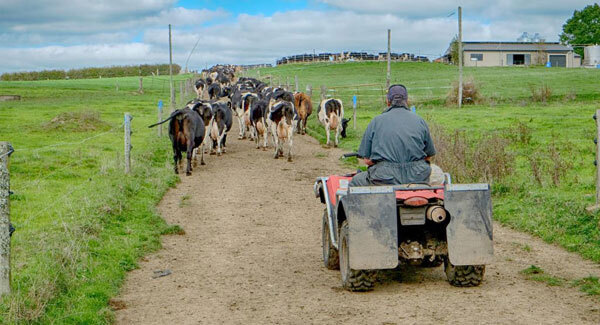
ATVs or quads can reduce work time on dairy farms, but are lethal if used incorrectly. It is imperative that operators undergo essential training before using quads — and children should never be allowed to use them.
The majority of accidents with PTOs or machine moving parts occur when the machine is stationary. Ensure complete covering of the power-shaft and adopt a work procedure where you do not have to work near the rotating shaft. Also, particular care is needed when adjacent to operating powered machines such as balers or combines when stationary.
Always turn off the PTO and the power before leaving or approaching a revolving machine component.
A recent national study indicated that farmers as an occupational group have one of the highest mortality rates. In the study, the highest mortality rates were reported for the behaviour-related chronic diseases: Cardiovascular disease and cancer.
The key document for managing farm health and safety is the risk-assessment document. Completing and updating this document is a legal requirement under the Safety, Health, and Welfare at Work Act (2005). In this document, the key questions regarding safety and health are asked. Information on causes of accidents, along with pictures of key controls, are provided. Safety and health actions needing attention should be listed on the action list and acted upon.
The document should be kept on the farm. A Health and Safety Authority (HSA) inspector can examine the document during an inspection. The HSA has announced that it plans to use a direct prosecution approach in the following situations: Children less than seven years old being carried as passenger on tractors; uncovered power-shafts; and unprotected slurry tanks.
Teagasc provides a half-day training course to farmers on completion of the risk-assessment document. The feed-back from half-day training courses is very positive; 99% of farmers agreed that it would be worthwhile to offer the course to all farmers, 97% of farmers agreed that the course motivated them to implement health and safety measures, while 100% said they planned to make health and safety improvements on their farms.
Discussion groups (or other groups) are particularly powerful in gaining health and safety improvements on the farm. These are a facility to spot safety hazards and suggest better ways of farming safely. Bringing peers into the farm allows an unbiased assessment of the farm at a relatively low cost.
Why not ask a friend or neighbour to take a look at your farm, and suggest ways to improve safety?
Farm accidents lead to tragedy, pain and suffering, disability, and farm business loss. One accident is one too many. By putting safety first you are protecting your vital assets — your life, the lives of your loved ones, and the family livelihood.