Rural achiever has to depend on the post rather than internet
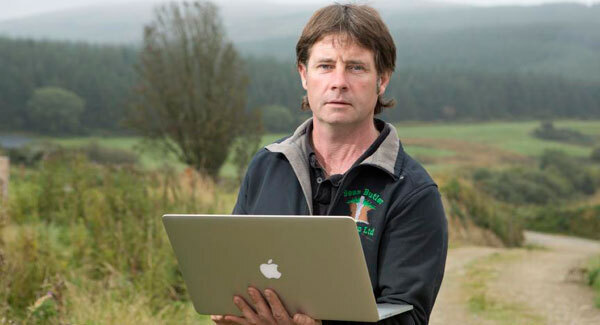
The next he’s getting a phone call asking if he can solve a problem with an irrigation system on a golf course in Africa (the Achimota Golf Course in Accra, capital of Ghana, which has been re-designed by Ryder Cup star Paul McGinley).
Sean, who has 26 suckler cows on a 70-acre hill farm at Silvermines, admits a phone call like this wasn’t in his wildest dreams once. But the 46-year-old has been running a one-man company, Sean Butler Irrigation Ltd, for the past 12 months.
“I install and repair sprinklers on sports grounds, gardens and golf courses.”
He represents the 36% of farmers in this summer’s Irish Examiner ICMSA farming survey who have a job off the farm (which grew from 28% in last year’s survey).

Reflecting the continuing shift in the farming community towards one or both in a family having a second, off-farm, occupation, Sean’s wife Patricia works in the planning section of the local county council.
The survey also confirmed that fewer than half of farmers agree that their local broadband is satisfactory. 39% disagreed — and Sean’s case illustrates how important a finding that is.
Sean, an ICMSA member, isn’t new to off-farm work. “In my previous life, I repaired milking machines.”
A 12-year stint with Naas-based TurfCare, where he worked in the irrigation area, convinced him he could strike out on his own.
His company is based in his home at Dolla, about three miles from his Silvermines farm, and his sprinklers work takes him to the four corners of Ireland.
“Today, I’m in Ballybunion Golf Course. Yesterday, I was in Craddockstown, in Naas. I go back as far as Dingle and the Old Head of Kinsale, Milford in Donegal, even Antrim.”
Aside from the dog tracks and recreation grounds, he has about 60 golf courses on his books.
“The golf industry has been good to me,” he says. But he never foresaw Africa beckoning.
“I was asked by an English irrigation supply company if I’d go over and solve their problem.”
Shortly before Christmas last year, Sean headed off to Accra. For 80 years, from 1887, it served as the capital of the British Gold Coast.
“Achimota is an 18-hole golf course in three different sections. You have to cross three public roads within the city of Accra to get to the various parts of it.”
Sean helped resolve their issue (“the problem was within the wiring and computers”).
He spent a further week there after Christmas, swapping the familiar landscapes of north Tipp for the red soil, Bermuda grass and tropical savanna climate of Ghana.
“In the dry spell, you’d use 80,000-100,000 gallons of water a night on the 18-hole golf course. Here, even in a dry weather period, you’d use half that.”
He saw multi-coloured parrots in the trees and anteaters. “Here, you only see anthills in cartoons. In Ghana, termite mounds are a feature on golf courses.”
The experience was certainly a learning curve, especially when it came to watching out for poisonous scorpions.
“You’d have about 60 control boxes for the irrigation system inserted into the ground on the golf course. In Ireland, you’d think nothing of putting your hand down to pull up the wiring.”
Luckily for Sean, his Ghanaian assistant stopped him doing anything so foolhardy in Achimota.
“He grabbed my hand and told me to always, always check for scorpions. I never actually saw one but you’d hear the lads talking among themselves, saying one had been seen on the 10th green.”
The Ghanaian workers live in tin shacks while away from their families during the working week. Nevertheless, they had their smartphones and could access broadband internet — something Sean can’t do when he’s home in Silvermines.
The Irish Examiner/ICMSA survey found just under half of farmers agreed that broadband in their local area is satisfactory. Thirty nine percent disagreed – over half of these said they strongly disagreed. Sean is among this latter cohort.
“Where I live, I have no broadband at all. We’ve tried different service providers to see if we can get an internet connection of any speed. They’ve come back and said it’s an unserviceable area, a black-spot.
"We’re not living on the side of a mountain or down in a hole, we’re just five miles from Nenagh. Even though we have a computer, it’s still on the old dial-up.
"We don’t even try it anymore. If we want to use internet, we either go to my wife’s home in Nenagh or I go to the local hotel there.”
As a result, Sean finds himself at a serious disadvantage in all areas of his working life.
“If I need to register a calf, or deal with transfer forms after selling cattle, I do it all by post. I can’t get Herdwatch or any packages for betterment of farming. The Single Farm Payment would issue faster, if you applied online.
TAMS II can only be looked for online, there’s no form (to post). The new Genomics Scheme for suckler farmers (whereby you get a grant if you build your herd up to a certain star rating), they’re looking for that to be done completely online. There won’t be postal forms after a while.”
While lack of broadband forces him to do his farming administration work by post, it constrains him to do his company business by phone.
“I can’t order stuff online. If somebody rings with a problem, I can’t download a technical manual, look at the fault-finding section, and get an insight into the problem before calling out to them.”
How is the broadband in Accra, where Sean has been asked to do twice-yearly maintenance work on the irrigation systems at Achimota (and work on other golf courses is possibly in the pipeline)?
“It’s instant on a smartphone. It’s just there. The [Ghanaian] lads are so savvy with it. The fact I’m not using it here in Ireland, I wouldn’t be so quick off the mark. For them, it’s instant on the phone. They don’t see it as a problem or understand how it could be one.”