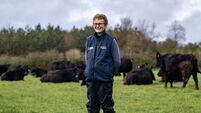
Joe Sheehy: Replacement cost estimated at €1,545 each

The researchers estimate that poor fertility in Irish dairy herds is costing €100 per cow in the herd, or 1.5c/l of milk produced, mostly due to high replacement costs.
Cow fertility criteria are improving, but are still well short of achievable targets — such as 4.5 lactations per cow, or an 18% replacement rate.
There is overwhelming evidence that these targets can be readily achieved, by exploiting genetic improvements, and fertility management.
Recent data from the ICBF indicated that the median calving date on Irish spring calving herds is March 9 (the target is February 20). The mean 21-day submission is 60% (target is 90%), and the mean six-week calving date is 52% (the target is 90%).
It is impossible for farmers with a scattered calving pattern to achieve these targets in the short term, but they should work towards them as quickly as possible, by compactly calving heifers at the start of the breeding season.
The full cost of bringing a replacement into the herd is estimated to be €1,545.
Yields around 1,400 gallons (6,500L) which are being achieved by most top farmers would cut the cost of replacements significantly, compared with average Irish yields.
About 18 to 20% replacements is desirable to raise the EBI and keep herds relatively young and healthy, but our national average is around 27%, and this is costing farmers dearly.
These high levels of replacements drive down herd milk yields, because first calvers usually produce only 80% of mature cow yields.
Farmers should do everything possible to reduce replacement costs.
All replacements should be bred from AI bulls with a proven index for high fertility. Reduce involuntary culling by taking good care of the health and reproduction of cows.
Follow best advice regarding breeding management and having cows in proper condition score especially at calving and breeding.
Avoid short lactations and low milk yields per cow.
Late calves must get special attention to calve down at 22 months early in the season at the proper weight, and this will have a very favourable effect on calving pattern.
Having replacements on target for weight from birth to calving is one of the most important aspects of dairying.
Yet this is very often neglected; only about half our replacements calve down at less than 30 months, and many of those that calve down around two years old are well under-weight.
Based on trials, Teagasc has set the following targets.
At six months, the target for Holstein Friesian and Holstein Friesian x Norwegian Red crosses should be 175kg, and 164kg fro Holstein Friesian x Jersey.
The Teagasc target live weights at AI for different breeds are 330kg for Holstein Friesians and Norwegian Red crosses, 315kg for New Zealand Friesian, and 295kg for Friesian/Jersey crosses.
These weights are about 60% of target pre-calving first lactation weights. Condition scores must also be correct.
Pre-calving target weights should be 550 kg for all, except the Holstein Friesian x Jersey, at 490kg.
Based on a study with 1,400 heifers on over 40 farms, Teagasc researchers came to the following conclusions.
Live weight at the start of mating is more important than age.
Heavier heifers produce significantly more milk than lighter heifers.
Weight at first calving also significantly affects second lactation milk yield.
Heifers weighing less than 290kg at AI produced 160 gallons of milk less than heifers weighing over 342kg at AI.
Heifers at condition score 3.25 also produced about 160 gallons more than heifers at CS 2.75.
Over weight heifers are not satisfactory.
This study showed that it was practical to have heifers at the ideal weight calving down at 22 months of age.
This provides an ideal opportunity for farmers with late calving herds to bring forward and compact calving dates.
If replacements performance is not satisfactory, it will affect herd performance for years to come.