Zero grazing makes wet springs and autumns easier
The full potential of grazed grass is not achieved on most beef farms.
According to Teagasc, grass makes up only half of the total dry matter fed in a steer calf to beef system.
Grass utilised is only 4.7 tonnes of dry matter per hectare — despite the potential to grow over 13 tonnes of dry matter per hectare.
Wet weather in the spring and late autumn often makes grazing very difficult, with poor utilisation of grass and extensive poaching damage to paddocks possible.
When this happens, beef farmers are forced to keep their stock housed, and to feed them silage, plus concentrates in some cases.
For any livestock enterprise to be profitable, the best use must be made of grass.
Shane O’Reilly farms near Ballinrobe, in south Mayo.
Traditionally, Shane purchased high quality weanlings, and reared them and sold them on as forward stores.
Shane is relatively highly stocked, and puts a big focus on grassland.
A rotational paddock grazing system is used, to produce the highest quality grass for the cattle.
Shane targets early April to turn his cattle out to grass.
However, a wet spring, or poor grass growth, often delays the cattle turn-out, with the added risks of running low on forage, and having to supplement with concentrates to maintain high levels of performance — which would reduce the profit margin.
He doesn’t want to risk putting the cattle out on the rain-softened fields.
“I regularly carry out reseeding, so I want to avoid poaching damage to the paddocks,” Shane explains.
In order to overcome the problems of poor spring weather, to get better utilisation of grass, to maintain high weight gains — and for peace of mind — Shane recently purchased a zero grazer.
“Zero grazing gives me a Plan B if the spring weather is bad.
“I don’t have to let the cattle out, there is no poaching damage, no wastage of grass, and I don’t have to worry about running short of grass, or having to bring in cattle again if the weather turns very bad after turnout,” Shane explains.
“I had seen the zero grazer at the Ploughing, and I also did further research into it, I spoke to other farmers who are using them, to get an idea of the positives and negatives of zero grazing,” Shane said.
“I got positive feedback from every farmer I spoke to, so I decided to buy it”.
Shane purchased the zero grazer in late 2014 — and is very happy with it.
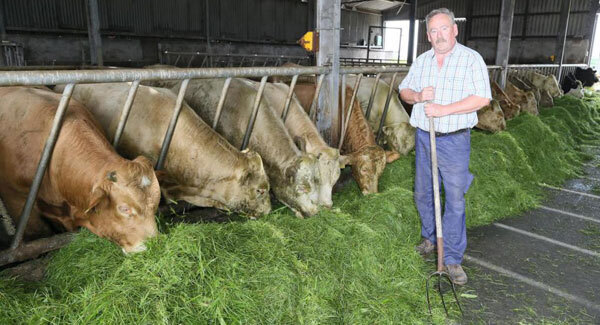
Shane is zero grazing 22 acres, relatively near the cattle shed, and currently feeding 80 bullocks.
“I can cut a trailer of grass and bring it in to the shed in 20 minutes, it only takes me five minutes then to shove it in to the cattle each side“, Shane points out.
“With the zero grazer, I get 95% utilisation of the grass. When the cattle are grazing, and conditions are not ideal, I often only get 35% utilisation, due to the cattle dirtying and trampling the grass”, Shane says.
“When I come back to the yard in the morning, any grass that’s left, I just shove it into the cattle with a rake”.
He says he still requires good quality baled silage, but probably slightly less than before, because he can bring grass into the cattle earlier in the spring, and later in the autumn, thus increasing the proportion of grass in the diet, and reducing costs.
“With the zero grazer, I know exactly where I am in terms of grass, grassland management is easier.
“I’m also using less bag manure, as I’m getting much better use of slurry.
“When I have finished a field, I can go in with watered down slurry, and remove the need for chemical fertiliser“, Shane says.
I visited his farm on a warm day during a spell of fine weather in June, and was curious to see how comfortable the cattle would be indoors, with the temperature in the high teens.
Shane told me they are always very comfortable.
“They are on mats, and there is very good ventilation in the shed, even during the warm days, it is still cool in the shed, and the cattle are relaxed and comfortable.”
“Excellent ventilation is very important”.
Shane recently sent some of the bullocks that had been on the zero grazing system for slaughter, and was very happy with the kill out, carcass weight and grade and fat cover.
He now plans to buy more bullocks and finish them in 100 days on zero-grazed grass.
“The cattle I’m feeding at the moment are doing well, they are putting on 1kg plus daily with no meal, so I’m very happy with that,” says Shane.
To sum up his zero grazing system to date, he says “The zero grazer gives me fantastic options, with no worries of running out of forage if I cannot let the bullocks out, or not being able to keep good quality grass ahead of the bullocks in difficult grazing conditions”.
With the increased utilisation of grass, more grass in the diet, no concentrates, and a much-reduced requirement for chemical fertiliser, Shane O’Reilly is confident that zero grazing is reducing his costs and improving his profit margin.