Bells chime to mark the dawn of a brave new era for Irish dairy
There can be no doubt about it, if the enthusiasm and sheer creativity that was shown by the farming community of Grangemockler, Co Tipperary, last Tuesday night and into Wednesday morning is only half replicated by those entrusted with advancing the image and sale of Irish dairy products abroad post quota, the Irish dairy sector’s future is fully assured.
The creativity I speak of was the recognition by three local farmers, Walter Power, James White, and Tom Kennedy, that the passing of the milk quota system presented a combination of unique opportunities.
Firstly to commemorate the beginning of a new age for the dairy sector while at the same time using that “new beginning” to help raise funds for a local charity, in this case the Carrick on Suir branch of Hospice.
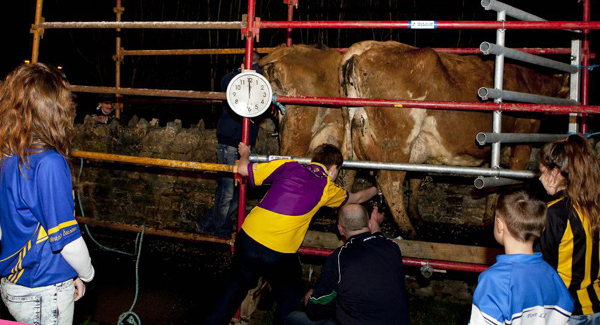
The basic idea was simple; they would milk two cows, one on either side of midnight on March 31, thus symbolising the passing of one era and the arrival of another. From this flowed the idea of doing it for charity, thus turning it into a community event.
The village of Grangemockler consists of a string of buildings flanking a straight section of the N76 about halfway between Clonmel and Kilkenny. You pass through noticing a pub, a couple of shops, a church, and a few other buildings before pressing a little heavier on the accelerator and refocusing on your journey. It’s a nondescript type of place really.
Yet so to was the Belgian village of Waterloo in 1815, but it is now synonymous with having changed the face of Europe in June of that year.
While none of this event’s organisers had a hand in the political decisions made almost a decade ago in Brussels to change the landscape for milk production across Europe they did decide to mark the event in a very unique way.
The site chosen as the focus of all activity was Grangemockler parish hall, a building dedicated to the memory of local man Michael Browne, who ended his days a cardinal in Rome.
And so it was that. when I arrived on that faithful evening, I found a hive of practiced activity. The hall itself was immaculate, 130 chairs were set out to accommodate the early arrivals, facing a stage with more chairs, microphones, and a very large television screen.
Two more screens with speakers were positioned outside the building. The walls were bedecked with Glanbia banners, the large kitchen held many trays of sandwiches, scores of cups and several boxes of Baileys liqueur.
A smaller ante room was the nerve centre for the sound and television relay engineers. Through a door at the end of a corridor you emerged at the rear of the building to a floodlit area of green where, against one of its boundary walls was constructed the platform onto which the two cows to be milked would be led.
It’s amazing what you can do with a few well-placed pallets and scaffolding! It was on this structure that its creator and the man who provided the mini milker for the night, Nigel Hanrahan, had placed a large white-faced clock.
Having arrived early (proceedings proper would begin at half nine) I made my way back inside and quickly fell into conversation with members of the Kildalton farm discussion group, men and women in their early 30s.
I began by asking where would all this extra milk Irish farmer’s were gearing up to produce go.
They took to the debate with gusto. Milk consumption, I was told, is expected to increase globally by 2% year on year until 2020, and concerns at the ability of the industry to process added supplies had, at least in this area, been silenced by the recent opening of Glanbia’s facility at Belview.
Add to this the fact that in the scale of world production Ireland rated only 40th, there was huge room to improve.
My question on what would happen if New Zealand increased its production was met with serious comment, not on the threat from New Zealand but the potential of the US. New Zealand, I was told, produces only 20% of what the US does and, because of the scale of US farming, should US farmers with the backing of their Government decide to move up their production in milk, they could do so very quickly and cheaply.
I do know a number of years ago that the US set aside a percentage of its corn crop to for bio fuel refineries and if the decision was made to move some of that land back into production for primary food they could, in theory, make life complicated for overseas producers in everything from beef to milk to tillage.
The US aside, the biggest threat to the future inside the Irish dairy farmer’s gate, the possibility that issues on animal CO2 emissions from the dairy herd might gain real traction in Europe?
While not dismissing the threat entirely, it was pointed out to me by Frank O’Brien that for him to graze his cows and send their milk 60km to Ballyragget for processing, his carbon footprint was significantly less than a German farmer who fed his cows indoors all year round and had only one mile to travel to the processing plant.
More worrying, he felt, was the possibility that, if world prices did decline, Irish processors might be tempted to begin undercutting each other on international markets in an attempt to keep product flowing, pushing prices even lower.