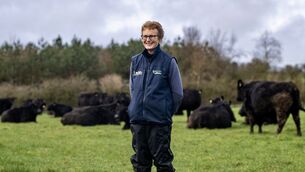
Kieran Coughlan: Good news for farmers if Government plans to end discriminatory taxes

This is great news for farmers, who are by far the largest cohort of self- employed persons in Ireland.
Creating employment in Ireland has for two generations been almost exclusively focused on winning foreign direct investment (FDI), mainly from US multinationals which use Ireland as a springboard for expansion into Europe.
This strategy has attracted multinationals seeking access to our well-educated, English-speaking workforce, our relatively uncomplicated bureaucracy, not to mention our stable and low corporation tax rate.
The success of our hunting expeditions in securing FDI can be measured in terms of the calibre of the companies who have located here, including eight of the top 10 internet companies, nine of the 10 top global pharmaceutical companies, and more than half of the world’s leading financial services companies.
The success of our FDI programme is reflected in the number of people employed by these companies, which currently stands at over 250,000.
However, over-dependence on foreign direct investment alone must be balanced by shifting the emphasis, tax breaks and state support for job growth towards our own economic sphere, to create our own home-grown businesses.
After all, over 320,000 people are self-employed, which dwarfs the numbers employed by the multinational sector.
And this figure doesn’t fully reflect the scale and importance of our indigenous industry, until you factor in those private sector employees employed by our army of self-employed.
Figures from the Central Statistics Office show that there are 93,400 self-employed persons who themselves are employers, with figures from the Small Firms Association showing that 862,000 persons are employed by small firms.
Data from the CSO shows small businesses and micro-businesses together employ nearly 50% of the workforce.
The numbers self-employed in Ireland peaked at 362,000 in 2007, and at that stage, more than 125,000 self-employed businesses also employed additional staff.
The economic downturn hit the self-employed in a far more silent manner than the headline-grabbing redundancy announcements by large companies, and the self- employed figure bottomed out at about 290,000 people in the first quarter of 2012, with the number of employers amongst them dropping to about 66,000.
Since 2012, the role that the self-employed are playing in our recent economic recovery can be expressed as an increase of about 30,000 persons engaged in self-employment, but also the number of self employed persons who are employers has grown significantly, by more than 27,000, in three years.
This growth in self-employment comes almost in spite of rather as a result of the support of our state agencies, at a time when access to credit for SMEs has been nearly non-existent.
Our tax system and social welfare system have discriminated on many levels against the self employed.
The accompanying table (above) shows the effective tax payable for a standard self-employed person, in comparison to an employee, for various levels of income.
At every level of income, a self-employed person pays more tax than an employee, but it is exacerbated at lower levels of income, where a self-employed person earning €15,000 pays more than seven times the amount of tax, compared to an employee.
A tax system that actively discriminates against an individual who seeks to create their own employment, and in many cases goes on to create employment for others, makes no sense.
As rightly pointed out, this tax system was inherited by the Government, but the discrimination against self-employed is long-standing.
Many of the appeals to correct this have come from our farming representative bodies, as well as the Small Firms Association, over many years.
The PAYE credit for employees has existed for more than 30 years. At the time of its introduction, the kickback to employees was worth only a few hundred euro, depending on the marginal rate of tax that the employee was paying. However, the gap between the tax treatment of employees and self employed has widened ever since, and across successive governments.
The Small Firms Association has recently rekindled their efforts to equalise the tax treatment of self- employed, calling for three key measures:
Introduction of a voluntary PRSI scheme which would allow self-employed persons access unemployment benefit, should their business fail.
Equalisation of the tax rates, by allowing self- employed persons claim an equivalent PAYE credit worth €1,650 per annum, and by removing the 3% USC surcharge that applies to self- employed earnings over €100,000.
Promoting an entrepreneurial capital gains tax regime.
For us self-employed farmers, now is the time to weigh in heavily behind abolition of long-standing tax discrimination, so that the self-employed can literally get the credit they deserve.