Great 60 years for IFA, but it’s as challenging as ever
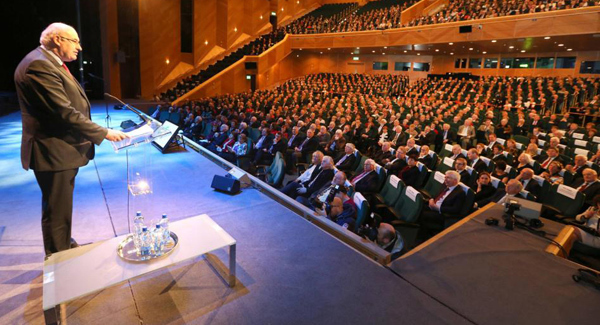
Speaking at the event to mark IFA’s 60th anniversary, perhaps the Commissioner overdid the flattery.
After all, IFA President Eddie Downey, addressing the same event, said Irish farm families again find themselves under immense pressure, with an inadequate return for their hard work and investment.
If that’s the payoff for the best-organised and most influential farmers in Europe, how bad are things for farmers in less influential member states?
Nevertheless, Mr Hogan laid it on, saying IFA is one of the most successful Irish and European movements.
Their role in representing the interests of farmers and rural people had been second to none over the past 60 years, gently coaxing national governments and EU institutions, in a way that could be held up as an example of how citizens can organise and unite to advance their common goals, said the Commissioner.
He cited the example of Taoiseach Garret Fitzgerald walking out of a European Council in hard bargaining which gained Ireland almost 5% of extra milk quota, when all other countries took less, or at best, stood still.
That a man from Rathmines, who wouldn’t know a cow from a bullock, engaged in such hard bargaining for Irish agriculture, can in large part be attributed to the persuasion of the IFA at the time, led by Michael Berkery, Donie Cashman, Joe Rea and Con Lucey, said Commissioner Hogan.
His praise is of course more than fitting — if one considers where Irish farming came from, guided by IFA.
The Ireland of the 1950s was a land of subsistence farming and mass emigration.
Farming then was an exercise of survival, with scant domestic demand for foodstuffs and weak export prospects.
And it was in this context that NFA — which became IFA — became a voice, recalled Hogan. EU membership changed all that, providing market access to over 500 million people, and income support now which is now worth €1.2 billion annually to Irish farmers.
Without those advantages, agri-food could not have become our largest indigenous industry, employing 167,000, and this week celebrating a 4% increase in food and drink exports for 2014, to reach a new record high of almost €10.5 billion.
According to Hogan, the years of progress have made European agriculture a dynamic sector that has proven its resilience and capacity to adapt to the new global context.
That context right now is, as usual, volatile markets driven by events beyond farmers’ control — a strong dollar which reduces global commodity prices, huge harvests which also depress commodity prices, and stumbling global demand also hitting prices.
Nevertheless, Europe has become the largest exporter of agricultural produce in the world, a stunning achievement according to Hogan, for a continent that always seemed at risk of being flooded with cheap imports in the past.
To his credit, he also highlighted the obstacles of blatant unfairness which face farmers, as well as the unpredictable market forces they contend with.
He asked why Irish fertiliser prices are expected to increase by 7% in 2015, even though the Brent crude oil price has fallen more than 45% since June, 2014.
According to the Commissioner, just like on the retail side of the equation, it is clearly obvious that highly concentrated input suppliers have real pricing power, and are using that power to extract profit margins far higher than can be justified.
He warned that he will not hesitate to call for changes so that farmers are not put out of business by the input suppliers squeezing farm profitability too hard.
Irish farmers will hold him to that promise, while playing their part to live up to his vision of driving Irish and EU agriculture towards 2050 and beyond, in a world of over nine billion to feed.