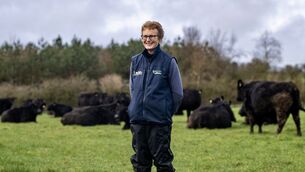
Farmers have mixed views on contents of Budget 2015
Ahead of last week’s announcement, IFA had delivered a concise message to the Government: Investment in agriculture will pay a wider dividend in terms of jobs, output, and a stronger rural economy.
We had prepared a strong submission as part of the agri-taxation review and our key message on the Rural Development Programme (RDP) was the importance of the early introduction and payment of farm schemes, in particular the new agri- environment scheme, Glas.
On the one hand, the Government responded positively to our proposals on increasing land mobility and restructuring through the tax system, and the additional support for the vital suckler herd is welcome.
However, the funding allocated for the agri-environment programme for 2015 is simply not sufficient, and does not meet the expectations of the thousands of farmers in vulnerable sectors and regions who will be without a scheme next year.
Farmers have been short-changed by the Government plans for Glas payments next year. It is unacceptable that hard-won EU Pillar II money is replacing some national funding in 2015.
Agriculture Minister Simon Coveney will have to revisit his decisions on Glas for 2015 and will have to accelerate the process to ensure that the 30,000 farmers entering the scheme get a substantial payment.
The part-payment of three or four months proposed for 2015 must be improved on significantly, given the start-up costs associated with Glas.
The additional money allocated for the Beef Genomics scheme is welcome and needs to be built on as the sector is under real income pressure.
The provision of other farm schemes — disadvantaged areas, discussion groups and TAMS — that are contained in the budget announcement will make an important contribution to farm income, supporting investment and economic activity in the rural economy.
The decisions in relation to land mobility and restructuring reflect the proposals made by the IFA and followed detailed discussions with the review committee. Since this review was announced 12 months ago, we identified a number of measures that were necessary to drive on the sector.
The enhancement of measures to encourage land leasing and farm consolidation are positive — as is the extension of income averaging from three to five years. The increase in the flat rate Vat refund to 5.2% reflects higher input costs on farms.
IFA supports the principle that reliefs must be targeted at active farmers; however, the proposal to retain Agricultural Relief and Stamp Duty Consanguinity relief for active farmers must be defined appropriately to ensure that genuine farmers are not excluded from availing of these reliefs.
The definition of an active farmer must reflect the fact that many farmers engage in farming on a part-time basis, with off-farm employment necessity. IFA will be putting its proposals in these areas to the Department of Finance in advance of the Finance Bill. There is more that must be done within the tax system to encourage lifetime transfers and tackle income volatility, which is an increasing threat given the exposure to world prices.
IFA will continue to work with the agri-taxation review team to further progress income volatility measures and the Phased Partnership model, which would incentivise families to work in partnership over the phased transfer of the family farm.
Eddie Downey is president of the IFA
Minister Simon Coveney will have to revisit his decisions on GLAS for 2015