Rural Life: Wealth of history buried in boglands
Q&A: Gary Snelling
Rural Life: Wealth of history buried in boglands

They support distinctive animal and plant life and are the only eco-systems which contain a record of their own growth and development.

This living archive also contains valuable information on the environment and human activity and also records the effect of climate change. But many of the sites that have provided such invaluable insight into the history of farming and the impact of humans on our landscape, have been destroyed by development and their evidence cannot be recreated.


Bogs also play an important part in combating global warming. It has been estimated that peatlands contain 5,000 tonnes of carbon per hectare and in its undisturbed state, peat accumulates carbon from the air at a rate of up to 0.7 tonnes per hectare every year.

But 40% of peatlands have stopped accumulating peat and are actively decomposing. The extraordinary preservative properties of bogs have led people to utilise them for storing — and hiding — a variety of objects.

These include butter stored in wooden caskets that remained edible more than a hundred years later, the disposal of bodies during periods of conflict, and even a Silver Ghost Rolls Royce, once owned by Oliver St John Gog-arty and fitted out with a machine gun. It was built in 1919 and was discovered in a bog near Cobh and restored to its former glory.

Over the many years of turbulent human history, more than 1,000 bodies have been discovered in bogs across northern Europe in various stages of preservation.

And it is a chilling fact that most of them were not the result of an unfortunate accident on a dark night. Most of these bodies have signs of garrotting, stabbing, have bound hands and show other signs of human sacrifice.

Some unfortunates may have been deposited in the bog as a form of punishment for transgressions.

Gigantic oak trees, ash and yew once towered high on the landscape. Then, a rise in sea level caused flooding of rivers and wetlands and trees that fell into the silt were preserved under the prevailing anaerobic [airless] condi tions. Some preserved trees have been reported as having a branchless length of 100 feet.

But the recovered trees are extremely fragile and can degrade very quickly.

Bog oak, also known as abonos or morta, is usually stained brown by tannins dissolved in the acidic water.

Bog oak represents the early stages of fossilisation of the wood with further stages ultimately forming lignite and coal over a period of many millions of years. When they are first excavated, the trees are saturated. With salvaged timber, it is usual at the end of the drying process to have removed a staggering 3.2 gallons of water per cubic foot — over 50% of the tree’s original volume. The challenge of drying bog oak is to extract these huge amounts of water while maintaining a flat, straight and split free board.

The characteristic and highly prized black quality of bog oak is a result of the chemical reaction between the tannins in the oak and soluble irons present in the mineral subsoil.

Today, an increased appreciation of bog oak’s intrinsic beauty and long history has led to a renewed interest in some of the beautiful objects being made with it.

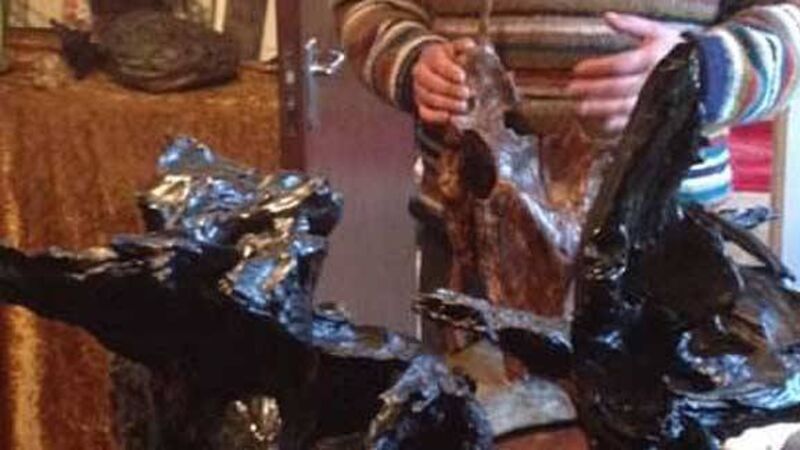
West Cork artist Gary Snelling has a passion for forests and the pieces of bog wood he is sometimes lucky enough to find there. I talked to him about his work.

¦ Even after you’ve been lucky enough to find a piece of bog oak, that’s only the beginning, isn’t it?

>> “That’s right. It’s a long process, from the thrill of discovery. Each piece has to be dried carefully. I have a special room in my house for that. Then it is cleaned, seasoned and sanded to prepare it for waxing and mounting. It’s a long process but the results really justify the journey. I love the woods, and spending time in them, so the process is special for me, being a part of the natural world. The first piece I found I literally tripped over it. It was a root and I took it home and cleaned it up and from then I was hooked.”

¦ Because of the length of the process, it must take quite a time to build up a body of work.

>> “Yes it does. But then again, when you think of how long it took that bog oak to develop, it’s not that long by comparison. And I’ve accumulated enough pieces over the years to have had several exhibitions of my work. I find people are fascinated by bog wood and I always try to explain the history and mythology behind my pieces.”

¦ When did you move to West Cork, Gary?

>> “It was in 1998. I am originally from Norfolk, England, from a farming background and I had worked at many different jobs — flat roofer, tiler, and fisherman and flint knapping. Then one day out of the blue, I decided that I was going to come to Ireland, just like that. I had no connections to the country and I can’t really explain why I made that decision.

“But it was very clear-cut and I just knew it was what I wanted to do. I stayed for six or seven weeks before going back to the UK, then I made the move here permanently. Once I found West Cork, I knew that this was where I wanted to be. The landscape and the people make it a special place.”

¦ How has the ongoing recession affected you?

>> “I still exhibit in some galleries and I sell my pieces at Skibbereen and Schull markets. But it’s definitely a difficult time. Many people just don’t have any money to spare. And my prices have to reflect the time it takes to produce them.

“As I like to point out to people, these trees go back to the time that the stone circles were being built. And that is quite a thought, isn’t it? I’m making wands too because I like the idea of spreading a little magic. At the moment, I’m offering a barter — one of my pieces in return for a road-worthy vehicle.

More in this section

Farming

Newsletter

Keep up-to-date with all the latest developments in Farming with our weekly newsletter.

Cookie Policy Privacy Policy Brand Safety FAQ Help Contact Us Terms and Conditions

© Examiner Echo Group Limited