Fergie comes out of retirement
I grew up with David Brown tractors. We had a 990 at home and later I worked with a 995 and a 996.
These days, if you presented me with a tractor of that vintage and asked me to do a little farming with it, you would quickly see my smile turning to a frown.
I like the modern tractor and the creature comforts that go with it. Having said that, I cannot but admire those who are thrilled by restoration of old machinery. I presume nostalgia is the primary motive behind it.
I know many in farming who have a vintage tractor parked in a dry shed as a reminder of more carefree days. Or times, perhaps, when a loved relative worked happily alongside them with the machine.
Hughie O’Donovan from Kilmore, Bandon, recently celebrated his 90th birthday.
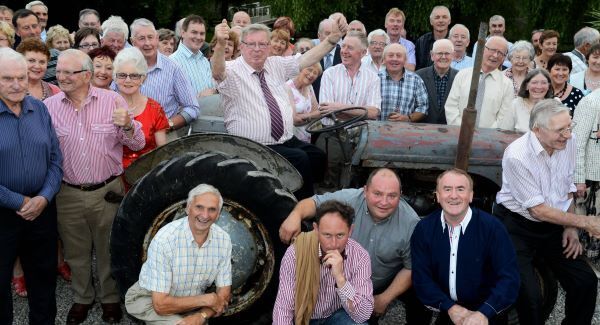
A big celebration was organised, with old friends joining him at Innishannon House Hotel.
And by way of a special gift, he was re-united with his first tractor, a 1953 Ferguson. Hughie had sold the tractor back in 1974, but it made a welcome return on his birthday night.
The tractor was rescued from the scrap heap by Hughie’s son Willie, who with the help of his cousin Mossie O’Donovan, John Desmond, P J Ryan and others, restored it to full working order.
I spoke to Willie O’Donovan about the return of the Ferguson, asking him first to take me back when the tractor was a fixture on the farm.
“The tractor was manufactured in 1953 but was bought by my father in 1968, from the late Pascal Sweeney of Bandon. It cost my father £150, and was used for setting potatoes, drawing in the hay, that kind of thing. Before the tractor, we had horses here.”
Like most youngsters, Willie loved tractors. “I remember back in 1974 when we made our first silage, when contractor Bernie Deane cut the silage, he brought in Jim Mahony of Castlelack to push in the silage. Jim had a Massey Ferguson 35, a tractor with a red bonnet.
“And I suppose I was dazzled with the red and I thought, ‘We have a grey tractor, so why don’t we get some red paint and make ours red also’. So myself and my sister went up to the top of the hill where the tractor was parked with our cans of red paint.
“When we came down that evening, we were all paint, and our mother went mad. She ordered my father to get rid of the tractor before someone got hurt. And so the tractor was sold.
“Hughie sold it to Eddie Barry of Brinny, and from there it moved to Eddie’s brother in Ballymurphy.
“I knew where the tractor was, I used to see it as I passed by, then sometime later, the tractor disappeared. I realised my tractor was gone.
“So time went on. Then one day I met John Desmond, and we were talking about the old times, and we got talking about the tractor. John said, ‘Try and find it. Wouldn’t it be a great surprise?’.”
There was, of course, concern that the tractor had gone for scrap, but after some investigation, Willie found his father’s old grey Fergie.
He was able to identify it because Hughie had cracked the gear handle when working with the tractor back in the late 1960s, and Jimmy Ryan of Templemartin had repaired the handle with a weld. It was this distinctive weld that Willie spotted.
With the tractor purchased once again, Willie, with the help of his first cousin Mossie O’Donovan, checked to see if the engine had seized up — and it hadn’t.
But practically every other moving part in the tractor had.
With four flat tyres and no mudguards, there was clearly a good stretch to go before the tractor would be back on the road.
However, after more searching, Willie found the mudguards in Courtmacsherry. “I knew they were my mudguards, because they still had the splashes of red paint from when we had tried to paint it all those years before.”
They bought the tractor home in the cow box, and to a shed where it was worked on in secret when Hughie was out hunting on Sundays.
And so to Innishannon, and Hughie’s recent 90th birthday. A night where old friends gathered, and a resurrected old grey Fergie almost stole the show.
Hughie, game as ever and delighted with the surprise, climbed onboard and gave all the thumbs up.
And with neighbours and friends looking on, Hughie, a man who simply cannot possibly act his age, swung the leg over to get off the grey Fergie, just like he did way back in the day when the Fergie was anything but vintage.
To shed some light on the man and the tractor and their times, I spoke to his good friend John Desmond.
“You have to remember,” John began, “that Hughie was born the year the civil war ended in this country. WT Cosgrave won the general election with his newly formed Cumann Na nGaedheal party.
“An Garda Síochána was established, workhouses were abolished, and the Land Commission was set up.”
The late president Patrick Hillery, and Brendan Behan, were other notables born in 1923.
“You could say that Hughie was ‘in the dark’ for the first 30 years of his life, except for the Tilley lamp, the candle and the flashlamp.
“There was no electricity, no landline or mobile phones, not to mention broadband, computers and i-Pods.
“There was no water on tap, no milking machines, no bulk tanks, no tractors, no combine harvesters, no balers, no corn drills, and very few motor cars.
“And even though the people were living in what could only be described as a full-time recession, they were an industrious people.
“Locally, you had the late Paddy and Mary O’Callaghan setting up the first gravel pit.
“The late Jack Deane had the first reaper and binder. The McDonalds of Castlelack and O’Mahony’s of Brinny had state-of-the-art mills. The late Mick Lordan and his six brothers operated threshing sets.
“Then, as time moved on, Castlelack School had its first teacher on a motorbike. Jim O’Mahony had the first buck-rake that I’d say moved more hay, straw and silage than any modern-day loader.
“Hughie saw tough times, but he took them in his stride as he went through life.”
Co-operation was strong in the farming community back then, and John tells me of a time when Hughie had a young Shorthorn bull on the farm.
“Hughie would bring him to a neighbour’s place by a rope and halter to carry out his services on the neighbour’s cows, as his neighbour didn’t trust the man with the straw.”
Hughie would also help neighbours with their thrashing, who in turn would help Hughie before he got his first tractor.
“Hughie I would say was an entrepreneur before the word entrepreneur was invented.
“In his young days, Hughie would hire himself out spraying potatoes with his horse and sprayer. He sold seeds to farmers, he then sold lime to make them grow, and he sold the sheds to cover the finished produce.”
And as if that wasn’t enough, Hughie got involved in politics. “When the late Flor Crowley was eager for election, he approached Hughie for assistance.”
Later on, Hughie, with his daughter Helen and son-in-law Robert, set up what is now a very well respected undertaking business in Bandon.
Today Hughie is still working as hard as ever. Ever present with funeral duties, he also keeps an interest in farming, with a flock of Jacob sheep.
Most nights he can be hard to find, as he tends to be out and about with a group of friends who sing and play music.
When asked recently what was his secret to his long and happy life, Hughie had this to say, “I reckon, it’s because most nights I went to bed and slept, when I should have sat up and worried”.