Suckler farmer vows to keep standards high despite €15m cutback

Martin Coughlan hears why Dermot Kelleher is prioritising welfare of his herd despite scheme closure
Suckler farmer vows to keep standards high despite €15m cutback

DERMOT KELLEHER flicks the switch on the TV remote and the RTÉ six o’clock news disappears from the screen in his living room.

It is instantly replaced by a TV stream originating 100 yards away in one of his calving sheds.

It isn’t new technology, it has been used by the dairy sector for nearly a generation, but it is now only gaining widespread acceptance among suckler farmers.

If there was to be one recurring theme in my visit with Dermot and his son Christopher, it was that application of science, research and technology is where suckler farmers need to go in the future.

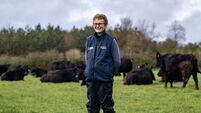
They run a Charolais suckler farm at Inchegeela in West Cork. The 80 acres owned, 40 superior Charolais cows, and 30 acres leased for sheep doesn’t come close to explaining 31 years dedicated to the land, and the up and downs it has brought.

“My father was a shopkeeper and insurance salesman in the village. I got this place from my uncle Timmsie O’Riordan in 1982, about the time I started as an auxiliary postman.”

He still does his 33 hours a week for An Post, but the bicycle he started with is long gone.

“There was 27 acres here, of which only 11 was arable. Over the years, I’ve made ground, reclaimed ground, and bought ground. In 1985, I had 20 cows and was milking 20,000 gallons, and then the milk quota came in. They based it on 1983, and knocked me back to 8,000 gallons”.

Just then Dermot’s wife, Mary announces that dinner is ready. When Dermot resumes his story in due course it’s now 1989, and after struggling with the 1983 quota handicap for a few years, he decided to change from dairying. “I bought my first Charolais bull in ’89, paid £2,300 for him.

“My Teagasc man arrived out to the yard and told me I’d need my wheel barrow and sprong no more.

“He started building a shed with calving boxes here, a slatted unit there, and a silage slab somewhere else. So I told him, ‘I’ve one good field, and you want to cover it with concrete’.”

Two years after buying his first Charolais bull, he won his first show cup at Castleisland Mart; it would be the first of many. There would be bad years too, of course, years when prices were not great; years when changing a bull resulted in difficult calving; and the year a virus nearly wiped out all the new calves. Gradually, however, he “got to where he wanted”.

Dermot acknowledges that without the income from his postal route, it would probably have been near impossible to stay going and rear his family of five.

It’s that sort of honesty that has seen “the West Cork postman” — as he is known in ICSA, the Irish Cattle and Sheep farmers Association — rise steadily up its ranks, to the point where he now is in his second term as their national suckler chairman.

“We dropped some of the leased land this year, because we discovered that pushing the number of cows above 40 wasn’t working out, for one reason or another. I suppose it was to do with my job, and Christopher being so involved with AI, there are only so many hours in the day, and you can’t watch everything. We kept the 30 acres for the sheep though.”

Dermot’s other son, Timmy, runs the sheep side of the business, as well as being very involved with the show cattle.

I ask about the decision by Agriculture Minister Simon Coveney not to extend the €25 million a year suckler cow welfare scheme, and replace it with the Beef Data Programme (BDP), which has a 2013 budget of just €10m. “The suckler cow welfare scheme was a fantastic scheme, it broke new ground in animal welfare and husbandry standards,” says Dermot.

“Go back before the SCW, you’d go deaf in half the marts in the country, because farmers were turning out stock straight off their mothers, not weaned, the noise used to be horrendous. It was stressful to the calves, we’d have animals going on trucks to go to Spain and Italy, and they’d be coming off at the other side with snotty noses, coughs, and stressed because they really weren’t ready. The SCW put an end to all that.

“Calves were weaned properly, they were introduced to meal feeding at the proper stage, and as a result they were bigger, better, healthier and stronger starting off. On top of that was the requirement to supply information to ICBF to help get an accurate picture of where we were with our breeding.”

The SCW scheme initially paid €80 per cow, which was cut to €40, and this year, the scheme ran its intended five-year course. Its replacement scheme pays €20 per cow for 20 cows.

I draw Dermot’s attention to ICSA president Gabriel Gilmartin’s scathing assessment of the new BDP scheme, and suggest it made suckler farmers appear ungrateful, at a time of national economic difficulty.

“My position as suckler chairman for ICSA is that I will be continuing to fill in all the relevant forms and send them off to ICBF. I will also continue to apply the same standards of welfare as set out in the old scheme, and I encourage every farmer who was in the old SCW scheme to do likewise.

“Yes, the money is less, and the requirements on welfare and weaning have been dropped, but at this stage, it must be abundantly obvious that the standards we achieved under the old scheme must be maintained, because our stock are so much better as a result. And definitely, fill out the forms and draw the money.”

At this point, Christopher produces the ICBF ledger for the Kelleher farm. The book whose origins began with the SCW scheme contains information on every one of Dermot’s animals, spanning the duration of the scheme. “You send in all the information on births, sire, weights, growth rates, temperament, loads of stuff. Then, if you send off a few quid, ICBF will present all the information you have submitted, plus details on carcase conformation and carcase weight in booklet form, even on the animals you may have sold, provided they were slaughtered in the Republic,” Christopher says.

Dermot adds: “If we are really serious about keeping our weanling shipping trade alive, we need to continue to be serious about the science.”

What of the changes to CAP and their possible effects?

At this point, Dermot leans forward and points out the window, through the now dark night to where I know there are a range of low running hills.

“There are men out there who may go to the wall if the system isn’t changed. They have very low entitlements, and I know you and me, Martin, have been over this ground many times. Yes, lads got well paid in the marts for the punch; they got well paid once!

“Is it right that the men who bought their cattle are still drawing that punch or two punches eight years later? I don’t think so.

“We hear all about the importance of supporting the big commercial farms from the IFA and the minister. To a lot of smaller or mid-sized men, it sounds like the minister is getting ready to stick another silver spoon in the mouths of the big boys… again.”

More in this section

Farming

Newsletter

Keep up-to-date with all the latest developments in Farming with our weekly newsletter.

Cookie Policy Privacy Policy Brand Safety FAQ Help Contact Us Terms and Conditions

© Examiner Echo Group Limited