What farmers need in order to succeed
In a subtle but effective manner, the Associate Professor of Public Health at University College Dublin gave farmers an insight into where the industry should be going.
He said farmers have every right to be confident — recession or no recession, people will still eat, and in the developing countries which become more affluent, they will want to move to a more western style diet.
A farmer needs to have confidence in himself, his product and his industry. On the competitiveness and creativity side, we are lagging seriously behind international competitors, when we should be at the forefront.
To find sustainable and future markets for our dairy products, we can’t be dependent on skim milk powder and butter as our main exports.
Agriculture can’t be expected to bring the whole country out of recession, but we should build on it as best we can, it is a time to be optimistic in farming.
He spoke about how farmers generally don’t see their most valuable asset as being their health. Far too often, farmers have health regrets. They should look after their physical and mental health as a priority.
Being positive and optimistic is important, as are attitude and outlook. You can only deal with the present and future, there is no good in reminiscing about the past or being negative about your future, ultimately you have the power to change your future.
By default, we all start out optimistic as children, and it’s our experiences and interpretations that can bring us to a negative place.
If you are positive and optimistic, your hoped-for future in farming is more likely to come about. If you are always bad mouthing it, why would your sons or daughters want to be involved in farming? Likewise, farmers often fail to recognise the huge lifestyle benefits from farming. You are around the yard if the children or family need you, you have the ability to down tools and choose how you spend your time. He spoke about how our attitudes in Western Europe are so different to those in Africa, where he had experienced people in severe poverty who say they were happy, they had enough to eat. Even when the Celtic Tiger was going well, a lot of people in Ireland were unhappy. He spoke about how farmers should see themselves as being in the food safety and food production business. Producing nutrition which is directly linked to human health should be the focus.
Too often, dairy produce is given bad press as containing high cholesterol or saturated fats. We should emphasise the positive aspects of our produce — it is healthy and good for you. Any potential negative issues are far outweighed by the health benefits. Milk, cheese, beef and yoghurt are on the food pyramid, as foods which scientists and nutritionists recommend.
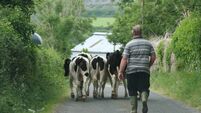
On protecting our industry, he said that there is no place for rogue operators, we can’t afford any food health crises. The negative news has a disproportionate effect and can ruin an industry. Professor Wall spoke about farmers taking responsibility for everything they produce — everything from the right feed to correct use of antibiotics — and animal welfare. Ireland should be marketed as the food isle or the green isle where our cows roam freely in green pasture — we should sell that idyllic imagery. In America, premium prices are paid for grass-fed beef — we should be marketing our produce overseas as grass-fed, to differentiate it from feedlot beef.
We are not marketing our unique features. Our farmers are some of the best in the world, as are the animal genetics on Irish farms.
He advised dairy farmers to look at the factors measured for the annual NDC/Irish Dairy Board awards.
On the latest technology, Prof Wall spoke about animals being fed marine algae derivative, which would give meat containing Omega 3. Anything that helps us market produce as being more health advantageous should be looked at — with infant formula, bone and teeth health in children, prevention of osteoporosis, and health of the elderly all important dairy produce marketing areas.
With 1% of the milk supply, Ireland produces 15% of the world’s infant formula. There is huge potential for whey in nutrition of the elderly.