Nothing borderline about their milk quality
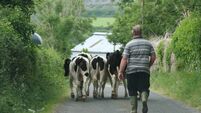
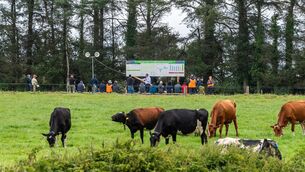
Farmers in the border counties were the first in Ireland to be subjected to demanding standards of low cell counts and freedom from antibiotics, and they have not failed to deliver in more than 30 years.
They send 500,000 litres of skim milk from 20,000 cows on 400 farms every day to the Abbott manufacturing plant in Cootehill, Co Cavan.
It is the largest production plant for infant formula in the Abbott Group’s worldwide network of 120 facilities in 60 countries, which employ 70,000.
In turn, Abbot makes a significant contribution to the Town of Monaghan Co-op, enabling it to pay a strong milk price to farmers in the border counties.
Of the 100 million gallons of milk processed annually by Town of Monaghan Co-op, more than 80% comes from 600 suppliers across the border in the North, which is the source of one third of the skim milk supplied under contract to Abbott at Cootehill.
The Northern farmers are key to the all-year-round supply needed for the Abbott plant, because their supply pattern is more even than in the South, where peak deliveries in the summer are three times the larger than the winter supply trough.
The Abbott plant produces 300,000 tins of Similac, Gain and Gain Plus, each of which provides sufficient food for an infant for 10 days. The products go through up to 150 quality control checks.
Production commenced at the Cootehill plant in 1975 with 68 people employed.
The most recent investment of €88.5m doubled the capacity, to make Cootehill the Abbott Group’s largest nutritional powder plant, employing 250 people.
More than one third of its output is sold in South East Asia, one quarter goes to the Middle East, and 12% each to China and Latin America. Smaller amounts are sold to Israel, Canada, and Africa; only 3% goes to Europe.
When Abbot came to Cootehill, they required up to 16,000 gallons of skim milk per day. It was considered a lot of milk by the local dairy industry, and the high quality standard required was of equal concern.
“The quality that was demanded at that time was a rude awakening for the co-op and for the farmers in the area,” said Vincent Gilhawley, the current Town of Monaghan Co-op chief executive.
“Abbotts financed additional staff in the laboratory to help the co-op achieve the standard that they were looking for, and we grew with them in the whole area of quality, because every single load had to meet the standard,”, he said.
“The suppliers to the co-op were the first in the country to have to meet high SCC standards and antibiotics were just no, no, and no. There was no room for mistakes,” he said.
Steve Nicholls, chief executive at the Abbott plant, has nothing but high praise for their relationship with the co-op.
“The quality has been very consistent over the years. Quality is not an issue. One of the advantages that we have over other plants is we have the best milk supply in the corporation,” he said.
The availability of enough high quality milk protects Cootehill from the lure of lower cost economies. “I just don’t see it happening,” said Steve Nicholls of the possibility of re-locating in search of lower wages and overhead.
That’s good news for Town of Monaghan Co-op, and the 250 well paid workers at the Abbott factory, which has become such an integral part of the community, gaining accolades such as the “Good Neighbourhood Award” and “Best plant for Environment, Health and Safety 2006”.
THERE’S a major “What if . . .” for the 1,000 farmers who supply Town of Monaghan Co-op to ponder. If lawyers for a multinational company had not inserted a restriction clause in an Irish contract more than 30 years ago the farmers’ fortunes could be very different today.
When the IDA negotiated with Abbott to bring their infant formula factory to Cootehill in the early 1970s, the plan was that the daily requirement of up to 16,000 gallons of skim milk would be supplied jointly by the Lough Egish, Town of Monaghan and Killeshandra co-ops.
As negotiations progressed, it transpired that a deal had been concluded by Abbott to make Lough Egish the sole supplier of the milk — until a senior executive of Glaxo stormed into the Lough Egish Co-op offices and questioned the rumour that they had agreed to supply milk to the new plant.
He revealed a specific clause in the Glaxo contract with Lough Egish Co-op which barred them for entering into any supply agreement with another party.
The Abbott-Lough Egish deal was in tatters, and the new factory, the construction of which was almost completed, was suddenly “high and dry” without a milk supply.
With panic in the IDA, an urgent request to meet senior IDA executives was made to John O’Donnell, Town of Monaghan’s Chief Executive at the time.
Within hours, the contract to supply Abbott was agreed with the Monaghan co-op, and the IDA were spared serious embarrassment which would have damaged Ireland’s food industry.
It was a challenging contract for the co-op, but offered an opportunity to underpin their milk price for decades to come. Since then, Town of Monaghan Co-op has grown, taking over much of the former Leckpatrick and Strathroy milk production and processing, to build a throughput of more than 100 million gallons.