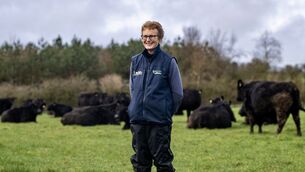
Call for more intensive pollution monitoring
No formal response is expected from the Agency until they complete their study of Professor Brian Alloway’s review of the EPA’s four year investigation.
Following the Alloway review, and an EPA admission that unplanned emissions of potentially toxic substances occurred earlier this year, farmers in Askeaton have called for more intensive pollution monitoring.
One of the local farmers devastated by animal losses says the problems have not gone away, and new cases are showing up.
In his review, commissioned by IFA, Professor Alloway concluded: “From the results provided, the lack of any data for certain probable pollutants, and the uncertainty inherent in some of the analyses, it is not possible to accept the assertion that pollution did not play any role in the livestock health problems”.
“Throughout the project, there appears to be a biased approach to the investigations related to environmental pollution. While in some cases raising relevant points about levels of pollutants, in each report there is a firmly stated conclusion that the animal health problems were not due to pollution. This bias in the design of the monitoring regime and the interpretation of the results is regrettable. Important features of the data may have been overlooked in the quest to play down any risk of pollution. It is possible that pollution was not the major cause of the animal health problems, but one would have expected an objective and open-minded approach until the project had been completed and all the results had been collected, and time taken to interpret them carefully”.
He said further monitoring and analysis, using more reliable methods, is needed to clarify the situation.
His report was welcomed by IFA leader John Dillon, who said it has removed the finger of suspicion which was pointed directly at bad farm management. Those affected were not bad farmers and it was unfair to brand them in that way, said the IFA leader. The cause of the problem remains unresolved and further investigation is necessary, he added.
Liam Somers, who lost more than 130 animals to mysterious illnesses over the past 15 years, said that the situation has improved, but has not gone away.
“I have animals on the farm who are now showing the very same symptoms and it is very worrying to think that it is still there, and the cause has not been found. There must be a reason for it and I believe that more monitoring is necessary“, he said.
In a letter to Mr Somers last April, the EPA confirmed finding sodium, aluminium, chloride, and iron in vegetation samples from his farm, and also confirmed “two unplanned emissions of material to the atmosphere” from a local industry on the day before the samples were taken.