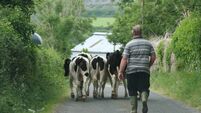
The bould tenant farmer now lives in Belgium
The average is 59%.
Even within countries, there is tremendous variation. In France, up to 80% of northern farmers rent their land, but southern farmers are more likely to own it.
The varying pattern of land ownership is just one more factor making it very hard for Brussels to even the playing field with their aid schemes, which must be adapted nationally for 15 member states.
Whether you own or rent can determine your economic viability just as much as the EU subsidies you earn.
It can also be very hard to maintain or increase your farm’s economic viability by buying more land.
And some EU countries, the system determines how easy or difficult it is for young farmers to get hold of land.
In Germany, only 37% of farmers own the land they farm, and farm sales are rare.
Usually, retiring parents hand over the “beneficial” rights to their children, but hold onto the deeds, and supplement their retirement pension from the rent.
The reason that Germany now has one of the youngest farming populations in Europe is that a 1957 social welfare scheme improved incomes for the retired, but only if they transfer the farming of the land to the next generation. Previously, many farmers were forced to farm beyond retirement age to earn a living, and young people could not go farming.
Farmer pensions are still relatively low, so parents are often supported by the next generation.
Now that the Farmer Retirement Scheme has been taken on by all member states, the structure of ownership of farms is likely to improve generally across Europe.
In France, a land owner may own the land and receive a low rent, at a rate fixed annually by the Minister of Agriculture, but the “exploitation right”, or the right to farm the property, is usually held by the tenant farmer. Tenant farmers can pass these exploitation rights onto their offspring, with the consent of the land owner.
But the final decision on whether the next generation goes farming is decided by a commission of state officials and local farmers.
Add part-time farming, and the EU farming jigsaw gains yet another ingredient.
While young French people are leaving rural areas, 45 to 50-year-olds are returning when their parents retire. They trade 20 years of working elsewhere for a “rather leisurely lifestyle running an uneconomic farm, in semi-retirement.”
German farmers have the best part-time farming opportunities, due to the country’s low unemployment levels.