Nitrates overkill is exposed
There was none of the hysterics which have featured in the campaign so far just solid information outlining why Ireland must be treated as a special case when applying a directive designed for an entire continent.
The Grassland Association have clearly set out, for the scientists who devised the Nitrates Directive, why it amounts to an environmental overkill in Ireland.
They cannot ignore what the Association makes clear is discrimination against grassland farming as practiced in Ireland.
Pressure must be kept on by Irish farmers and agri-business in general, to ensure Brussels does not ruin Ireland's unique agri-food contribution to the EU from very high grass production and an unusually long growing season.
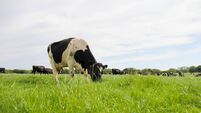
As conditions for grass growth are exceptionally good here over a very large part of the year, according to the Grassland Association, high stocking rates can be sustained, and their organic nitrogen efficiently utilised without excessive nutrient leaching.
The proof of this is in Ireland's standard of water quality, one of the highest in Europe.
Instead of a Nitrates Directive, containment of point source pollution and Good Agricultural Practice are sufficient for intensive Irish grass based farming, says the Association.
They point out that no other EU member state has Ireland's land use ratio of 90% grassland, 6.3% tillage, and 3.4% root crops one of the main reasons why the directive should be adjusted for Ireland. The obvious point is also made that Ireland has a totally different climate to much of the rest of Europe.
And since 1991, when the original Nitrates Directive was formulated, the science and management skills in managing grassland to balance animal performance and minimize environmental damage have progressed. Irish farmers now measure grass covers, herbage allowances and post grazing sward heights, and aim for farm cover targets.
The Grassland Association warns that the proposed generalised Nitrates Directive approach will unduly penalise a core of progressive farmers, will be difficult to police, and undoubtedly bureaucratic.
It is suggested a targeted approach might better deliver the directive's objectives of reducing water pollution caused or induced by nitrates from agricultural sources and preventing further such pollution.
Or authorities could repeat for nitrogen the promotional campaigns and greater awareness of nutrient planning which have led to Irish farmers using 30% less phosphorous, without need for regulatory controls.
Adopting a country-wide approach of 230 to 250 kg per hectare of organic N, and continued monitoring of water quality in each catchment, would allow Ireland to comply with the Directive, according to the Grassland Association. Standards and measurement criteria for water quality should be identical across the Member States.
They are talking commonsense on slurry spreading too; pointing out that managing it is more critical than when to spread it. A safe spreading notification system run by Met Eireann, which already provides pollen count, potato blight and sunburn index warnings, is suggested.
The directive allows farmers to judge when it is safe to spread slurry; they should also be allowed to judge when it is safe to do so in the closed periods for slurry, another argument which cannot be easily refuted.
According to the Grassland Association, 14 of the EU15 member states have failed to incorporate the directive into national legislation in the manner intended.
There can be no question now of it being stuffed down the throats of Irish farmers for whom it is least suited of all.