Government expenditure to outpace revenue growth, EU warns
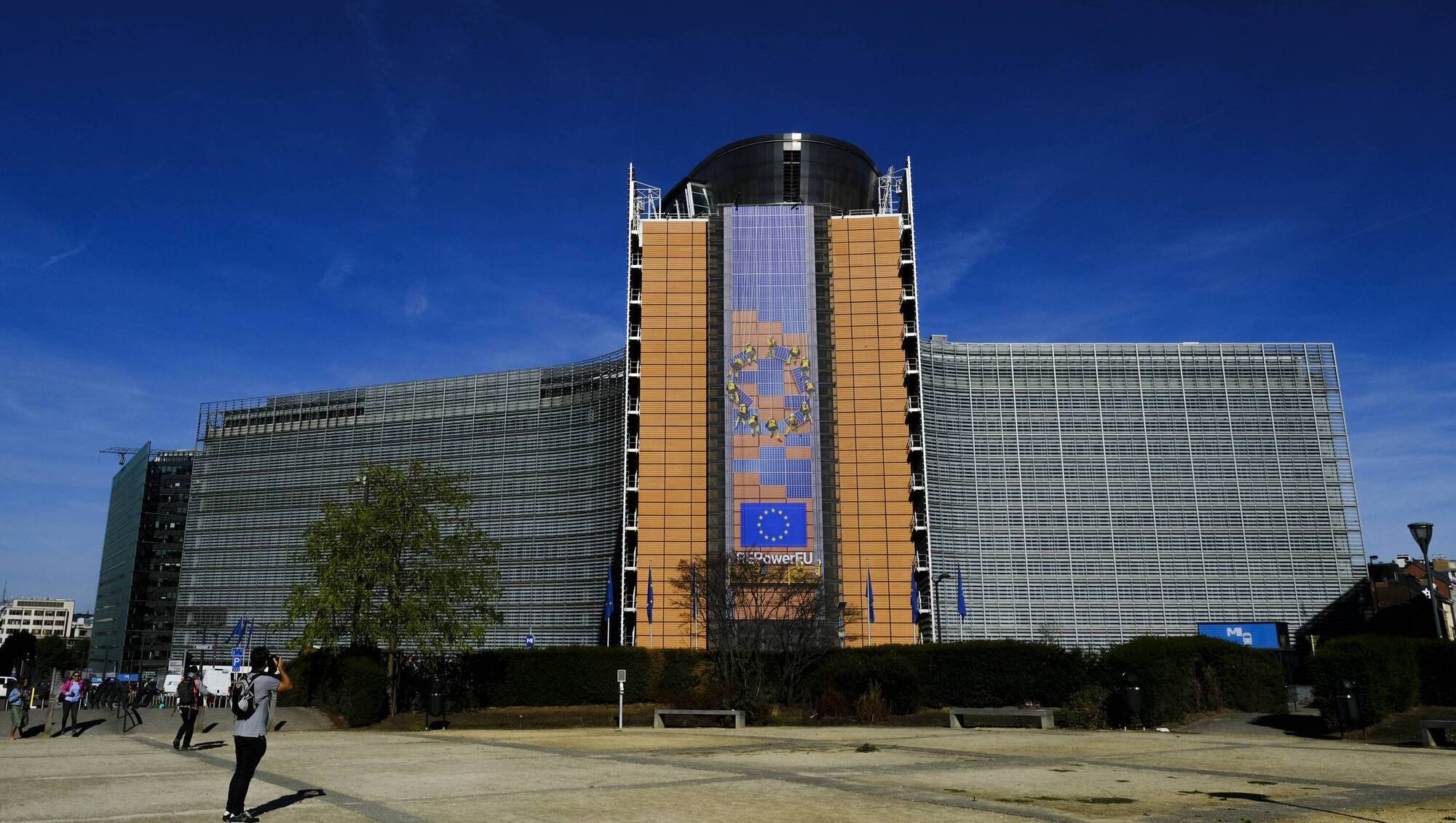
The headquarters of the EU Commission in Brussels, Belgium.
Ireland’s reliance on high corporation tax receipts continues to be a “major risk” for the country’s public finances, as projections show Government spending growth is expected to outpace revenue growth in the years ahead even after energy supports are phased out, the EU Commission has said.
In its latest European Economic Forecast, the commission said this year the budget surplus was expected to decline to 1.4% of GDP — compared to 1.8% of GDP last year.
It said direct taxes such as income tax as well as corporation tax was expected to grow this year. New tax arrangements for larger corporations are also expected to generate an additional €3bn in revenue annually.
Indirect taxes are also set to grow on the back of strong domestic activity and higher prices, though this will be partially offset by a range of reduced Vat rates entering into force in 2026.
However, despite this, the EU Commission warned expenditure growth was forecast to outpace revenue growth, “reflecting additional spending on energy support measures and large projected increases in Government consumption, social transfers and capital investment, the latter supported by the revised National Development Plan”.
In 2027, the surplus is forecast to further decline to 1.2% of GDP based on unchanged policies.
“Ireland’s public finances remain vulnerable to changes in US trade and tax policies, as well as shifts in the international tax environment, due to the significant concentration of tax revenues in a handful of companies in the pharmaceutical and ICT sectors. This continues to present a major risk.”
Read More
On inflation, the commission said higher global energy prices, combined with Ireland’s high reliance on energy imports, were expected to put upward pressure on inflation.
“Overall, headline inflation is forecast to reach 3.5% in 2026 before moderating to 2.6% in 2027, as energy prices are expected to gradually drop.”
In the forecast, the EU Commission noted Ireland’s gross domestic product (GDP) is set to contract this year by 1.2%. This is largely due to the base effect of frontloading of pharmaceutical exports in 2025 which led to a surge in GDP.
However, GDP is expected to return to growth in 2027, reaching 3.7%.
“Growth in domestically driven economic activity is expected to continue. However, the energy price shock is expected to push inflation higher, weighing on real income and growth,” the commission said.
“Modified domestic demand — a more reliable indicator of domestic economic activity in Ireland — is set to expand by 2.8% in 2026 and 3.0% in 2027.”
Private consumption is expected to moderate as elevated inflation levels weigh on the purchasing power of households.
“However, accumulated savings and a resilient labour market are expected to support household spending over the forecast horizon,” the commission said.
Employment continued to grow in 2025, supported by an increasing labour supply, but the pace of employment growth “has moderated, while the unemployment rate has edged up slightly, suggesting some easing in labour market conditions”.
“Employment is set to continue expanding at a more moderate pace in 2026 and 2027, in line with the expected expansion of the domestic economy,” it said.


CONNECT WITH US TODAY



Be the first to know the latest news and updates