IMF warns EU not to shield consumers and businesses from energy price spike
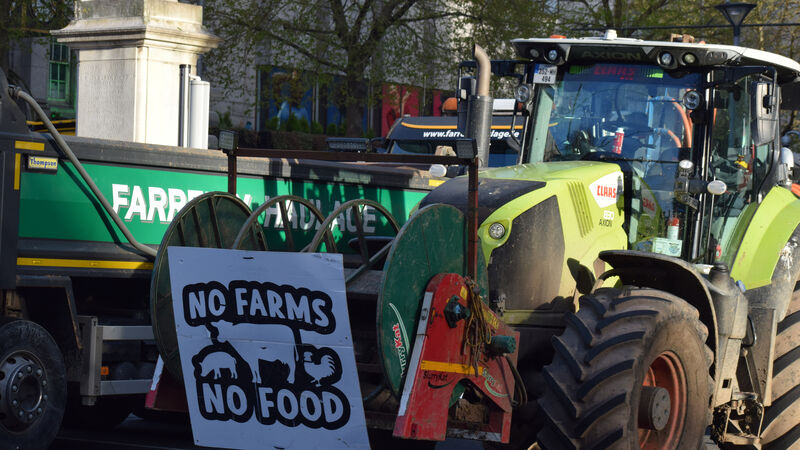
Fuel protestors in Dublin last Sunday: The IMF warns tax cuts on fuel distorts signal to cut consumption.
European governments should not excessively shield businesses and consumers from more expensive energy because that distorts the price signal to cut consumption and could be fiscally very expensive, the International Monetary Fund said.
Europe's heavy reliance on oil and gas imports has left it exposed to spiralling prices since the Strait of Hormuz, a vital global oil and gas shipping route, was closed as a result of the US-Israeli attacks on Iran and Tehran attacking energy infrastructure in the Middle East.
The European Commission wants to let countries spend more public money to help businesses with fuel and fertiliser bills as governments race to offset the economic shock from soaring prices.
"Prices help reduce demand and bring supply and demand back into balance. Many measures under discussion weaken that signal," the head of the IMF's European Department, Alfred Kammer, told Reuters.
"We recommend lump‑sum transfers to vulnerable households. During the Russian energy shock, the average fiscal cost in Europe was about 2.5% of GDP. Around 70% to 80% of those measures were untargeted. If support had been targeted to the bottom 40% of households, it would have cost only about 0.9% of GDP," Mr Kammer said.
Finally, all such cushioning measures should have a clear end date. "Some countries still have 'temporary' measures from the last crisis in place, which is clearly too long," he said.
He noted fiscal discipline was crucial because European countries were already facing enormous spending pressures on defence, ageing societies, pensions and healthcare, that the IMF estimated at 5% of GDP by 2040.
But voter pressure on politicians to step in and offset the high fuel prices was very high, Kammer said, because Europeans have come to expect state support whenever a crisis hits after the covid pandemic in 2020 and the Russian energy shock in 2022.`
The Irish Government has announced a €505m programme of tax cuts to soften the impact on consumers and businesses from the surge in fuel prices, on top of a €250m package introduced last month.
It followed days of protests by farmers, hauliers and contractors angered by a more than 20% rise in diesel prices since the outbreak of the Iran war and used vehicles to block an oil refinery, two ports, a fuel terminal and Irish roads.
The IMF also said the European Central Bank should lift its key interest rate twice this year to combat an energy-driven inflation surge, but should then reverse these moves in 2027.
"Under our reference scenario, we would expect the ECB to raise rates by about 50 basis points in 2026 in order to maintain a neutral monetary stance," Mr Kammer said.
"Then, in 2027, rates could come down again. If you want to keep the real policy interest rates constant, you would need to increase the nominal policy rate a bit," he said on the sidelines of the IMF and World Bank spring meetings in Washington.
"That is what our models, and we expect the ECB models, would recommend. But we are so uncertain, that I would not emphasise this is our recommendation for the ECB. This is not set in stone. This is just a model-based recommendation, based on where we are today," he said.
CONNECT WITH US TODAY



Be the first to know the latest news and updates