'Does it take 17 or 18 people on screen to deal with planning queries?'
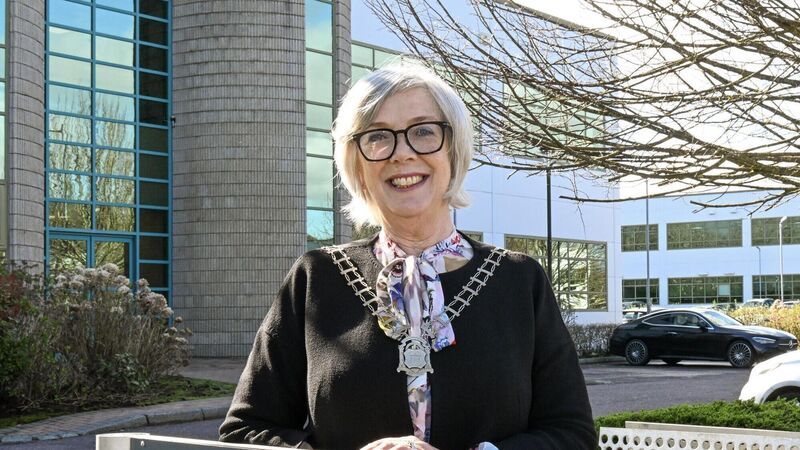
Patsy Supple was appointed the chairperson of the Construction Industry Federation (CIF) Cork branch last month, her second time holding the role. Picture: Brian Lougheed
“A lot of people will say it's not a great industry for women to be in. I don't agree with that. I mean, I really don't. It hasn't been my experience.” So says Patsy Supple, recently appointed chair of the Construction Industry Federation (CIF) Cork branch. It’s her second time in the hotseat: the last time was 2007-2008, just as the financial/property crash was galloping into view. Now, nearly two decades later, the scene is entirely different.
“So much is happening. I mean, it is a very exciting time. Cork’s star is definitely rising. All you have to do, you know, is measure the metric of cranes across the skyline. Cork is definitely on the way up, which is fantastic, but it has taken a while.” Ms Supple believes in an “holistic” approach to development, that co-operation between all sectors involved in delivering projects – planners, developers, contractors, local authorities, utility providers, housing agencies, government bodies, financiers - must be the roadmap for the future.
“I think we're starting to see shoots of that now, but no one sector can deliver the solution to all of the challenges that we're facing. If we all operate in our own little silos, you end up with housing or, you know, one element going off on a tangent, whereas the joined up thinking is very encouraging, and I think that has to be the roadmap for the future.”
Even with better cooperation between different sectors, there are core concerns, chief among them the onerous, resource-intensive, time-intensive planning process. “All of the processes that we have, there's a reason for them. They all have a very important role to play in making sure that we're all, you know, singing off the same hymn sheet. The problem comes up when you're expecting something to happen in six weeks or 10 weeks or 16 weeks, whatever the prescribed time is. And like 12 months later, you're wondering, why haven't I moved on?
"But it’s not just money, it's the impact it has on the person waiting for the new school or the extension to the hospital or the house, whatever they're waiting for.” As an example of how labour-intensive the planning process is, Ms Supple says that even with her own property company, Mavro Property Ltd – which focuses on delivering housing units in Cork city – they could have up to a dozen advisors in a room when trying to get a project started.
“I'm looking at them and I’m thinking, this project is only 10 apartments – and yet we have all these people here. And I know we need rules and regulations, nobody’s trying to dispense with them. But does it take 17 or 18 people on either side of the [Zoom] screen to deal with the queries?”
While Ms Supple’s own company is small, she cut her teeth, in the main, with John F Supple, founded by her father Barry. A leading developer in Munster in the ‘90s/2000s – their flagship project was the Castlemartyr Hotel - they, like many others, fell victim to the Crash.
“Do you ever really get over something like that? You're running a successful business, you're moving forward, and then the rug is pulled out. We decided we'd just stay and sort it out as best we could. There was no pretending that it could be sorted out, but we certainly stayed with it. And I'm glad we did, because we did our best. Not everybody might agree with that, but we did do our best. And eventually we were able to set up a small business (Mavro).”
Ms Supple remains grateful to her father – he's involved with Mavro - for giving her a start “as the proverbial girl in the office”, but says she is where she is because she “pushed every door that was left ajar”.
“It wasn't that I just sailed through them or anything. But there's no getting away from the fact that the construction industry is male dominated: for some legacy reasons, for historical reasons, for physical reasons. But we have to make it more female-friendly.
“We have to make it so that woman can come back in [after time off for family reasons, maternity leave etc]. We have to support them coming back to work in the same way that they are supported in other industries. And it's not that they're not supported, it’s just that we need a culture change, a change of thinking on both sides really.”
Changes are also needed in the education system, she says. “In a lot of the all-female schools, the subjects aren't necessarily being offered. Now that's probably starting to change, but lots of subjects - construction management, applied maths, those types of subjects - aren't traditionally being taught in the female schools.
“But there is a programme the CIF is very actively involved in, asking members to go into schools and talk to the transition year, and trying to partner with some of the companies, so that there's a clear path for those students if they want to go straight into the industry from school or after college or whatever.
“So it's definitely long term, but we have to start at the school level. I mean, there is no other way to solve that problem, if we want to make it very normal for females to be in the industry.”


CONNECT WITH US TODAY



Be the first to know the latest news and updates